By BK, Athletic Hitting Development
Complete Hitters Are Built… It’s Earned!
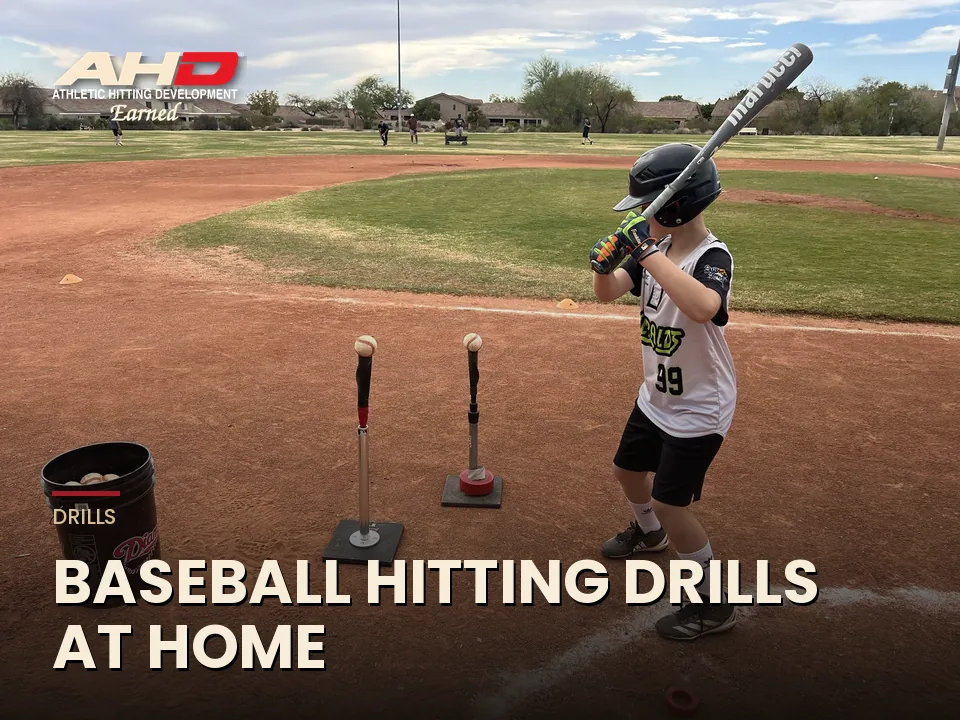
Parents and players ask for baseball hitting drills at home all the time.
The best baseball hitting drills at home fit a 15-minute daily plan: an athletic position check, slow-motion swing sequence, a barrel-awareness drill, eye work and a few game-intent swings. Train one skill at a time and keep the reps purposeful rather than counting swings.
Train it: Complete Hitter Masterclass →Fair question. But the answer cannot be, “Take 200 swings in the garage.”
More swings are not automatically better swings. A hitter can repeat a bad move 200 times just as efficiently as a good one.
The best at-home hitting work has a purpose. It helps a player build an athletic position, learn where the barrel is, improve visual focus, and take that work back to real baseball or softball.
This is a 15-minute daily plan. No field required. A bat, a few balls or wiffle balls, a mirror or phone, and a little room are enough.
1. The rule: Train a skill, not just a swing
At home, you are not trying to prove how hard you can swing.
You are trying to improve one part of the complete hitter:
- The body: balance, posture, body control.
- The swing: movement, sequence, barrel awareness.
- The processor: seeing, tracking, timing and decisions.
- The competitor: focus, consistency and confidence earned through work.
That is why this plan has five short stations instead of one long round of mindless cuts.
2. Minutes 1–3: Athletic position check
Start without a ball.
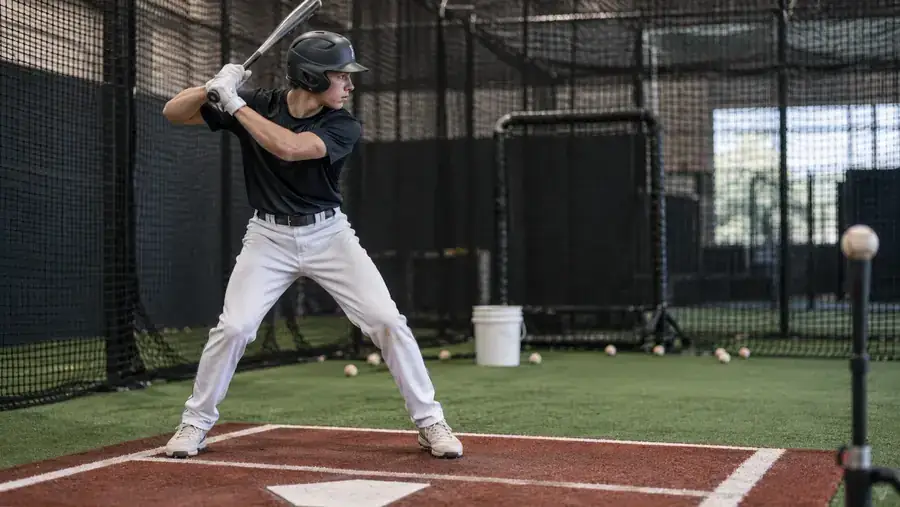
Get into your normal stance. Feel athletic—not stiff, not sitting in a chair, not standing straight up. Your knees have some bend. Your feet support you. Your head is quiet enough to see. Your hands are ready to move.
Make three slow dry swings and freeze at contact. Ask one question: Could I hold this position without falling, standing up, or losing control?
If the answer is no, do not race ahead. Better balance gives every other part of the swing a better chance.
Coach cue: Stay athletic through the swing and finish. Do not lose your body before the barrel reaches the ball.
15 MINUTES AT HOME
TRAIN A SKILL.NOT REPS.
- Athletic position
- Slow-motion sequence
- Barrel awareness
- Eye work
FEWER SWINGS. BETTER SWINGS.
3. Minutes 4–6: Slow-motion swing sequence
Make five slow-motion swings. Pause at setup, gather/load, stride/forward move, launch, contact, extension and finish.
You are not trying to manufacture perfect positions. You are learning the order of your own movement.
Good hitters create force in sequence. They do not rush the hands away from the body, dump the barrel toward the ground, or throw everything at the baseball at once.
Use a phone from the side once a week. The video does not lie. What you feel and what you do are often different.
For a full checkpoint breakdown, use AHD’s seven-step swing sequence.
4. Minutes 7–9: Barrel-awareness drill
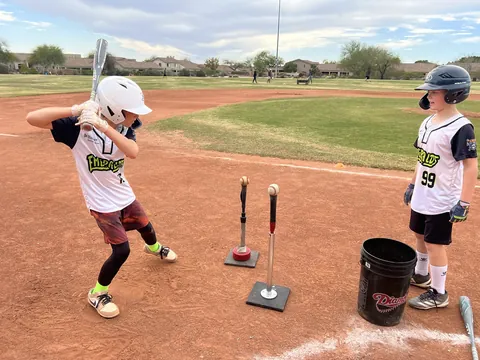
Hold the bat with your normal grip. Take short, controlled swings at a soft ball on a tee, a wiffle ball, or an imaginary contact point if space is limited.
The goal is simple: keep the hands and barrel above the ball until the barrel works into contact. Do not let the barrel dump early. Do not cast it away from the body.
Make ten quality reps. If you lose posture or control, slow down.
This is not a home-run drill. It is a “know where the barrel is” drill.
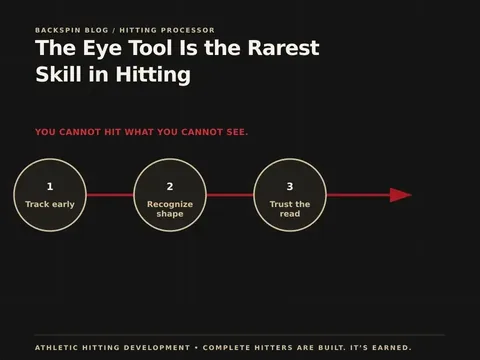
5. Minutes 10–12: Eye Tool work
Hitting starts before the swing.
Have a parent or partner toss different-color balls from a short distance. Call out the color early. If you are alone, bounce a small ball off a wall and pick up the logo, seam, or color before it returns.
You can also watch a game or a pitch-video clip and say “fastball” or “spin” as early as possible—before the result is obvious.
The goal is not to pretend every hitter will have the same eyesight. The goal is to build a better visual process: focus, tracking, recognition and timing.
Read more about the Eye Tool, then make it part of daily work.
6. Minutes 13–15: Game-intent swings
Finish with five to ten swings that have a plan.
Before each rep, say the situation:
- “Middle fastball. Attack it hard through the middle.”
- “Away pitch. Stay through it and use the big part of the field.”
- “Two strikes. Compete. See it late.”
That small detail matters. It connects garage work to the box.
7. What to avoid at home
Do not turn at-home work into a competition for the biggest swing or the highest number of reps.
Avoid:
- Swinging full speed when you cannot hold posture.
- Chasing five different internet drills in one day.
- Fixing every part of the swing at once.
- Training only mechanics and ignoring vision, timing and approach.
One clear priority, done well, beats a pile of random reps.
8. A simple weekly scorecard
Write down four things after each session:
- Did I stay athletic through contact?
- Did I keep control of the barrel?
- Did I train my eyes—not just my swing?
- Did I work with focus for the full 15 minutes?
That is how players become more independent. They learn to own their development instead of waiting for somebody to fix them.
9. The bottom line
At-home baseball hitting drills work when they develop the whole hitter.
Do not collect drills. Build the athlete. Develop the swing. Train the processor. Strengthen the competitor.
Fifteen focused minutes, done consistently, can become a serious advantage.
Not magic. Not guessing. Better work.
If you are unsure what to train first, start with SwingChecker™. It helps identify the biggest priority before you spend another month practicing the wrong thing.
Complete Hitters Are Built… It’s Earned!
THELESSON.
- One clear priority.
- Stay athletic.
- Train the eyes too.
- Swing with a plan.
- Fifteen focused minutes.
Complete Hitters Are Built…Earned.
Quick answers
What hitting drills can I do at home?
A 15-minute plan works well: an athletic position check, slow-motion swing sequence, a barrel-awareness drill, eye work such as color calls, and five to ten game-intent swings with a situation called before each rep.
How many swings should a hitter take at home?
Fewer, better swings beat volume. Ten to twenty purposeful reps with a clear priority build more than 200 random swings, which can groove a bad move as easily as a good one.
Can you train pitch recognition at home?
Yes. Color-call tosses, wall-ball tracking and calling fastball or spin on game video all train the visual side of hitting without a field.
Can you get better at hitting without a batting cage?
Yes. A tee, a net, soft balls and 15 minutes a day build the swing, the eyes and timing, as long as the work follows a plan instead of random swings.
This article is part of the AHD guide Baseball Hitting Drills by Age. Start there for the full picture and every related article.