By BK, Athletic Hitting Development
Complete Hitters Aren’t Born. They’re Built… and Earned.
Key takeaways
- Cleveland fed Junior Caminero high fastballs in the ALCS, and he chased 13 of 26 four-seamers out of the zone.
- Bat speed punishes mistakes in the zone. It can’t turn a chase into a good pitch.
- Good hitters see it, match it to a plan, and commit or shut it down before the swing starts.
- Train decisions like a skill: score good takes, not just hard contact.
You stop chasing the high fastball by training the decision, not by swinging harder. Bat speed punishes a heater in the zone. Against a heater at your eyes, it just helps you miss faster.
Bat speed punishes a fastball in the zone, but it can’t make a fastball at your eyes a good pitch. Hitters stop chasing by training the decision daily: a narrow attack zone, takes in every round and points for good decisions, not just hard contact.
Train it: Hitting Processor → Free tool: Pitch Recognition Trainer →Junior Caminero is one of the most dangerous young bats in the game. Per MLB.com, he hit .368 and slugged .882 against elevated fastballs in the regular season. So in the ALCS, Cleveland went right at him with high heat anyway, and kept moving it up.
Through the first five games he was 4-for-20 with 11 strikeouts. Over six games he chased 13 of 26 four-seamers out of the zone. That’s 50%, the highest monthly chase rate of his career, and those chases averaged 3.70 feet off the ground. Up, not middle.
1. Why Did Pitchers Feed Caminero High Fastballs?
Pitchers don’t quit competing because a hitter can punish velocity. They hunt for where he’ll expand. Cleveland’s plan, in MLB.com’s words: “Fastballs, fastballs and more fastballs.”
Here’s how I read it, and every young hitter should study this. The elevated fastball was a pitch Caminero did damage against all season. Cleveland didn’t run from his strength. They moved it higher, out of the zone, and dared him to say no.
In the postseason he swung under 17 of the 24 four-seamers he swung at. He told reporters his whole approach is to “stay as level as possible,” because when he feels under the ball, he’s going to miss it.
Same pitch type. A little higher. A totally different result.
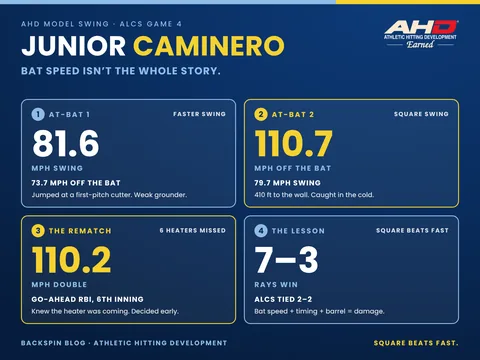
I broke down the bat speed side of his ALCS in Junior Caminero Bat Speed. This post is the other half: the decision.
ALCS SCOUTING REPORT
HIGH HEAT.THEN HIGHER.
- Elevated heat: .368 in the season
- 13 of 26 chases out of the zone
- Swung under 17 of 24 four-seamers
- 4-for-20, 11 K in first 5 games
PITCHERS HUNT YOUR CHASE
2. Isn’t Being Aggressive the Whole Point?
Yes. I want hitters aggressive and athletic. "Swing at a bad pitch? No biggie. Take a good pitch to hit? Not happening." Never let a pitch you can drive go by.
But read it close. It’s about not taking good pitches. It isn’t permission to chase the same bad one six times in a series. One chase is no biggie. A pattern is a scouting report.
"He's gonna make mistakes that are destroyable… watch the big leaguers, they do it often." Your job is to be loaded and ready for his mistake, not to chase his best pitch.
Aggression without a plan is just chasing with confidence. And the higher you climb, the longer pitchers will keep moving the target until you prove you can lay off it.
3. How Do Good Hitters Decide So Fast?
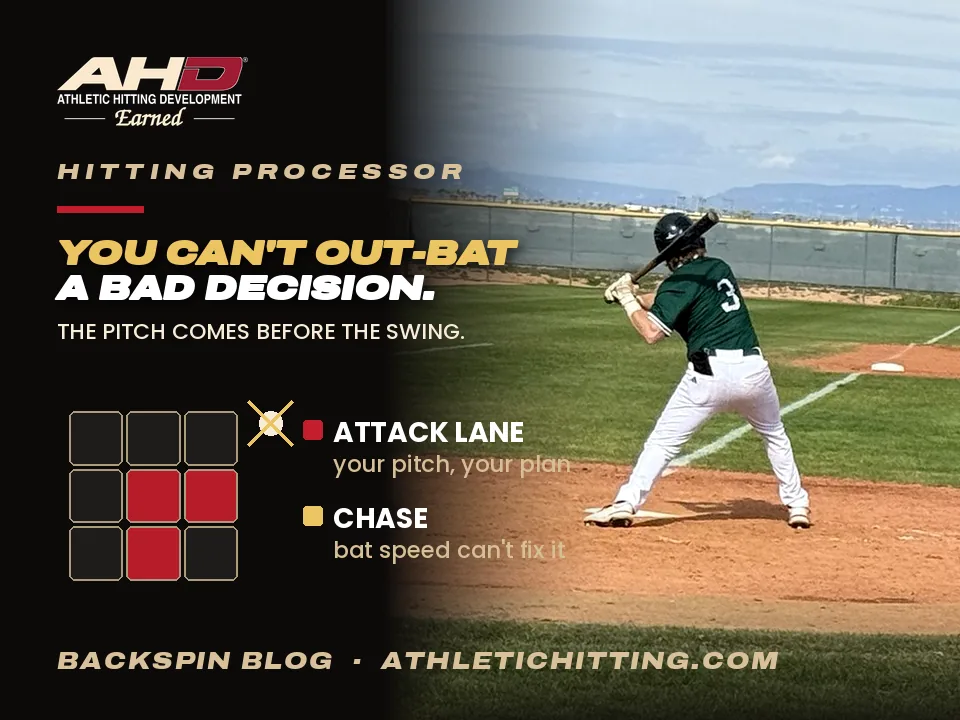
Bat speed and Mechanically Advantaged Angles (MAA) give a hitter the tools to do damage. The decision picks which pitches get them. A mature hitter does three things, fast:
- See it earlyPick up release, lane and height out of the hand. The high heater looks hittable early, so the read on its lane has to come early too.
- Match it to the planIs this pitch, in this spot, in this count, one I want to attack right now?
- Commit or shut it downThe decision has to happen early enough for the body to organize the swing. A late yes is a weak swing. A late no is a check swing that gets rung up.
That sequence is the Hitting Processor, one of the 4 Pillars of a Complete Hitter: see it, time it, decide, attack it. It’s why two hitters with the same bat speed can have totally different seasons. It has to be trained DAILY, same as the swing.
4. Was It a Good Swing or a Good Decision?
Sometimes a hitter chases a fastball at his eyes and still fouls it back hard. That doesn’t make it a good choice. A hard foul at the letters shows bat speed. It may also show a pitch he never should have offered at.
That’s a coaching moment. Don’t just say, “You were late.” Ask:
- Was that your pitch? Was it in the lane you planned to attack?
- What did you see? Where did it come out of the hand, and when did you know?
- What was your plan in that count? If he can’t answer, there wasn’t one.
Parents, the same questions work on the car ride home. Ask about decisions, not just results. More on scoring decisions in Plate Discipline Is a Skill.
5. How Do You Train a Hitter to Lay Off the High Fastball?
Here’s a simple AHD progression for high school, travel and college hitters. About 20 minutes, three or four days a week, front toss or machine.
- Narrow the lanePick one attack zone with one yes/no rule. Rounds of 15 pitches, with about a third of them above the lane.
- Call the takesHe says “take” out loud on every pitch above the lane. Saying it trains the eyes to label it early.
- Score the decisions+2 for a quality swing at a pitch in his lane, +1 for a disciplined take, −1 for chasing outside the plan. Keep the score on a card.
- Add the countCall a count before each pitch. Early in the count the lane is small. With two strikes it widens a little, but the heater at his eyes is still a take.
- Add consequenceFirst to 15 points wins, or lose the round on two straight chases. Now the drill trains game behavior.
Watch his hands on the takes. If the barrel starts and he has to check it, his decision came too late. Give him a little more time, then speed it back up once the yes or no happens before the swing starts.
6. Where Does Video Fit?
Film the rounds, same two angles every time. Video shows whether the body was on time. It can’t tell you what the hitter decided.
So after each clip, have him label the pitch before he watches the swing: attack, take or emergency (two-strike battle). Then compare his label to what he did and to the contact. When the label and the swing don’t match, that’s your work for the week.
Not sure if the problem is the decision, the timing or the swing? Run SwingChecker™ free. It takes about 3 minutes and ranks his top priorities across the 4 pillars. If the Hitting Processor comes up, start with Hitting Processor Lesson 1, free. The full Hitting Processor course is 16 lessons that train it daily.
You can build more bat speed. You can clean up the path. But hitters who never train decisions leave a huge part of their offense on the table.

THELESSON.
- See it early
- Match it to your plan
- Commit or shut it down
- Score the takes too
Complete Hitters Are Built…Earned.
Want to go deeper? Read Bat Speed Isn’t the Whole Story and Swing Decisions Are a Skill.
Quick answers
Why do hitters chase high fastballs?
The high fastball looks hittable out of the hand and gets on you fast, so a hitter who decides late commits before he can tell it’s above the zone. An earlier read and a clear attack zone fix it, not more bat speed.
How do you stop chasing pitches out of the zone?
Train decisions, not just swings. Narrow the attack zone, mix takes into every round and score good takes and good swings, not only hard contact.
Does more bat speed help plate discipline?
It can buy a hitter a little more time to decide, but it doesn’t make a bad pitch a good one. Chasing with a faster bat usually just means missing faster.
How did Cleveland pitch Junior Caminero in the ALCS?
Mostly with high four-seam fastballs. Per MLB.com, he chased 13 of 26 out-of-zone four-seamers over six games and swung under 17 of the 24 four-seamers he swung at in the postseason.
Don’t collect drills. Build a complete hitter.
Complete Hitters Aren’t Born. They’re Built… and Earned.