By BK, Athletic Hitting Development
Complete Hitters Aren’t Born. They’re Built… and Earned.
Junior Caminero has the fastest bat in baseball. He’s AHD’s current model swing. And on Saturday night in Cleveland, his fastest swing of the game produced his weakest ball in play.
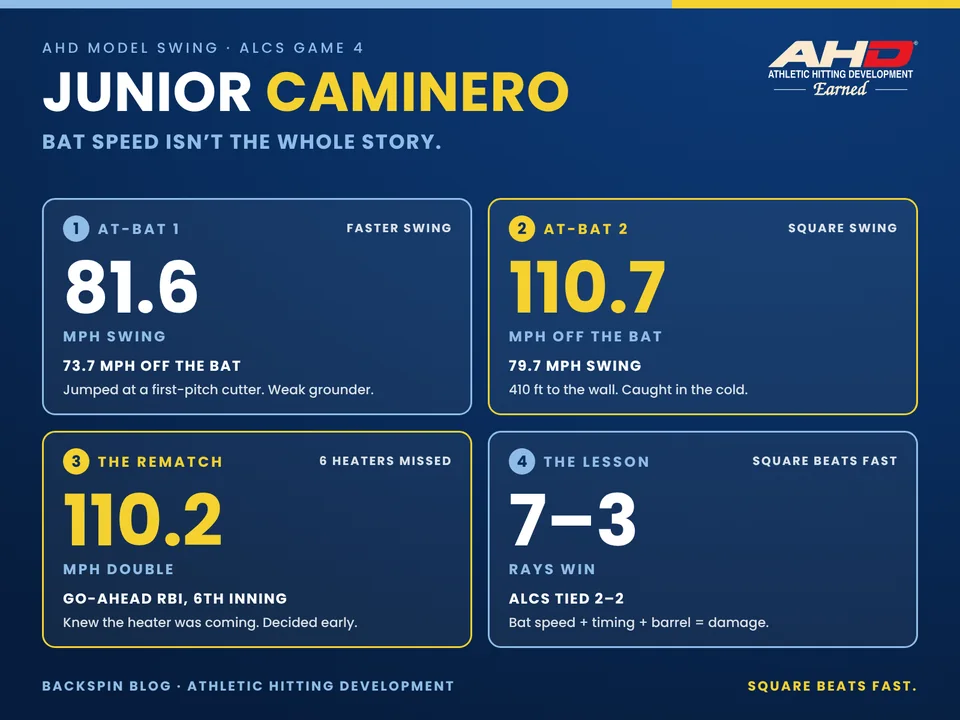
In ALCS Game 4, Caminero’s 81.6 mph swing produced a 73.7 mph ground ball. Two innings later, a slower 79.7 mph swing produced a 110.7 mph drive to the wall. Bat speed is the engine. Timing and barrel accuracy decide what it’s worth.
Train it: Bat Speed & Power →Coming into Game 4, the Rays’ superstar was stuck. He had driven in one run in his first five postseason games. In Game 3 he struck out four times, only the second time in his career and the first since August 2025. Cleveland reliever Daniel Espino had beaten him twice in the series with fastballs at the top of the zone: three swing-throughs at 98–99 mph in Game 1, then three more at 100-plus in Game 3.
The Rays moved him from third to fourth in the order. Then he went out and showed every young hitter the difference between swinging fast and hitting hard.
Faster isn’t always harder. Square is harder.
1. Faster swing, weaker ball
Here are his first two at-bats, side by side. Same hitter, same night, same cold air.
| At-bat 1 | At-bat 2 | |
|---|---|---|
| Pitch | First-pitch cutter | 92 mph fastball, up |
| Swing speed | 81.6 mph | 79.7 mph |
| Exit velocity | 73.7 mph | 110.7 mph |
| Result | Weak grounder to second | Caught at the base of the center-field wall |
The faster swing lost by 37 mph of exit velocity. Not because the bat was slow. Because the barrel didn’t meet the ball squarely. He jumped at a first-pitch cutter, the pitch moved, and all that bat speed went into the top of the ball.
The second swing was about 2 mph slower and met the ball dead flush. That’s the whole lesson in two at-bats: exit velocity comes from bat speed delivered on time and on the sweet spot. Take away either one and the number on the radar gun doesn’t matter.
SAME HITTER. SAME NIGHT.
SQUAREBEATS FAST.
- 81.6 mph swing → 73.7 off the bat
- 79.7 mph swing → 110.7 off the bat
- Bat speed + timing + barrel
DAMAGE NEEDS ALL THREE.
2. The engine and the steering
Don’t read this and decide bat speed doesn’t matter. It matters a ton. Caminero’s slower swing was still elite, and it’s the reason a good swing on a 92 mph fastball went 410 feet. Nobody squares a ball at 110 with a 60 mph bat.
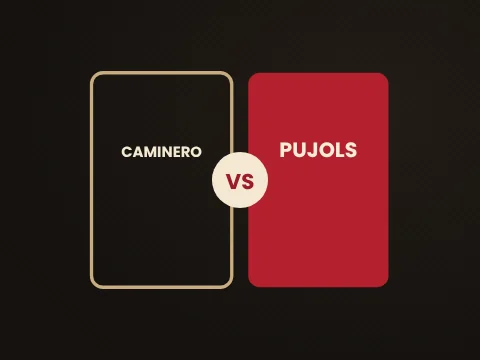
Think of bat speed as the engine and barrel control as the steering. A big engine with no steering ends up in the ditch. What makes Caminero special is that he has both: the fastest bat in the game and a swing that still makes a lot of contact. We broke down why in Caminero vs. Pujols: a short, flat, direct path built on Mechanically Advantaged Angles (MAA). Those angles let him swing with controlled violence and still keep the barrel in the zone long enough to find the ball.
That’s what we build in AHD hitters. Aggressive and athletic, with a barrel you can steer. Chasing bat speed alone with heavy overload work and max-effort swings can make a hitter faster and wilder at the same time. We wrote about that trap in Harder Without Wilder and Bat Speed Isn’t Timing.
3. Six heaters he couldn’t touch
The go-ahead hit in the sixth was a rematch. Two walks to start the inning, tie game, and Espino on the mound again. In two earlier meetings, Espino had thrown Caminero six fastballs at the top of the zone, 98 to 100-plus, and Caminero swung through all six.
This time Espino came up there again with a 97.9 mph heater. Caminero didn’t miss it. A 110.2 mph line drive over a leaping José Ramírez and down the left-field line. Rays 2, Guardians 1.
That’s the Hitting Processor at work. He had seen the plan twice. He knew what was coming. Knowing the heater is coming lets a hitter start on time and decide early, and an early decision is what lets the swing be fully aggressive. As I tell my hitters: heater or hanger. Be ready for the heater, and do damage on the mistake.
Elite velocity at the top of the zone doesn’t beat hitters because they’re weak. It beats them because they’re late to start or late to decide. More on that in How to Hit a High Fastball. Softball note: the riseball at the top of the zone works the same way. Fastpitch hitters win that pitch with an early decision and a barrel that stays above its path, not with a bigger swing. See How to Hit a Rise Ball.
SIX MISSES. THEN 110.
HEATEROR HANGER.
- Know the plan
- Start on time
- Decide early
- Aggressive and athletic
LATE TO DECIDE = LATE TO HIT.
4. Jumping at the first pitch
Look at that first at-bat again. Runner on after an error, a struggling star moved down in the order, coming off a four-strikeout game. He swung at the very first pitch, a cutter, as hard as he swung all night.
Every hitter knows that feeling. You had a bad game and you want it all back on one swing. That’s exactly when hitters jump: they start early, they swing harder, and the barrel goes looking for the ball instead of meeting it.
The fix isn’t to swing softer. It’s to keep the same plan you’d have on a good day. Get a pitch you can drive, and let the swing happen. We covered the mental side of this in The Error Doesn’t Get the Last At-Bat: the last game, or the last play, doesn’t get to take this at-bat too.
5. The best out of the night
In the fourth, Caminero took a called strike on a sweeper, then got a 92 mph fastball above the zone and crushed it to straightaway center: 110.7 mph at 29 degrees. Batted balls like that are almost always home runs. On a 46-degree night at Progressive Field, center fielder Petey Halpin caught it on the run at the base of the wall, about 410 feet away. Caminero said afterward he was 100% sure it was gone.
The box score says out. I say that was the at-bat that told everyone in the Rays dugout he was back. Good process, great contact, bad luck. Gotta swing it to hit it. Two innings later the same swing was on the board.
Young hitters need to hear this: judge the at-bat, not just the result. A hitter who goes 1-for-5 with two strikeouts and two balls smoked at 110 had a good night. Teach your hitter to remember the good swings. After the game Caminero pointed reporters straight back to the four-strikeout game and told them to look at what he did today. That’s a hitter who doesn’t let one bad night become a slump.
6. Four pillars, one night
1. The swing: square beats fast
A short, flat, direct path with MAA lets elite bat speed actually reach the ball. Barrel accuracy is a swing skill, so train it on purpose.
2. Athletic development: build the engine
Caminero’s bat speed comes from real strength and rotational power. Build it in the weight room and with med balls, then make sure the swing can steer it.
3. The hitting processor: know what’s coming
Six misses taught him Espino’s plan. See It → Recognize It → Time It → Decide → Attack It. The third time, the decision came early and the heater got hit.
4. Mental approach: same plan after a bad night
The first at-bat was a hitter trying to fix a bad game with one swing. The next two were a hitter trusting his plan. That’s the whole difference.

THELESSON.
- Bat speed is the engine.
- The barrel is the steering.
- Know the heater is coming.
- Same plan after a bad night.
- Judge the at-bat, not the result.
Complete Hitters Are Built…Earned.
7. For players, parents and coaches
- Players: if you use a bat sensor, log exit velocity next to bat speed. If bat speed is climbing and exit velocity isn’t, you don’t need more speed. You need a squarer barrel.
- Parents: don’t judge a game by hits alone. Ask, “How many balls did you hit hard?” Two balls smoked and a 1-for-5 is a good night.
- Coaches: train velocity at the top of the zone with an early decision, not a bigger swing. And after a bad game, coach the plan for the first at-bat before your hitter walks up there.
8. Build the complete hitter
Caminero didn’t need a new swing on Saturday. He needed his swing, on time, with a plan. That’s the difference between a hitter with tools and a complete hitter.
Don’t collect drills. Build a complete hitter.
Start with the free SwingChecker™ hitting evaluation to find which pillar is holding your hitter back. The AHD Complete Hitter Masterclass trains all four pillars together, and Bat Speed & Power shows how to build the engine without losing the steering.
It’s a great day to hit!!
Source note: Pitch, swing-speed and exit-velocity details come from Yahoo Sports’ Game 4 breakdown (Statcast data). The 110.2 mph double and Caminero’s reaction come from ESPN and MLB.com; game result from CBS Sports. Also covered by The Athletic. This article is AHD’s coaching interpretation.
Quick answers
Is bat speed the most important thing in hitting?
No. Bat speed is the engine, but the barrel has to meet the ball on time and on plane. In ALCS Game 4, Junior Caminero’s 81.6 mph swing produced a 73.7 mph ground ball, while his 79.7 mph swing produced a 110.7 mph drive. Timing and barrel accuracy turn bat speed into exit velocity.
How can a slower swing hit the ball harder?
Exit velocity depends on how squarely the barrel meets the ball, not only on how fast the bat is moving. A slightly slower swing that hits the ball flush on the sweet spot transfers far more energy than a faster swing that catches the ball off the end, on top or out in front.
How do you hit a high fastball?
Know it’s coming, start on time and decide early. Elite velocity at the top of the zone beats hitters who are late getting started or who are guessing. Plan for the heater, keep the barrel above the ball’s path and let the decision happen early so the swing can be aggressive and athletic.
What should a hitter do after a bad game?
Don’t try to make up for it on the first pitch. Learn one thing from the bad game, keep the same plan and stay patient enough to get a pitch you can drive. Caminero jumped at the first pitch in his first at-bat after a four-strikeout game, then squared up two balls once he settled in.
This article is part of the AHD guide Bat Speed & Power Training for Hitters. Start there for the full picture and every related article.