By BK, Athletic Hitting Development
Complete Hitters Aren’t Born. They’re Built… and Earned.
Key takeaways
- The complete hitter is not one metric. Impact, in-zone contact, chase control and barrel quality belong on the same report card.
- Baseball America’s 2026 Hit+ score grades minor league hitters on several of these measures together, because any one of them alone can mislead you.
- Parents can track a version without a lab: hard-hit balls, misses on strikes, chases and barrels, over 3–4 games.
- Find the lowest line, find the pillar behind it, and train that for 30 days. Don’t collect drills. Build a complete hitter.
To evaluate a hitter, don’t grade one number. Put four things on the same report card: how hard he hits it, whether he makes contact on the strikes he swings at, whether he swings at balls, and how often he barrels it.
Evaluate a hitter on four lines at once: impact, in-zone contact, chase control and barrel quality. Track them over several games, find the pillar behind the weakest line, and train that pillar instead of chasing one number.
Train it: Complete Hitter Masterclass → Free tool: Hitter Development Roadmap + 4 Pillars Scorecard →Every parent I talk to has a number. Exit velo. Batting average. Bat speed off a sensor. One number feels clean, and it’s how you end up with a hitter who’s great at one thing and lost in a game.
Here’s the deal. The people who grade pro hitters for a living don’t trust one number either. So let’s build the report card the right way, then make a parent’s version you can keep from the bleachers.
1. What do scouts look at when they evaluate a hitter?
In October 2026, Baseball America published its Hit+ leaderboard for minor league hitters. Hit+ doesn’t grade a hitter on one stat. It blends several underlying measures together: contact rate and in-zone contact rate, 90th-percentile exit velocity (think of it as his typical hardest contact), chase rate and swing-minus-chase, and barrel rate.
I’m not going to throw names or numbers at you. The lesson is the design. Impact, contact, decisions and barrels all sit on the same page, because any one of them alone will lie to you.
Hit+ is a model built for pro hitters with tracking data. Your 15-year-old doesn’t have that, so hold it as a way of thinking, not a scale to grade your kid against.
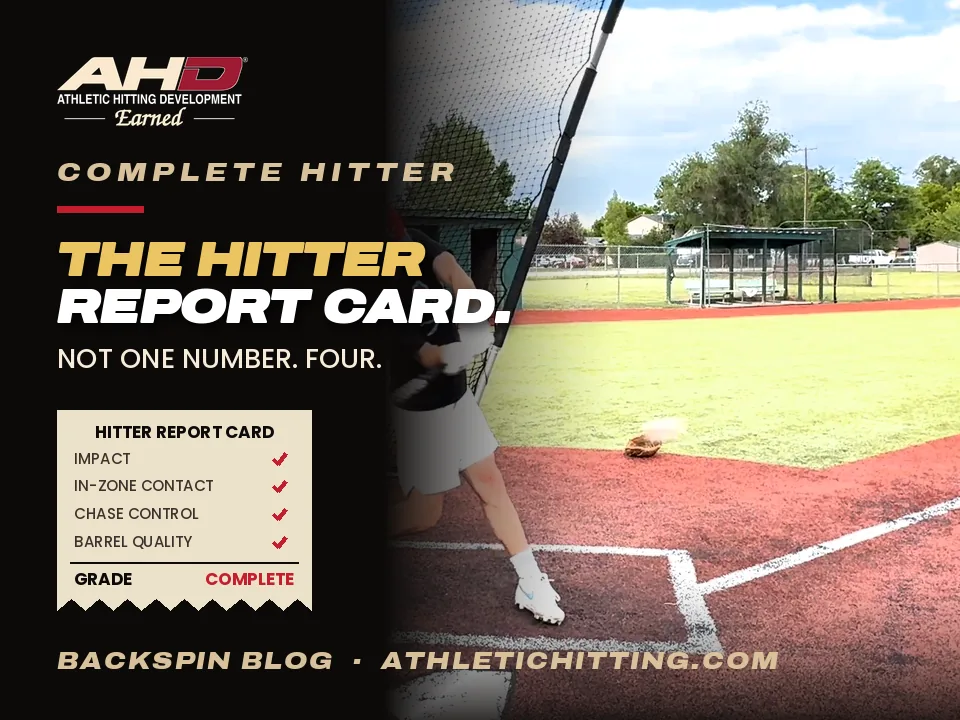
HITTER REPORT CARD
FOUR LINES.ONE HITTER.
- Impact: how hard
- In-zone contact: hit strikes
- Chase control: take balls
- Barrels: hard, good angle
NO SINGLE NUMBER TELLS IT.
2. What stats matter for hitters?
Four lines. Each one answers a different question about the hitter.
| Line | The question | What it catches |
|---|---|---|
| Impact | How hard does he hit it when he gets it? | The contact hitter who never does damage |
| In-zone contact | Does he hit the strikes he swings at? | The big swing that can’t find the ball |
| Chase control | Does he swing at balls? | The hitter who gets himself out |
| Barrel quality | Is the hard contact at a good angle? | Hard grounders that look great on a radar |
Look at how they check each other. A hitter can post a big exit velo and still miss strikes. He can make tons of contact and never drive the ball. He can lay off everything and still roll over the one pitch he should crush.
The complete hitter is not one metric.
3. How can a parent track this without a lab?
You don’t need a radar gun or a tracking system. You need a notebook, a pencil and honest eyes. Pick one game, or one live BP round of 20 swings, and keep four tallies.
- Hard-hit balls.Count every ball that’s loud off the bat, caught or not. That’s your impact line.
- Swings-and-misses on strikes.Only count misses on pitches in the zone. A miss on a ball in the dirt goes on the next line.
- Chases.Count every swing at a pitch out of the zone. Borderline pitches don’t count either way.
- Barrels.A hard line drive or a hard fly ball. A hard grounder is impact, not a barrel.
Do this over 3 or 4 games before you decide anything. One game is a snapshot. Four games start to look like a hitter.
Then track the trend, not the day. If his chases drop by half over a month, that’s real progress, even in a week when he went 0-for-3.
4. How does the report card connect to the 4 Pillars?
Every line on that report card has a source, and the source is a pillar.
- Impact comes from The Swing and from Athletic Development. Low impact usually means a sequencing problem or a hitter who isn’t strong enough yet.
- In-zone contact comes from The Swing and The Hitting Processor. Bat path, barrel approach and timing all show up here.
- Chase control lives in The Hitting Processor: see it, time it, decide, attack it, trained daily.
- Barrel quality pulls from all of it, plus the Mental Approach. A hitter who’s scared to miss won’t let it go with intent.
This is where Mechanically Advantageous Angles (MAA) matter. AHD hitters build MAA so the body can deliver the barrel on a good line through the ball. That shows up as impact and barrels on the report card, not as a pretty picture on video.
I love this one: “Ball — powdered.” That’s the sound of a barrel. Chase that sound in games, not a pretty swing in the cage.
The free Complete Hitter Development Roadmap comes with a printable 4 Pillars Hitter Scorecard that rates 12 skills 1–5. Your game tallies tell you what’s happening. The scorecard tells you why. I walk through scoring it in How to Evaluate a Hitter.
5. What’s the biggest mistake parents make with hitting stats?
They find the lowest line and buy a drill for it. Then another drill for the next line. Six months later the hitter has a bag full of drills and the same report card.
Don’t collect drills. Build a complete hitter.
The other mistake is chasing one number. Push only exit velo and you can get a hitter who swings harder at everything, including balls. Push only contact and you can get a hitter who pokes at strikes he should drive. Fix one line by breaking another and he hasn’t gotten better. I covered this in Exit Velo Is a Receipt, Not a Plan.
Here’s the plan. Pick the lowest line. Find the pillar behind it. Train that pillar for 30 days while you keep the other three honest, then retest with the same four tallies.
Not sure which pillar is behind the weak line? Start with the free SwingChecker™. In about three minutes it ranks your hitter’s top priorities across the 4 Pillars, with cues, drills and matching free lessons. When you want the full plan, the Complete Hitter Masterclass trains all four pillars in 24 lessons, and Lessons 1–3 are free.

THELESSON.
- Track four tallies, not one
- Give it 3–4 games
- Find the pillar behind the low line
- Train it 30 days, then retest
Complete Hitters Are Built…Earned.
Want to go deeper? Read How to Evaluate a Hitter: A 4 Pillars Assessment Checklist for Parents and Coaches and Exit Velo Is a Receipt, Not a Plan.
Quick answers
How do you evaluate a baseball hitter?
Grade four things together: how hard he hits it, whether he makes contact on strikes, whether he chases balls, and how often he barrels it. Then find the pillar behind the weakest line and train it for 30 days.
What stats matter most for high school hitters?
No single stat. Hard-hit balls, swings-and-misses on strikes, chases and barrels together tell you far more than batting average or exit velo alone.
Is exit velocity the best way to evaluate a hitter?
It’s one line. Exit velo shows impact, but it can’t tell you whether he hits strikes, lays off balls or hits the ball at a good angle.
What is Hit+ in baseball?
Hit+ is a Baseball America score for minor league hitters. It blends contact rate, in-zone contact, typical hardest contact, chase measures and barrel rate into one grade.
Don’t collect drills. Build a complete hitter.
Complete Hitters Aren’t Born. They’re Built… and Earned.