
By BK, Athletic Hitting Development
Complete Hitters Aren’t Born. They’re Built… and Earned.
Key takeaways
- A 2026 study of 23 elite hitters found pelvis and lead-forearm rotational speed together accounted for 45.4% of the differences in bat speed.
- The measured lead-leg force variables were not significantly linked to bat speed in that group.
- “Use the ground” doesn’t mean shove harder into the front leg. An athletic front leg lets the pelvis turn, then the lead arm delivers the barrel.
- Keep training lower-body strength. This is about what to coach inside the swing, not what to skip in the gym.
A hard front leg block is not what creates bat speed by itself. A 2026 study of elite hitters found that pelvis and lead-forearm rotational speed tracked with bat speed, while the measured front leg force did not.
A hard front leg block doesn’t create bat speed by itself. A 2026 study of 23 elite hitters linked pelvis and lead-forearm rotational speed to bat speed, not measured front leg force, so coach an athletic front leg that lets the pelvis turn and the lead arm deliver the barrel.
Train it: Swing Structure & Mechanics → Free tool: Exit Velocity & Bat Speed Calculator →Walk into any cage and you’ll hear it. Block the front side. Brace hard. Slam the front leg and the bat will fly.
I get where it comes from. Good hitters do land and turn against their front side. But somewhere along the way “use the ground” turned into “jam the front leg as hard as you can,” and that’s not the same thing.
1. What did the lead-leg study find?
In 2026 the Korean Journal of Applied Biomechanics published a lab study of 23 elite hitters. Researchers measured lead-leg forces, how fast each body segment rotated, and bat speed.
- Pelvis rotational speed was linked to bat speed.
- Lead-forearm rotational speed was linked to bat speed.
- Together, those two accounted for 45.4% of the differences in bat speed between hitters.
- The measured lead-leg force variables and trunk rotational speed were not significantly linked.
Now the honest part. This was 23 hitters in a lab, so I hold it loosely. It’s correlational, and it didn’t test sequencing, so it can’t tell us the front leg doesn’t matter. It can tell us that pushing harder into the ground was not what separated the faster bats in this group.
WHERE SPEED COMES FROM
PELVIS TURNS.LEAD ARM DELIVERS.
- Athletic front leg
- Pelvis keeps turning
- Lead arm turns the barrel
- Barrel above and inside the ball
STRONG, NOT STIFF
2. What does “use the ground” really mean in hitting?
The front leg has a job. It catches the move forward and gives the pelvis something to turn against. That’s a support role, not the engine.
The front leg lets the pelvis turn. It doesn’t swing the bat.
When a hitter is coached to shove into the front leg, I usually see one of three things. He locks out early and stops the turn. He jumps up out of his posture and loses the barrel’s line. Or he gets so busy creating a big front-foot moment that he forgets to deliver the bat.
That’s why I say “athletic front leg.” It lands, it accepts the weight, and it lets the hips keep turning. Strong, not stiff.
I tell hitters this all the time: “No reason to go all rodeo on us and look like you’re getting bucked off a bull while swinging with that violent stiffening or locking out early of the front leg… be athletic and the leg will straighten on time if it straightens at all!”
Try a quick check at home. Film five swings from the side. Pause each one at front-foot strike, then again at contact. If the belt buckle is still facing the same way at both frames, the leg stopped the turn instead of supporting it.
3. How do the pelvis and lead arm create bat speed?
Follow the swing order and the study lines up with what I teach. After a directionally sound load and a good launch position, two things have to happen in order:
- The bumpThe pelvis starts moving and turning, over an athletic front leg, while the hands stay back for a beat.
- Let go of the arrowThe body hands the speed up the chain and the barrel starts its trip.
- The lead arm deliversThe lead arm and forearm turn the barrel into the ball, approaching above and inside it.
- Contact and extensionHands in a strong position at contact, then extension through the ball and a full finish.
The pelvis gets the speed going. The lead arm puts it on the barrel. That’s where Mechanically Advantageous Angles (MAA) live: AHD hitters get into positions where the body can actually hand force to the bat, instead of leaking it into a stiff leg. If you want more on the turn, read increase bat speed with rotational power.
4. What should coaches look for instead of a hard front leg?
Stop judging the swing by how violent it looks at front-foot strike. Judge whether the hitter organizes the pelvis and the lead arm into the barrel.
- Does the pelvis keep turning after the front foot lands? If everything stops at landing, the leg is acting as a wall.
- Does he stay in his posture? A hitter who pops up off the front leg changes the barrel’s line.
- Does the lead arm deliver the barrel on time? No casting, no dragging.
- What does the ball say? Hard contact through the middle of the field beats a loud front leg every time.
Then go by the sound. “Ball — powdered.” That’s the sound of a barreled ball, and it’s what I want hitters chasing, not a big brace that looks good on a phone. It’s still controlled violence. The violence goes into the barrel, not the dirt.
Not sure if your hitter’s bat speed problem is the swing, the strength or the timing? Run the free SwingChecker™. In about three minutes it ranks his top priorities across the 4 Pillars, with cues, drills and matching free lessons.
5. Should hitters still train lower-body strength?
Yes. Don’t throw out the legs. This study measured force in the swing, not how strong the hitters were in the weight room, and it says nothing against getting stronger.
A stronger, more explosive athlete has more to give the pelvis and more control over his front side. Strength in the gym and organization in the swing are two different jobs. Train both, and don’t ask one to do the other’s work. That’s why Athletic Development is one of the 4 Pillars. The Athletic Development course builds it, and I covered which numbers matter in strength numbers that track bat speed.
In the swing itself, coach the order: athletic front leg, pelvis turns, lead arm delivers the barrel. Check where your hitter stands with the free Exit Velocity & Bat Speed Calculator, then start Lesson 1 of Swing Structure & Mechanics, free. The full 16-lesson Swing Structure & Mechanics course teaches the bump and the barrel route step by step.

THELESSON.
- Use the ground, don’t shove it
- Coach the pelvis and lead arm
- Judge the barrel, not the brace
- Keep training the legs
Complete Hitters Are Built…Earned.
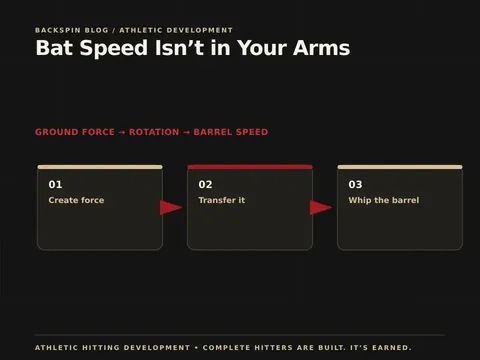
Want to go deeper? Read Bat Speed Isn’t in Your Arms and More Separation Is Not Always the Answer.
Quick answers
Does blocking with the front leg increase bat speed?
Not by itself. A 2026 study of 23 elite hitters found the measured lead-leg force variables were not significantly linked to bat speed, while pelvis and lead-forearm rotational speed were.
How do you increase bat speed in baseball?
Build a swing that turns the pelvis over an athletic front leg and lets the lead arm deliver the barrel, then add strength and explosiveness so the body has more to give.
Should the front leg be straight when hitting?
The front leg should be athletic: it lands, accepts the weight and lets the hips keep turning. Locking it out early to force a block can stop the turn and change the barrel’s line.
Does lower-body strength help bat speed?
Strength still matters for hitters. The 2026 study measured force during the swing, not strength, so keep training the legs and coach the swing order separately.
Don’t collect drills. Build a complete hitter.
Complete Hitters Aren’t Born. They’re Built… and Earned.