By BK, Athletic Hitting Development
Complete Hitters Aren’t Born. They’re Built… and Earned.
Key takeaways
- The movement that maximizes rotational force may not be the movement that maximizes hitting production. Those are two different objectives.
- A 110-mph exit velocity means absolutely nothing on the pitch you missed.
- Stay athletic longer: a slightly flexed, athletic front knee is a checkpoint for preserving control — not a universal law.
- AHD trains maximum USABLE force: the most force a hitter can accurately deliver to the baseball, repeatedly, against real pitching.
The movement sequence that maximizes rotational force may not be the movement sequence that maximizes actual hitting production. Those are two very different objectives — and I think we’ve confused them.
The kinetic chain is real and it builds bat speed. But training every hitter for maximum force can cost barrel adjustability. AHD trains maximum usable force: the most force a hitter can accurately deliver, repeatedly, against real pitching.
Train it: Swing Structure & Mechanics →There’s something about modern hitting instruction that’s been bothering me for a long time. And I’m going to challenge a teaching philosophy that has become almost gospel in baseball and softball: the kinetic chain.
Let me start by saying something important. I believe the science behind the kinetic chain. The coordinated movement of the legs, hips, torso, arms and bat is unquestionably important to generating bat speed and force. But here’s where I believe we’ve taken a wrong turn.
1. We’ve become obsessed with maximum force
In today’s hitting world, everybody wants more. More bat speed. More exit velocity. More hip rotation. More lead-leg blocking. More separation. More launch angle. More, more, more.
There’s nothing inherently wrong with developing any of those things. But somewhere along the way, I believe we started training hitters to produce the biggest possible number rather than training them to become the most effective possible hitter.
We’ve watched hitters learn how to rotate violently, straighten their front leg, pull the torso around and generate impressive bat speeds. And when everything lines up perfectly? Holy hell, they can hit the baseball hard.
What happens when everything DOESN’T line up perfectly?
What happens when the hitter is a tick late? When the pitch changes direction? When the ball is three inches farther outside than anticipated? When the hitter needs to make a barrel adjustment after the swing has already started?
That’s where I believe the maximum-force interpretation of kinetic-chain coaching can become a problem — not because the kinetic chain is scientifically wrong, but because maximum force and maximum barrel adjustability are not necessarily the same thing.
2. The launch angle connection
I see a connection between this issue and the launch-angle movement in baseball. Let’s be precise: launch angle is the angle at which the baseball leaves the bat. It isn’t a swing technique by itself.
But when coaches start chasing a particular launch angle, maximum exit velocity or an exaggerated upward bat path, they can change the swing to favor the measurement rather than the complete hitting result.
I’m not against hitting the ball in the air. I’m not against home runs. I’m certainly not against hitting the baseball hard. I LOVE hard line drives. But I don’t want a hitter sacrificing his ability to consistently put the barrel on the baseball just to create a theoretically more powerful swing.
A 110-mph exit velocity means absolutely nothing on the pitch you missed.
A hitter who occasionally destroys a baseball but struggles to adjust against quality pitching may be giving away more offensive production than those spectacular batting-practice swings suggest.
3. My theory: stay athletic longer
Here is where my philosophy starts to separate from a lot of modern instruction. I believe hitters are significantly more capable of controlling and accurately delivering the barrel when they maintain a quality, general athletic position as long as possible.
Not rigid. Not frozen. Not passive. ATHLETIC. A body position that allows the hitter to keep moving, keep controlling the swing and keep making adjustments.
Think about nearly every athletic activity in which precision and reaction are required: playing defense, returning a serve in tennis, fielding a ground ball or changing directions in football. You don’t intentionally sacrifice your athletic position earlier than necessary. You maintain the ability to react. Why would hitting be fundamentally different?
You’re trying to square up a round ball traveling at high velocity, often moving in two directions, with a round bat. And you’re doing it within an unbelievably small window of time.
THE AHD STANDARD
STAYATHLETIC.
- Not rigid
- Not frozen
- Not passive
- Ready to adjust the barrel late
KEEP YOUR OPTIONS OPEN
Why would we want to surrender our most adjustable positions any sooner than necessary?
4. The front knee: a simple way to teach it
Here’s one of the simplest coaching cues I use to explore this idea:
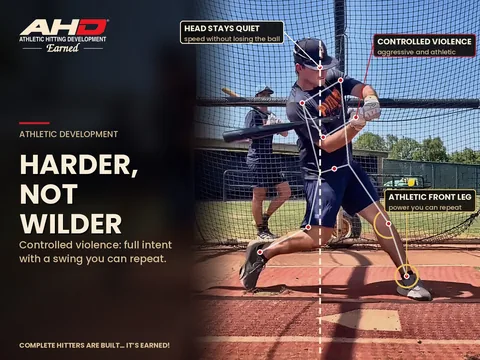
Keep the front knee slightly bent until contact — or even into the early follow-through.
Not collapsing. Not drifting forward. Not sitting back. And certainly not eliminating the lead leg’s ability to support force. I’m talking about retaining a slightly flexed, athletic front knee rather than aggressively trying to snap it straight well before contact.
Why? Because I believe premature, exaggerated front-leg extension can encourage some hitters to leave their best athletic position too early. The hips may turn too aggressively. The torso may commit too soon. The posture may change. And the barrel can become less adjustable to the pitch that’s actually arriving.
Now, that doesn’t mean every hitter with a straightening front knee is doing something wrong. Some outstanding hitters extend the lead knee before contact while maintaining tremendous body control and bat accuracy. A bent knee alone doesn’t prove that someone is balanced or adjustable.
The cue isn’t really about the knee. The cue is about preserving athletic control. The knee simply gives us something visible to evaluate. It’s a checkpoint — not a universal law.
5. What if maximum power is actually costing you production?
Let’s imagine two hitters.
| Hitter A: Maximum Force | Hitter B: Maximum Athletic Control | |
|---|---|---|
| The swing | Aggressively braces the front leg, rotates hard, reaches tremendous bat speed. | Still creates substantial force, but keeps better posture, balance and adjustable positions deeper into the swing. |
| When it’s perfect | The ball absolutely explodes off his bat. | He can still hit the baseball hard. |
| When timing is off | The swing may become difficult to adjust. He might roll over, swing underneath or miss entirely. | He can make a later barrel correction, handle a different contact depth and stay through an outside pitch. |
Maybe Hitter B’s absolute maximum bat speed isn’t quite as impressive. But what if his ability to produce quality contact is substantially better? Which hitter produces more runs? Which handles better pitching? Which gives you the better at-bat over an entire season?
I’ll take the guy who consistently delivers the barrel with authority over the guy who wins the bat-speed contest but struggles to make adjustments. And if Hitter A can maintain all that force without sacrificing accuracy? Even better. That’s exactly what we’re trying to build.
6. The science is more complicated than the popular teaching
A 2023 study involving 20 collegiate hitters found significant relationships between lead-leg ground-reaction forces and bat speed. That supports the lead leg’s role in creating bat speed.
A 2026 study examining 23 elite hitters found that pelvis and lead-forearm rotational velocities were associated with bat speed, while the measured lead-leg kinetic variables were not significantly associated in that sample.
Neither study establishes the ideal front-knee angle for contact accuracy. Neither proves that a maximum-force swing is necessarily the best game-hitting swing.
A 2025 analysis of acceptable timing error at bat-ball impact found that the timing window for acceptable contact varied considerably depending on swing trajectory. In its modeled conditions, acceptable timing errors ranged from approximately 2.5 to 30.4 milliseconds.
The way the bat moves through the hitting zone changes how much timing error a hitter can survive.
That’s far closer to what I’m interested in developing: not simply the fastest possible bat, but the fastest, most powerful bat the hitter can accurately deliver across different pitches and imperfect timing.
7. Barrel control is a skill. Adjustability is a weapon.
A hitter doesn’t know exactly what’s coming. He doesn’t get to stop the swing halfway through and start over. He’s making a complex athletic movement while processing information under enormous time pressure.
Research on batting coordination suggests that skilled hitters can use functional movement variability and make adjustments during the swing. That’s why I don’t believe we should teach hitters to become mechanical robots.
I want them athletic. I want them explosive. I want them powerful. But more than anything, I want them to be able to HIT. That’s what Mechanically Advantaged Angles (MAA) are about for AHD hitters: body and barrel positions that create force and still leave room to adjust.
The ability to adjust your barrel late in the swing might be more valuable than adding a few miles per hour of bat speed at the expense of that ability.
This is the essence of what we teach at Athletic Hitting Development: create the largest practical margin for error for solid contact while generating maximum usable force and an effective bat-to-ball angle. Notice I didn’t say maximum possible force at any cost. I said maximum USABLE force. There’s a difference.
8. The AHD front-knee experiment
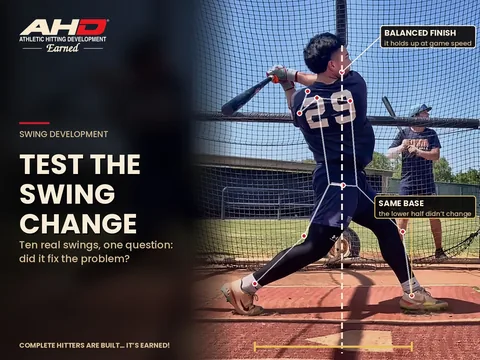
Here’s something I’d encourage every hitting coach to try. Take a hitter who aggressively straightens the front knee well before contact. Film the swing from the open side and from behind the hitter (here’s how to film it). Then compare two approaches.
- Approach 1: The hitter’s normal swing.Let the athlete swing naturally, using the mechanics they’re accustomed to. Record bat speed, exit velocity, quality of contact, misses and swing video.
- Approach 2: The athletic-position cue.Ask the hitter to stay in a strong, slightly flexed front-knee position longer into the swing. Don’t force knee flexion at the expense of rotation or lead-side support. Don’t tell the athlete to slow down. Emphasize an athletic position and controlling the barrel through contact.
- Progress the challenge.Compare over enough swings to make the observations meaningful. Start with the tee, then front toss, controlled velocity, and varied pitch locations and timing challenges.
- Repeat it honestly.Alternate the conditions when practical and repeat them on different days. Otherwise, fatigue, learning and pitch mix can distort the result.
Evaluate:
- Solid-contact percentage and mishit rates
- Whiff rate and accuracy across pitch locations
- Exit velocity on solid contact, not just one maximum
- Bat speed at contact
- Ability to adjust when early or late
- Knee angle, posture and balance at contact
Don’t judge the experiment by the single hardest-hit ball. Judge it by the entire collection of swings.
You might find a hitter who maintains power while improving contact. You might find a modest power tradeoff that’s worthwhile. Or you might find that the hitter already has an excellent combination of lead-leg extension, barrel control and adjustability. The point isn’t to prove every hitter should keep his knee bent. It’s to discover whether your instruction creates better hitters — the same idea behind our 4-step test for a swing change.
9. What I believe we’ll discover
My coaching hypothesis is that many hitters can improve barrel accuracy and consistency by learning to preserve athletic positions deeper into the swing.
I feel strongly enough about this that I believe the difference could be enormous. But I’m not going to assign a made-up percentage and pretend we scientifically measured it. We need real measurements and controlled comparisons. We need more investigation of contact quality and adjustability — not simply peak bat speed.
My belief is simple: keeping the body athletic longer can preserve options for the barrel longer. That’s a coaching hypothesis worth testing.
10. Stop worshipping one number
Exit velocity matters. Bat speed matters. Launch angle matters. The kinetic chain matters. But none of them exists independently of the goal. And the goal isn’t winning a biomechanics demonstration.
The goal is to hit the damn baseball. Hard. Often. Against real pitching.
If you can develop the fastest swing in the world, but the hitter can’t put the barrel on a pitch that’s slightly different from what he expected, what exactly have you built?
I want force. I want speed. I want athleticism. But I refuse to treat maximum force as the ultimate objective if it comes at the expense of solid contact. That’s not complete hitter development. That’s optimizing one part of a much larger problem.
11. The bottom line
I’m not arguing that the kinetic chain is wrong. I’m arguing that our interpretation and application of it might be incomplete.
We can understand how the body produces force without demanding that every hitter chase maximum force at every point in the swing. We can develop explosive hitters without abandoning balance, athletic posture and the ability to adjust.
My question isn’t, “How much force can this hitter generate?”
It’s, “How much force can this hitter accurately deliver to the baseball, repeatedly, against real pitching?”
That’s a completely different question. And I believe it’s the question hitting coaches should be asking.

THELESSON.
- Force matters — usable force matters more
- Judge every swing, not the best one
- Adjustability is a weapon
- Stay athletic, control the barrel
Complete Hitters Are Built…Earned.
Stay athletic. Control the barrel. Create force you can actually use.
Want to go deeper? Read What Is Leverage in Hitting? Build Power You Can Use and Harder Without Wilder.
Quick answers
What is the kinetic chain in hitting?
It is the coordinated movement of the legs, hips, torso, arms and bat that builds bat speed and force. It is real and important; the question is whether every hitter should chase maximum force at every point in the swing.
Should the front knee be straight at contact?
Not necessarily. Some great hitters extend the lead knee before contact and stay in control. AHD uses a slightly flexed, athletic front knee as a checkpoint for preserving control, not as a universal rule.
Is bat speed or barrel control more important?
Both matter. A hitter needs real force, but force only counts when the barrel finds the ball. AHD trains maximum usable force: the most a hitter can accurately deliver against real pitching.
How can a coach test whether a front-knee cue helps a hitter?
Film the hitter’s normal swing and a swing with the athletic-position cue, from the open side and from behind. Compare solid contact, misses, exit velocity on solid contact and adjustability over many swings on different days.
Sources: Orishimo et al. (2023), lower-extremity factors and bat speed, Sports Biomechanics · Lee & Park (2026), lead-leg kinetics, segmental angular velocity and bat speed, KJAB · Nakashima et al. (2025), acceptable timing error depends on swing path, Front. Sports Act. Living · Gray (2020), movement coordination and skill acquisition in baseball batting
Don’t collect drills. Build a complete hitter.
Complete Hitters Aren’t Born. They’re Built… and Earned.