
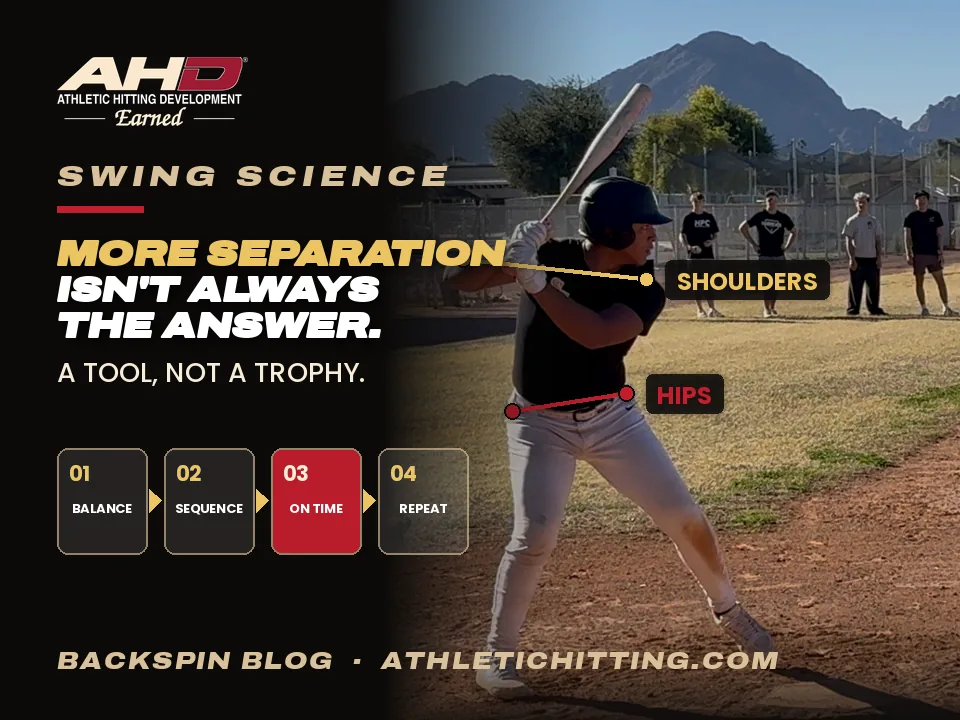
By BK, Athletic Hitting Development
Complete Hitters Aren’t Born. They’re Built… and Earned.
Key takeaways
- A 2026 in-game study of 247 Division I batters found a small positive association between hip-shoulder separation and bat speed.
- Association is not a prescription. The study did not show that forcing more separation makes a given hitter faster.
- Forced separation often makes hitters over-rotate, leak, fire out of order or get late. Healthy separation is usually a result of a good swing order.
- Coach the outcome, not the screenshot: judge it by balance, timing and hard contact, then film best and worst reps and compare.
No, more hip-shoulder separation is not always the answer. A 2026 study of Division I hitters found only a small link between separation and bat speed, and forcing a bigger angle often makes a hitter late, leaky or out of sequence.
More hip-shoulder separation is not always better. A 2026 in-game study of Division I hitters found only a small association with bat speed, so build the swing order and let separation show up as a result, judged by balance, timing and hard contact.
Train it: Swing Structure & Mechanics → Free tool: SwingChecker™ →Every few years a number takes over the internet, and coaches start chasing it. Right now one of those numbers is hip-shoulder separation: how far the hips open before the shoulders go.
I like the research. I just don’t want a hitter posing for it. There’s a big difference between understanding a movement and prescribing a pose. Here’s what the newest college data actually says, and what I’d coach instead. (If your hitter is younger, start with my post on hip-shoulder separation in youth hitters.)
1. What did the Division I study actually find?
In 2026 the Journal of Biomechanics published a study of NCAA Division I hitters in real games. Researchers used markerless motion capture and ball tracking on 3,958 swings from 247 batters and compared each swing’s maximum hip-shoulder separation to its bat speed.
The finding: a small positive association. Across hitters, and within the same hitter from swing to swing, each extra degree of separation went with about 0.05 meters per second more bat speed. That’s roughly a tenth of a mile per hour per degree.
The authors also noted that the size of that link may vary from one batter to the next. And contact depth, where the ball was met, was tied to bat speed too. Separation is one piece of a busy picture.
Association is not a prescription.
That’s honest science, and I respect it. It supports the idea that the pelvis and torso working in order help produce speed. It does NOT show that forcing a hitter into more separation will make him faster. It wasn’t built to test that, it didn’t look at what’s safest or most repeatable for each body, and it didn’t hand us one perfect number.
THE D1 STUDY
SMALL LINK.NOT A RECIPE.
- 3,958 in-game swings
- 247 Division I batters
- +1° ≈ +0.05 m/s of bat speed
- Link may vary by hitter
UNDERSTAND IT. DON’T POSE IT.
2. Why does forcing more separation backfire?
When a player chases “more separation” as a picture, I see the same four things over and over:
- He over-rotates the upper half. The shoulders wrap so far back that the barrel has a long trip to the ball.
- He leaks forward. Trying to hold the shoulders back, the body drifts and the front side opens early.
- The pieces fire out of order. Hips, torso and barrel stop handing off to each other and start fighting.
- He gets late. A bigger move takes more time, and the pitcher doesn’t give him any extra.
The move can look athletic in a freeze-frame and still make the actual hit harder. A screenshot doesn’t have a pitcher in it.
The real question is simple. Does the hitter get to a usable launch position, sequence the body well enough to deliver the barrel on time, and repeat it against a pitch he didn’t know was coming? I wrote more about that trade in the kinetic chain trap.
3. Where does good hip-shoulder separation come from?
In my experience, healthy separation is a RESULT, not a position you hold. It shows up when the rest of the swing order is right:
- Gather and loadRhythm into the back side early, with a directionally sound load that works toward the pitcher, not around the body.
- Launch positionThe body is stacked and ready. This is where separation starts to show without anyone forcing it.
- The bumpThe pelvis starts moving and opening while the hands and shoulders stay back for a beat.
- Let go of the arrowThe torso and barrel fire in order, with the barrel approaching above and inside the ball.
- Contact and extensionHands in a strong position at contact, then extension and a full finish over an athletic front leg.
When those pieces line up, AHD hitters get into Mechanically Advantaged Angles (MAA): positions where the body can actually deliver force to the barrel. Separation lives inside that. It isn’t the goal by itself.
For some hitters, more separation will come from a better gather, more lower-half control or more strength. For others, the better answer is a quieter move, earlier rhythm or a simpler path to contact. Same principles, different hitters. There is no team swing.
4. What should coaches and parents check instead?
Coach the outcome, not the screenshot. These four checkpoints tell you more than any angle:
- Balance. Is he balanced enough to make a late decision?
- Order. Does the pelvis organize before the torso and barrel fully fire?
- Barrel. Does it arrive on time without casting or dragging?
- Pressure. Does he keep the move when the pitch is fast and unpredictable?
Then go by the baseball. “Ball — powdered.” That’s the sound of a barreled ball, and it’s the one I want hitters chasing, not a pretty angle on a phone.
And check the direction. “Hard, down the other way means we are on our way!” A hard ball to the opposite field tells me he was on time and stayed through it, something an over-wound hitter usually can’t do.
5. How do you use video without chasing angles?
Video is a great teacher if you use it to compare, not condemn. Here’s a 15-minute session a parent or coach can run:
- Film the same way every timeSide and behind, chest high, landscape, slow motion if your phone has it. The free filming checklist on our online swing analysis page walks you through it.
- Take 10 full-intent swingsFive off the tee and five front toss.
- Pick the best and the worstChoose by ball flight and sound, not by how the swing looked.
- Compare them side by side yourselfPause both at launch and at contact. What changed: balance, when the pelvis moved, where the barrel started?
- Keep the pattern that hitsThe movement behind the best ball is the one to repeat. Put it in one cue and train it.
Not sure what to work on first? Run the free SwingChecker™. In about three minutes it ranks your hitter’s top priorities across the 4 Pillars, with cues, drills and matching free lessons. Want a trained coach on the actual video? AHD Swing Lab is a $79 coach-reviewed video analysis (opening Nov. 15).
6. So should my hitter work on separation at all?
Yes, as part of the swing, not as a trophy. Build the movement the hitter can own, then let the quality of the at-bat tell you whether it’s helping.
And remember The Swing is one pillar of four. Strength & Explosiveness, the Hitting Processor and the Mental Approach matter just as much. A stronger, more explosive athlete often finds more separation naturally, and a hitter who sees the ball early has the time to use it.
Separation is a tool, not a trophy.

THELESSON.
- Separation is a result, not a pose
- Sequence beats size
- Judge it by on-time, hard contact
- Film best and worst reps
Complete Hitters Are Built…Earned.
Start with Lesson 1 of Swing Structure & Mechanics, The Goal of the Swing. It’s free. The full 16-lesson course is here. It’s a great day to hit!!
Want to go deeper? Read Hip-Shoulder Separation Isn’t Automatic and The Kinetic Chain Trap: Are We Sacrificing Barrel Control for Power?.
Quick answers
Does hip-shoulder separation increase bat speed?
A 2026 study of Division I hitters in games found a small positive association, about 0.05 meters per second more bat speed per extra degree. That shows a link, not that forcing more separation will make a given hitter faster.
How much hip-shoulder separation should a hitter have?
There is no one perfect number, and the research didn’t find one. The right amount is what the hitter can create on time, in sequence and repeat against live pitching.
Can too much hip-shoulder separation hurt a swing?
It can when it’s forced. Hitters chasing a bigger angle often over-rotate, leak forward, fire out of order or get late.
How do I improve hip-shoulder separation in baseball?
Build the swing order first: gather, a directionally sound load, launch position and the bump. Add strength and rotational power, and let separation come as a result instead of a pose.
Don’t collect drills. Build a complete hitter.
Complete Hitters Aren’t Born. They’re Built… and Earned.