By BK, Athletic Hitting Development
Complete Hitters Aren’t Born. They’re Built… and Earned.
Key takeaways
- A 2026 study of 32 young hitters found whole-body vibration changed some early-swing rotation measures, but nothing was different at bat-ball contact.
- The study didn’t test exit velocity, game hitting or long-term training. It is not a reason to buy a vibration platform.
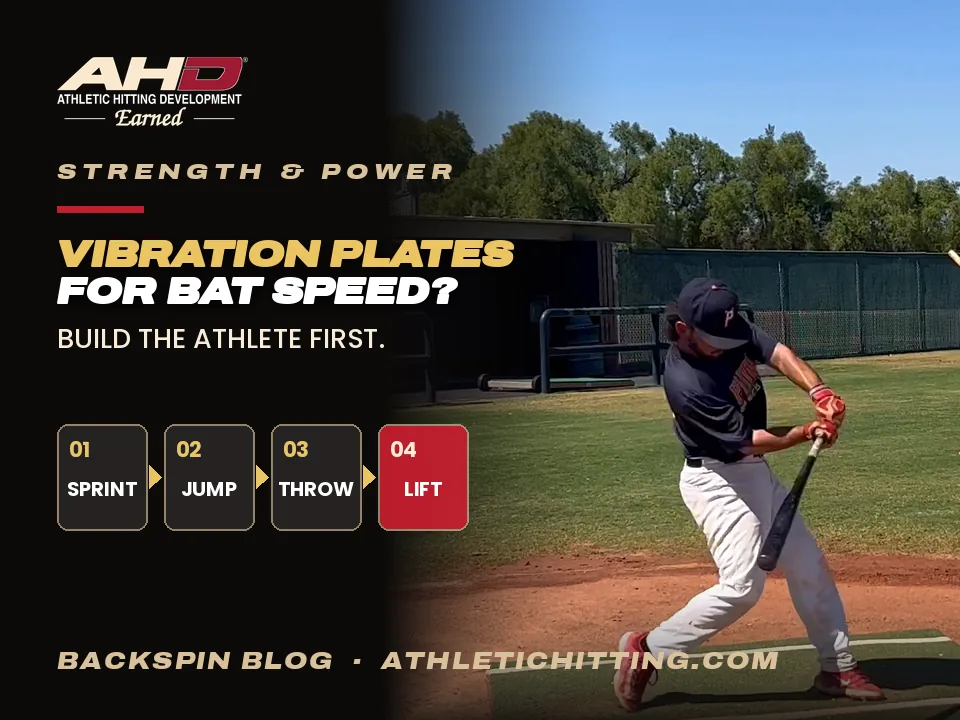
- Bat speed is built with simple work: sprint, jump and land, throw, rotate and lift the right way for your age.
- Test before and after every training block. If it doesn’t show up on the bat, it didn’t transfer.
Not from what we know today. A 2026 study found whole-body vibration changed a few early-swing rotation measures in young hitters, but nothing was different at contact, and nobody measured exit velocity or game hitting.
There’s no good evidence it does. A 2026 study of 32 young hitters found some early-swing changes but no differences at contact, so build bat speed with sprints, jumps, throws, med ball work and age-appropriate lifting, and test it before and after.
Train it: Athletic Development → Free tool: Free Hitter Combine →Here’s the deal. Every few months a new gadget shows up promising bat speed. Parents want to help, so they buy it. I get that.
So let’s look at what this study actually tested, what it found, and what I’d have a hitter do instead.
1. What did the vibration study actually test?
A research group published a study in the journal Life in September 2026. They took 32 national-level adolescent male baseball players and split them at random into four groups of eight.
- Group 1. No vibration.
- Group 2. Whole-body vibration only.
- Group 3. Vibration while holding a load of 30% of their one-rep max.
- Group 4. Vibration with 50% of their one-rep max.
Then they looked at how the body’s segments rotated during the swing. This was a short-term test: what happens to the swing right after a vibration session, not after weeks of training.
2. Did whole-body vibration increase bat speed?
Some early-swing measures changed, around the backswing and the start of hip rotation. Most of those changes showed up in the 30% group.
But at bat-ball contact, there were no differences between the groups. None. Contact is the moment that matters, because that’s when the ball finds out how hard you swung.
Contact is where the ball finds out.
The study also didn’t test exit velocity, game hitting or long-term training. The authors themselves say more research is needed to know if it improves batting performance. That’s an honest conclusion, and I respect it.
This was eight hitters per group in a short-term test, so I hold it loosely. It’s interesting science. It isn’t a training plan.
3. Should parents buy a vibration platform for bat speed?
No. Not based on this. A change early in the swing that disappears by contact doesn’t help a hitter drive a fastball to the gap.
Parents get sold gadgets all the time. Do your homework. Before you buy anything that promises bat speed, ask these questions:
- What did the research measure? Bat speed and exit velocity, or something upstream of them?
- How long was it tested? One session, or a full training block?
- Who was tested? Hitters your kid’s age and level, and how many?
- Does it show up in games? If nobody checked, you’re the experiment.
I’ve covered the same question with weighted bats and on-deck donuts. The answer keeps coming back the same way: the tool is only as good as what it adds at contact.
4. How do you actually increase bat speed with training?
Keep the foundation simple. The stuff that builds athletes still works, and it costs almost nothing. Here’s the order I like:
- Sprint.Short, fast sprints teach the body to produce force quickly, which is what a swing needs.
- Jump and land.Jumps build power from the ground up, and landing well teaches the body to control it.
- Throw.Throwing trains arm speed and the timing of the whole chain from the legs to the hand.
- Rotate.Rotational med ball throws train the hips and trunk to turn hard, the closest gym move to a swing.
- Lift for your age.Strength gives speed something to work with, with the load and coaching matched to the athlete’s age and training history.
BAT SPEED BASICS
KEEP ITSIMPLE.
- Sprint
- Jump and land
- Throw
- Rotate with a med ball
- Lift for your age
THEN TEST IT ON THE BAT.
If you want the detail, read strength training for young hitters by age and increasing bat speed with rotational power.
One more thing. Strength only helps if the swing can use it. AHD hitters work to get into Mechanically Advantageous Angles (MAA), positions that let the body’s power reach the barrel. A strong kid with a long, leaky swing just has a strong, leaky swing.
5. How do you know bat speed training is working?
You test it. Measure bat speed and exit velocity before a training block, train, then measure again the same way. Same bat, same tee height, same warm-up, same number of swings.
If the gym numbers go up and the bat numbers don’t, the training didn’t transfer to the swing yet. That’s not failure. That’s information, and it tells you where to look next.
Not sure what a good number is? Check the bat speed by age chart or run the free exit velocity and bat speed calculator.
I like this one for the work part: “Two choices: A. Do everything in your control. B. Anything but A.” Sprinting, jumping, throwing and lifting are in your control every week, and a platform can’t do them for you.
6. Where does bat speed training fit in a complete hitter?
Bat speed lives in the Athletic Development pillar. It still needs the other three: a swing that delivers it, a Hitting Processor that gets the barrel there on time, and a mental approach that lets the hitter swing free.
Not sure if strength is your hitter’s biggest need? Run the free SwingChecker™. In about three minutes it ranks his top priorities across all 4 Pillars, with cues, drills and matching free lessons.
If strength and speed are the gap, the Athletic Development course has 24 lessons built for hitters, with retests built in. Lesson 1 is a free test day.
THELESSON.
- No difference at contact
- Exit velo was never tested
- Build the athlete first
- Test before and after
Complete Hitters Are Built…Earned.
Want to go deeper? Read Bat Speed Starts With Athletic Power: Jump, Throw, Swing and The Med Ball Test That Tracks Bat Speed.
Quick answers
Does whole-body vibration increase bat speed?
There’s no good evidence that it does. A 2026 study of 32 young hitters found some early-swing rotation changes but no differences at bat-ball contact, and it didn’t measure exit velocity or game hitting.
What is the best way to increase bat speed?
Build the athlete with sprints, jumps, throws, rotational med ball work and age-appropriate lifting, and pair it with a swing that can use that power. Then test bat speed before and after each training block.
Should my teenager do strength training for hitting?
Yes, with coaching and loads matched to his age and training history. Strength gives speed something to work with, as long as the swing can deliver it to the barrel.
How do I know if bat speed training is working?
Measure bat speed and exit velocity under the same conditions before and after a training block. If the gym numbers rise but the bat numbers don’t, the training hasn’t transferred yet.
Don’t collect drills. Build a complete hitter.
Complete Hitters Aren’t Born. They’re Built… and Earned.