Feel vs Real in Hitting
You feel on time but you’re late. You feel on the ball but you’re under it. The AHD fix: go the opposite. Under? Swing over.
READ ARTICLE →
Originally published October 8, 2015 under Krush Athletics.
Backspin Blog — Free Instruction / The Early Days of AHD
This is historical coaching writing originally published under Krush Athletics. The wording reflects its original period. For current guidance, use AHD lessons and SwingChecker.
The Spark
Eyes or Ears
Lou Frazier and Billy Kehoe
While coaching and scouting from 1989 to 2004, I had observed an industry that, in my mind, was lagging behind other sports in many areas. I was trying to look “outside the box” for something different. I certainly believed that the coaching and teaching of the game(mine as well as others), as a whole, needed a wake-up call. Here is my disclaimer… there has and always will be excellent coaches in the game… but, there needed to be some mass improvement. I am one of the guilty ones, no doubt about it. I was guilty of teaching all my players to “squish the bug”, roll the wrists, etc. I FINALLY asked myself why we teach “squish the bug?” Who came up with that phrase, why do literally 90% of coaches I meet use this phrase and others like it ? My point being is that me, probably like most other coaches, were teaching players using phrases and other teaching methodologies that we heard from our Dad’s, our little league coaches, our high school coaches, from the camps and clinics we went to and on and on. The MAJOR PROBLEM with a lot of those words, phrases, etc that we use to teach our players today literally were and are not good. Yes, there are some “good” coach-speak-terms as well. Until the 2008 World Series, I had not seen a swing on video where a player actually “squished the bug” in a game setting. It rarely if ever happens. I was starting to observe with my own eyes in an unbiased way. What happens in the swing? Not looking at video or a live hitter with a preconceived notion that the hitter was going to do this or going to do that … what is the hitter really doing??? So that is one spark. One spark usually doesn’t start a fire and that one spark did not alone.
The Scout As a coach and a guy just being around the game a lot, I have been lucky enough to have worked with some players who have gotten some attention from Major League Baseball. Usually the area Scout comes around and takes a look at the kid and maybe has a conversation with you.
My second disclaimer of this write; there are some very good scouts all over the country, but let me tell a short story that ended up as one of the main reasons for the creation of the Krush Hitting Company. I was working at an elite baseball training center in Arizona where Big Leaguers would hit in the off season as well as some top local amateurs. Five players ended up getting drafted out of the group of local amateurs. Three were drafted in the top five rounds. The scouts flocked to watch these kids workout. It was during that period where I had a conversation with a Scout about the players that has now become one of the driving forces behind Krush. There were two big bats and a very athletic catcher with a cannon of an arm that were the most attractive to scouts. We had daily discussions about each one; their strengths, weaknesses, how they would develop, etc. The question I always got was, “which hitter do you like better?” The conversations were similar and most guys liked one more than the other. The knock on both of them was that they probably couldn’t hold down a defensive position in the Big Leagues. One of the kids was a right handed hitting shortstop who was an average high school defensive player.
Nick Evans
“Where are you going to hide him defensively?” asked the scout. My response was something like, “if he can at least be an average shortstop, he can probably LEARN how to play a corner (1st/3rd) infield position or at the very least a corner outfield position.” “He doesn’t have the hands to play in the infield, his arm isn’t good enough to play right field and probably isn’t athletic enough to play anywhere in the outfield”, he stated. He went on to say he swings and misses too much and doesn’t hit the off-speed pitch very well. He also doesn’t have much power to the opposite field. I was shocked and thought, why are you here then… but instead I asked him a question from, pardon the pun, out in left field. I asked him if he thought he was a good scout and with a perplexed look acknowledged that he thought he was. I went on to ask him when he became a good scout. Was he born that way, before he became a scout or did he have to LEARN to be a good scout?
“Where are you going with this?” he asked. I understood it was his job to project how good this player could become but asked him if he truly thought that with the proper coaching, could he get better at some if not all his flaws? I asked him if he ever spoke with the player about those specific deficiencies and if he had any knowledge on how to get better in those areas. The answer was no. I was steamed! Here is a somewhat powerful baseball person making an uneducated assumption and, for all practical purposes, ending this players chance to be drafted by that organization. That couldn’t happen! But it does everyday, everywhere the game of baseball is played. HOW CAN I HELP FIX THIS?
Fresh off a the stint working in Scottsdale, Arizona at the elite training facility where several Major League players worked out in the off season, I started my study on hitting that ultimately led to what now is the Krush Hitting Company,
The All-Star A conversation with a National League All-Star about what his lower half does during the swing led me to believe that this player was not fully aware of what was going on in his swing. If a 30 year old, MLB All-star didn't know, what does that say about the knowledge many other hitters possess throughout the world, especially the young ones.
The Coach Another spark came as good friend and ex-teammate Lou Frazier (ex MLB player and in 2008, the Pittsburgh Pirates first base coach), was training some players in the off season and invited me to watch. He is one of the most entertaining people alive and a quality coach as well. He and I were talking hitting and in the middle of the conversation, stopped, reached into his Suburban and handed me a tape. He then said what turned out to be the magic phrase, “Billy, watch this tape and teach your hitters what really happens in the swing, not what people tell you happens in the swing.”
These words were exciting, but I was nervous. I had coached at the high school and collegiate level, trained some of the best hitters on the planet (MLB players, minor leaguers, top collegiate players) as well as hundreds of high school and youth hitters… were my teachings sound, quality hitting philosophies and techniques or was the success some of the players and teams a product of pure talent of the players? It was definitely going to be a reality check … was I any good at my craft??? I was mesmerized watching the 5 or 6 hitters on the tape … but I needed more. I scrounged around and got as much video on MLB hitters as possible. Then there was the 2 months locked in a room, eating pizza and watching more video than a defensive coordinator in the NFL. As the days went by, two things became very apparent; 1. There are several commonalities or absolutes in most if not all elite hitters, and; 2. There are a lot of differences as well. The latter finding substantiates the old saying:” there are many ways to hit and all hitters should not be made into robots, each hitter has his or her own style”… and I believe that is a good thing. Driven by the quest to run a premier hitting development program, after the two month film study followed by another year or so of traveling the country swapping information with some of the best hitting minds available. The major goal of the study was to eliminate as much theory and opinion as far as teaching the art of hitting is concerned… too many different teaching methodologies can confuse and stunt young hitter’s growth. The first question that had to be addressed was, “Are there a number of common movements that most if not all exceptional hitters share?” If so, there is the basis of the program!! The answer… a resounding yes! There are many similarities that most, if not all elite hitters possess. So there are absolutes or facts (something that actually exists; reality; truth) that each and every hitter, regardless of age or skill level, could and should do.
The plan was coming together based upon what the very obvious similarities that were apparent while watching the video. It seemed very simple and obvious what to do. TEACH FACT AND ELIMINATE OPINION AND PHILOSOPHIES. 1000 plus events later... using my eyes to tell me what really happens in the swing, and not my ears was the best choice I could have made
Many coaches teach the phrases they learned from their own coaches without checking what elite hitters actually do on video.
Watching video without preconceived ideas and realizing many common teaching phrases didn’t match what great hitters do, which led to a fact-based program.
No subscription. No login. Keep learning, then take one priority into training.
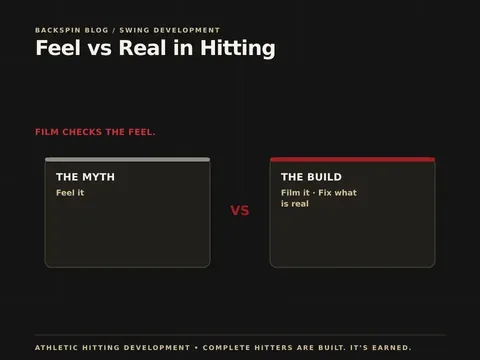
You feel on time but you’re late. You feel on the ball but you’re under it. The AHD fix: go the opposite. Under? Swing over.
READ ARTICLE →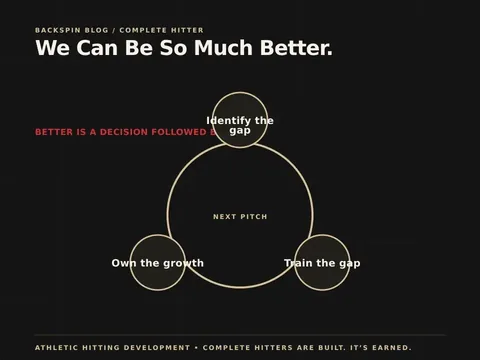
A brutally honest look at amateur hitting. I see a lot of meh. We can get so much better, and in a hurry.
READ ARTICLE →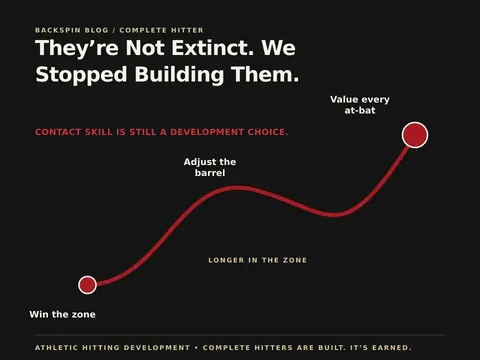
Gwynn, Boggs and Carew would win games in 2026. Why the contact artist is a winning brand of hitter.
READ ARTICLE →Guarantee & Refunds · Privacy · Terms · Safety · Delete My Data