By BK, Athletic Hitting Development
Complete Hitters Aren’t Born. They’re Built… and Earned.
Key takeaways
- A team hitting program starts with one hitting language every coach on staff uses the same way.
- Evaluate first. A preseason evaluation across the 4 pillars tells you what each hitter needs before you plan a single practice.
- Train all 4 pillars all year: the swing, strength and explosiveness, the Hitting Processor and the mental approach, weighted differently by season.
- Retest on a schedule. If nothing is measured, nothing is managed, and players buy in when they can see their own progress.
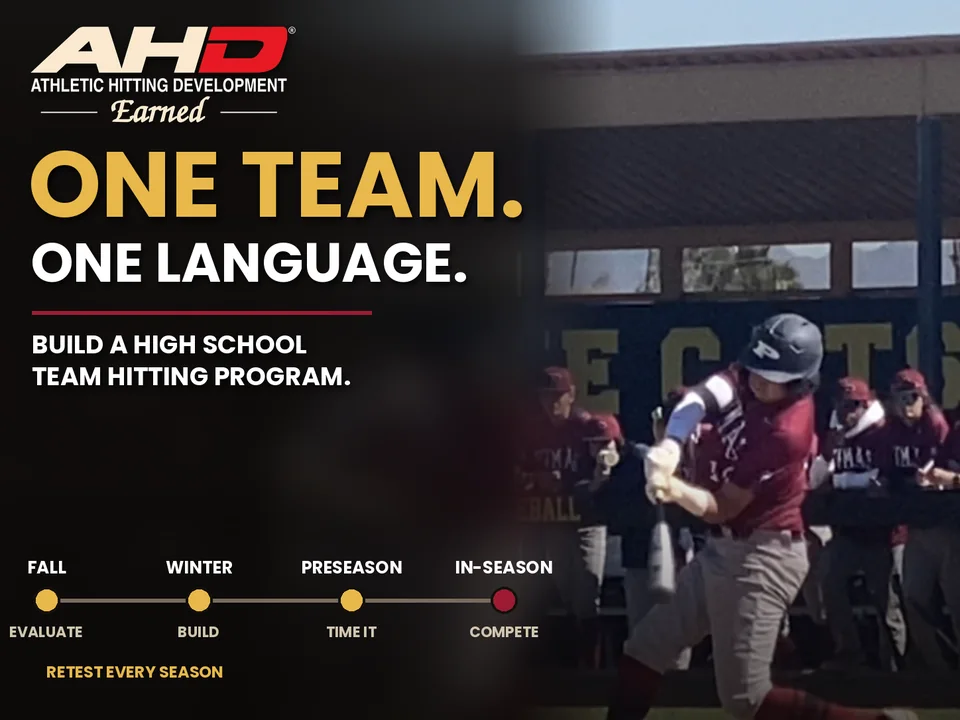
A high school team hitting program is one hitting language, a preseason evaluation of every hitter, the 4 pillars trained all year, station-based practices and a retest on a schedule. Without those, you don’t have a program. You have batting practice.
Build a high school team hitting program on one hitting language for every coach, a preseason evaluation of every hitter across the 4 pillars, year-round training weighted by season, station-based practices and scheduled retests so players see their progress.
Train it: AHD Coach Certification → Free tool: Complete Hitter Development Roadmap →I coached high school and college baseball and softball for 30 years in Arizona and Texas. The teams that hit weren’t always the most talented. They were the ones where every coach said the same thing, every hitter knew his job, and the work had a purpose.
Here’s how I’d build it if I walked into your program tomorrow.
1. Step 1: Pick one hitting language for the whole program
If your varsity coach says “stay back,” your JV coach says “get your foot down early,” and your freshman coach says “swing down,” your hitters are getting three different swings. That’s not development. That’s noise.
Pick one language and write it down. At AHD that language is the swing order: stance and ready position, gather, a directionally sound load, launch position, the bump, letting go of the arrow, barrel approach above and inside, contact, extension and finish. Your words can be your own. What matters is that every coach uses them the SAME way.
One program. One language. Every level.
This is exactly what the AHD Coach Certification gives a staff: a shared standard for how to assess a hitter, find the one priority that matters and prove the change on video.
2. Step 2: Evaluate every hitter before you plan practice
Don’t plan your hitting practices from a hunch. Evaluate first. I want to know where every hitter stands in all 4 pillars before I decide what the team works on.
- The Swing. Film side and behind, the same angles every time.
- Strength & Explosiveness. Simple, repeatable tests you can run again later.
- The Hitting Processor. Can he see it, time it, decide and attack it, or is he guessing?
- Mental Approach. What does he do after a bad at-bat, and does he have a plan in the box?
Our free 4 Pillars Hitter Scorecard rates 12 skills from 1 to 5, so you can score your whole roster on one sheet. For the full walkthrough, read how to run a preseason hitting evaluation for teams.
THE PROGRAM
ONELANGUAGE.
- Evaluate every hitter
- Train all 4 pillars all year
- Stations, not lines
- Retest on a schedule
NO PROGRAM, JUST BATTING PRACTICE
3. Step 3: Train the 4 pillars all year, not just in February
Most high school programs train hitting hard for six weeks before the season and then just play. The calendar is your biggest advantage if you use it. Here’s how I weight the year:
| Season | Main focus | Keep alive |
|---|---|---|
| Fall | Swing changes and the evaluation | Processor reps, approach talks |
| Winter | Strength & Explosiveness, swing reps | Processor daily, a few minutes |
| Preseason | Hitting Processor, live timing, approach | Short swing tune-ups |
| In-season | Approach, the Processor, maintenance | Strength 2x a week, short swing work |
The Hitting Processor gets trained DAILY in every season. See it, time it, decide, attack it. Ten minutes a day beats an hour once a week.
4. Step 4: Run practice in stations so nobody stands around
A roster of 20 and one cage means most of your hitters are watching. Stations fix that. Every hitter rotates through a few short, purposeful jobs, and every station has ONE cue.
- Tee stationWork the priority from the evaluation. One cue, quality reps.
- Front toss or machineBarrel approach and contact at a moving ball.
- Processor stationPitch calls, timing and decisions with no swing or a short swing.
- Live or cage roundCompete: a situation, a count, a goal.
- Strength or med-ballShort, explosive work that matches the season.
Here’s a ready-to-use version: a 60-minute team hitting practice plan. Don’t collect drills. Build a complete hitter, then pick the drills that serve the plan.
5. Step 5: Measure it and retest it
If nothing is measured, nothing is managed. Re-run the same evaluation on a schedule, at least at the end of fall, end of winter and midseason. Same tests, same camera angles, same scorecard.
Then show each player his own before and after. Nothing builds buy-in like a kid seeing his own swing change on video.
6. Step 6: Align your staff and let players own it
Your assistants need to see what you see. Watch film together, score a few hitters together and compare. When your staff agrees on what a priority looks like, your hitters stop getting mixed messages.
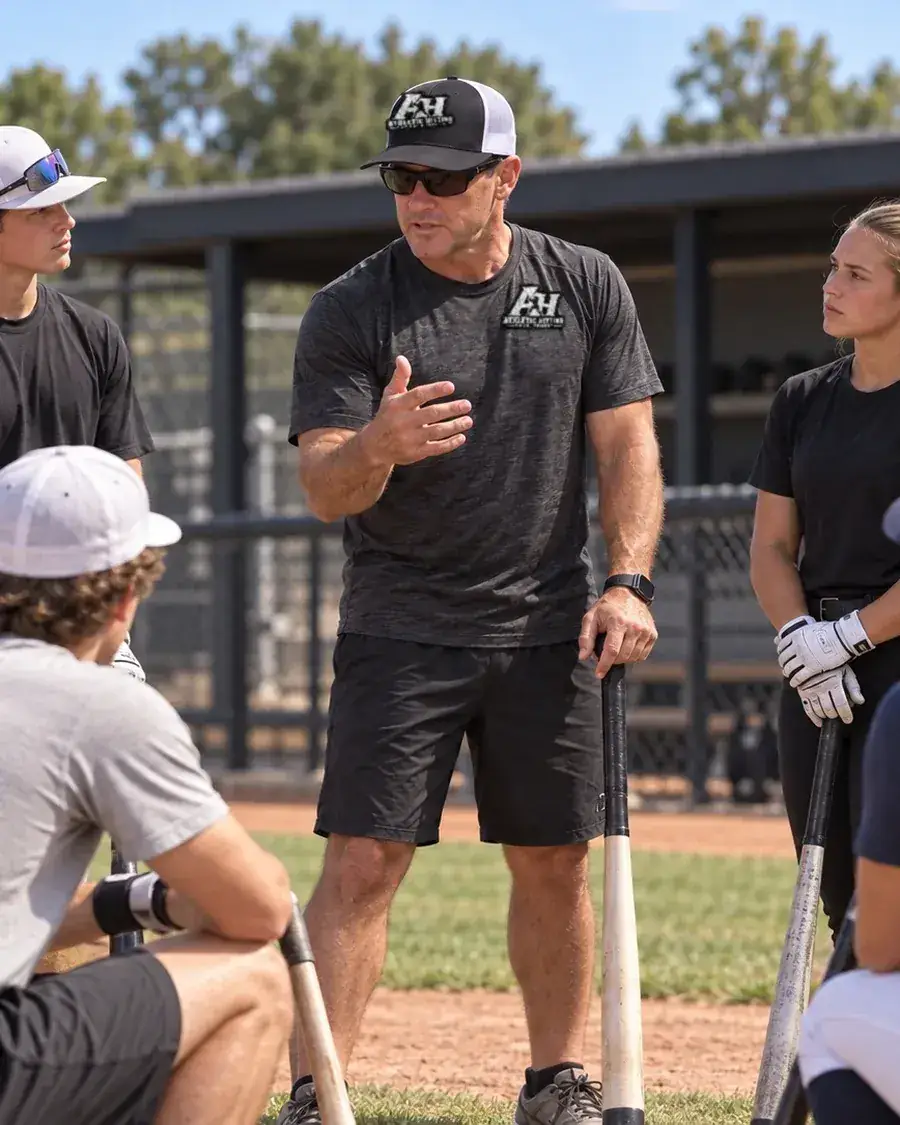
And give the players ownership. Each hitter should know his top priority, his cue and his next retest date. Hitters who own their plan work on it when you’re not watching, and that’s where real development happens.
THELESSON.
- Same words, every coach
- Know each hitter’s priority
- Measure it, show it
- Let players own the plan
Complete Hitters Are Built…Earned.
7. Where AHD fits in your program
Some coaches want to build all of this themselves. Great. Use the scorecard and the practice plan and go.
If you want help, there are three ways in. Put your roster on an AHD course with one team price through team and staff training. Bring me in for a camp or clinic for 12 to 60 players, baseball, fastpitch or both, and I travel. Or get your staff on the same page with the AHD Coach Certification, which you can start free with Lesson 1.
Have a hitter you want my eyes on first? Have him run the free SwingChecker™. Then Contact Coach for team pricing. It’s a great day to hit!!
Want to go deeper? Read The Preseason Hitting Evaluation Every Team Should Run and Team Hitting Practice Plan for Coaches (60 Minutes).
Quick answers
How do you build a high school hitting program?
Start with one hitting language for every coach, evaluate every hitter across the 4 pillars, train all 4 pillars year-round weighted by season, run practices in stations, and retest on a schedule so players can see progress.
How much hitting should a high school team do in season?
Keep the Hitting Processor daily for a few minutes, keep short swing work and strength about twice a week, and spend the rest on approach and situations. In season you maintain and compete; big swing changes belong in the fall.
How do you keep 20 players busy in hitting practice?
Run stations. Tee, front toss or machine, a Processor station, a live or cage round and a strength station, with every hitter rotating and every station using one cue.
Do all coaches on staff need the same hitting philosophy?
Yes. Different coaches teaching different swings confuses hitters. Agree on one language, watch film together and score hitters together so your staff sees the same priorities.
Don’t collect drills. Build a complete hitter.
Complete Hitters Aren’t Born. They’re Built… and Earned.