By Athletic Hitting Development
Complete Hitters Are Built… It’s Earned!
Ask most coaches how they evaluate hitters and you’ll hear the same thing: watch them take BP, maybe film a few swings. That tells you something about the swing. It tells you almost nothing about why a hitter struggles in games.
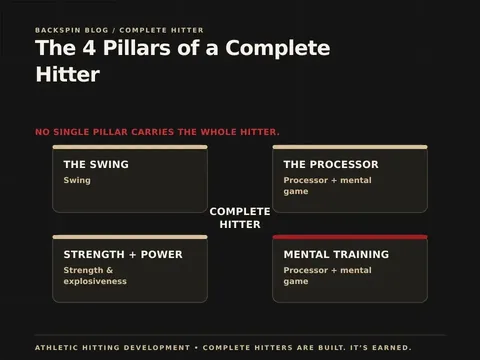
A preseason hitting evaluation should test all four pillars: swing, strength and explosiveness, the Hitting Processor and the mental approach. Run four simple stations in one practice, circle each player’s lowest pillar and train the weakest first.
Train it: Camps & Clinics →A complete hitter needs four things working together: the swing, strength and explosiveness, the Hitting Processor (how the eyes turn into decisions) and the mental approach. Test one and you’re guessing about the other three.
Measure all four. Train the weakest first.
1. Why test the whole hitter
Training the wrong pillar is how hitters work hard for a whole season and stay the same. A hitter with a sound swing who chases everything needs decision work, not more tee work. A hitter who decides well but can’t drive the ball may need strength and speed. The test tells you which.
2. The four test stations
Run these as stations in one practice. With three coaches or volunteers, a 12-player roster gets through all four in about an hour.
Station 1 — Swing
10 tee swings at game speed. Hold every finish for a three-count. Score balanced finishes out of 10. Film five from the side if you can; you’ll want it later.
Station 2 — Strength & explosiveness
Best of three standing broad jumps and a 10-yard sprint from an athletic stance. Add a rotational med-ball throw if you have a ball. Record the numbers.
Station 3 — Hitting Processor
10 mixed front tosses, some strikes and some balls. The hitter calls “yes” or “no” out loud before the ball is halfway. Score correct calls out of 10.
Station 4 — Mental approach
A quick private self-rating, 1 to 5: “I have a plan every at-bat” and “I reset fast after a bad at-bat.” Score out of 10. Keep these private; honesty matters more than the number.
PRESEASON TESTING
TEST ALLFOUR.
- Swing
- Strength & explosiveness
- Hitting Processor
- Mental approach
TRAIN THE WEAKEST FIRST.
3. The team sheet
| Player | Swing /10 | Processor /10 | Mental /10 | Jump | Sprint | Lowest |
|---|---|---|---|---|---|---|
| Player 1 | ||||||
| Player 2 | ||||||
| Player 3 | ||||||
| Team average |
Circle each player’s lowest of the three scored pillars. For strength, compare jump and sprint with the age benchmarks in our strength training by age guide.
4. Reading the results
- Low team Processor average: your team chases. Add a vision warm-up and a decision station to every practice.
- Low swing scores: balance and structure break at speed. Freeze-finish work and video on the checkpoint that breaks first.
- Low jump and sprint: the athletes need strength and speed work, and it will show up as bat speed.
- Low mental scores: teach a plan and a reset, and score the process instead of results.
The team average tells you what to practice. The individual lowest score tells you what to say to each hitter.
5. Plan the season from it
Build practice around the team’s weakest pillar, then give each player one cue tied to their own lowest score. Our 60-minute team hitting practice plan has a station for each pillar, so you can weight the plan toward what your team needs.
6. Retest on a schedule
Run the same four stations every four to six weeks: same order, same feeder, same setup. Post the team average. Players who see their number move buy in. Coaches who see it move know the plan is working.
7. Bring it to your team
The Complete Hitter Masterclass opens with this exact 4-pillar test, then gives each player 24 lessons and a full retest at the end. Start with Lesson 1: The Complete Hitter Test: Your 4-Pillar Baseline — the first three lessons of every course are free, so you can run them with your team before you decide anything.
Team pricing
Put your whole roster on an AHD course, with one price for the team. Every player gets the daily lessons, the scored challenges and a retest to show progress. Contact BK for a team quote →
Camps & clinics
Want BK in front of your players? AHD runs hitting camps and clinics for teams, clubs, leagues and schools, in Arizona and nationwide. See camps & clinics →
See the full Complete Hitter Masterclass →
THELESSON.
- One team sheet.
- Circle the lowest pillar.
- Plan practice from it.
- Retest every 4–6 weeks.
Complete Hitters Are Built…Earned.
Quick answers
How do you evaluate hitters before the season?
Test all four pillars of hitting: the swing, strength and explosiveness, pitch recognition and decisions, and the mental approach. Simple stations — tee swings with a held finish, broad jump and sprint, yes-or-no calls on mixed pitches and a short self-rating — cover a whole roster in about an hour.
What should a baseball hitting evaluation include?
More than batting practice. Include a swing structure check, an athletic test, a decision test on mixed pitches and a mental-approach rating, and record everything on a team sheet so you can retest the same way.
How often should coaches retest hitters?
Every four to six weeks, using the same stations, order and setup. Consistent retests show whether the practice plan is working.
Can I use the evaluation for tryouts?
Yes, the stations work for tryouts, but they are most valuable as a development tool: the lowest pillar for each player tells you what to train first.
Why isn’t watching batting practice enough to evaluate hitters?
BP tells you something about the swing and almost nothing about why a hitter struggles in games. A hitter with a sound swing who chases needs decision work, not more tee work. Test all four pillars so you train the right one.