By BK, Athletic Hitting Development
Complete Hitters Aren’t Born. They’re Built… and Earned.
Key takeaways
- Run four groups of 3–4 hitters through four 9-minute stations so nobody stands in line.
- Every station has one job: a tee checkpoint, a front-toss feel, a live decision rule, or recognition work.
- Train the Hitting Processor every practice — it’s the pillar most team BP skips.
- Finish with a competitive game so the swing gets tested under pressure before practice ends.
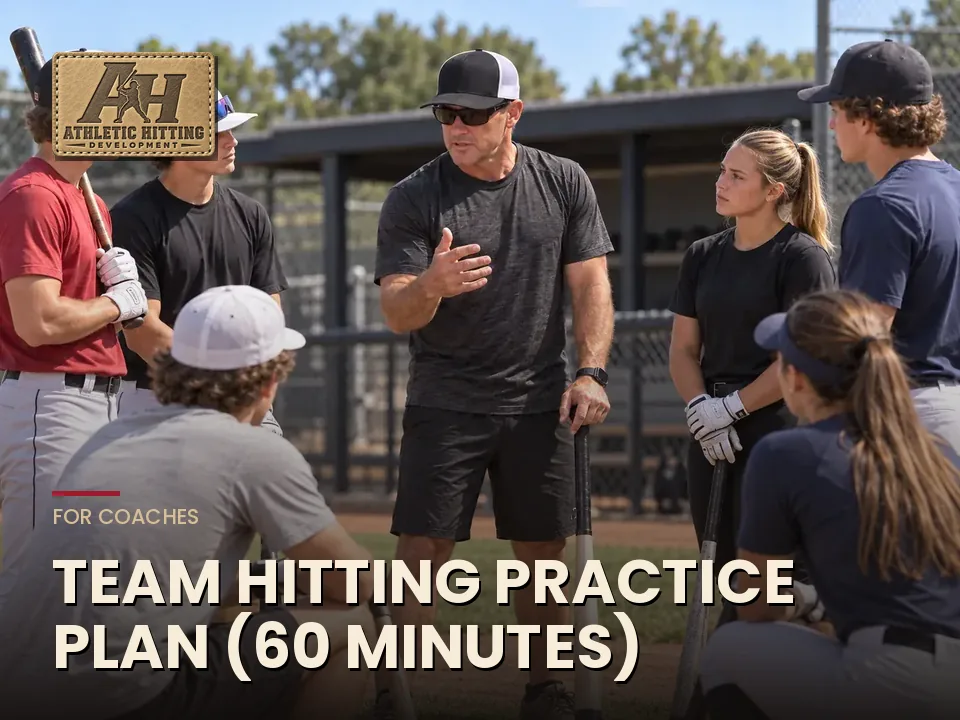
A good 60-minute team hitting practice is 8 minutes of athletic warm-up, four 9-minute station rotations, and a 16-minute competitive game to finish. Four small groups, every player working, every station with one clear job.
I’ve run more than 1,600 camps and clinics in 39 states. The number one problem I see in team practice isn’t the drills. It’s the line. Twelve kids, one cage, one coach throwing, and eleven kids watching.
This plan fixes that. It’s built for 12–15 players, high school or travel, with a few coaches or parent helpers. Steal it, adjust it, and run it.
1. What does a 60-minute team hitting practice look like?
Here’s the whole practice, minute by minute. The middle block is a rotation — each group hits every station once.
| Minutes | Station | What it trains |
|---|---|---|
| 0–8 | Dynamic warm-up and athletic movement (all players) | Strength & Explosiveness: move, rotate, get loose |
| 8–44 | Station 1: Tee with a checkpoint (9 min) | The Swing: one movement priority |
| 8–44 | Station 2: Front toss (9 min) | The Swing: carry the tee feel to a moving ball |
| 8–44 | Station 3: Live arm or machine with a decision rule (9 min) | Hitting Processor + Mental Approach: swing decisions |
| 8–44 | Station 4: Recognition / Processor station (9 min) | Hitting Processor: see it, time it, decide |
| 44–60 | Competitive game, then a 2-minute wrap | All 4 pillars under pressure |
Within the 8–44 block, rotate every 9 minutes on the coach’s whistle. Give yourself 30 seconds to switch. That’s four rounds, and every hitter touches every station.
TEAM PRACTICE
60 MINUTES.NO LINES.
- 0–8: Athletic warm-up
- 8–44: Four 9-minute stations
- Tee, front toss, live, Processor
- 44–60: Compete to finish
EVERY PLAYER WORKING. EVERY MINUTE.
2. How do I rotate 12–15 players without kids standing in line?
Split into four groups of 3–4. Mix ages and ability so the stronger hitters model good work. Inside each group, there are only three jobs: hitting, on-deck working, and feeding or shagging.
| Round | Group A | Group B | Group C | Group D |
|---|---|---|---|---|
| 8–17 | Tee | Front toss | Live / machine | Processor |
| 17–26 | Processor | Tee | Front toss | Live / machine |
| 26–35 | Live / machine | Processor | Tee | Front toss |
| 35–44 | Front toss | Live / machine | Processor | Tee |
- Short rounds. 5–6 swings, then rotate within the group. Nobody waits more than a minute.
- On-deck has a job. Dry swings to the checkpoint, or calling pitches for the hitter.
- Feeders are players. At the tee and processor stations, players feed and score each other.
- Coaches stay put. One adult per station who owns that station’s one job.
3. What should each hitting station actually focus on?
One job per station. If a station has five cues, it has none.
- Tee with a checkpointPick one priority for the week — balance at landing, barrel behind the hands, a finish they can hold — and grade every rep yes or no.
- Front tossSame priority, moving ball; mix heights and locations so the hitter has to adjust.
- Live or machine with a decision ruleGive a rule like “only swing at strikes middle-in until two strikes” and score good decisions, not just hard contact.
- Recognition / Processor stationHitters call pitch type or location out loud before it gets there — see it, time it, decide — with no swing required.
- Competitive gamePoints for line drives, quality takes and executing the situation; losers pick up the balls.
Good hitters have Mechanically Advantaged Angles (MAA), and the tee station is where your players learn to find them. But the swing is only one pillar. For more recognition ideas, see Train the Eyes Without Swinging.
4. Why finish hitting practice with a competitive game?
Practice should end the way games are played — with something on the line.
Split into two teams. Live arm or machine. Each hitter gets one at-bat with a count — start at 1-1. Score it: line drive 2 points, hard ground ball or fly ball 1, quality take of a ball 1, chase 0. Situational rounds work too: runner on third, less than two outs.
This is where the Mental Approach shows up. Who stays loose? Who resets after a bad swing? You learn more about your lineup in 14 minutes of competition than in an hour of BP. More on that in Coaching the Mental Game.
5. How do I adjust this plan for fastpitch softball?
The structure stays the same. A few details change.
- Front toss angle. Feed from a lower release so the ball travels on a fastpitch plane, including some balls that rise through the zone.
- Live distance. Pitching distance is 43 feet in most high school and college play (40 or 35 for younger ages), so reaction time is short. Make the decision rule simpler.
- Processor station. Add rise ball vs. drop ball calls. Hitters who chase the drop beat it into the ground.
- Small ball. Add slap and bunt rounds in the competitive game. See Team Bunting Practice.
For more on the differences, read Baseball vs. Fastpitch Softball Hitting.
6. Want help running this with your team?
I travel to run team camps and clinics for 12 to 60 players, ages 8 through high school — baseball, fastpitch or combined. Text me at 480-881-5447 for team pricing.
If you want to learn the system yourself, the Complete Hitter Development for Coaches certification is 24 lessons on how to teach all 4 pillars. And have every player take the free SwingChecker before the season so you know each hitter’s top priority for the tee station.

THELESSON.
- Small groups beat long lines
- One job per station
- Train the Processor daily
- Finish with competition
Complete Hitters Are Built…Earned.
Want to go deeper? Read The Preseason Hitting Evaluation Every Team Should Run.
Quick answers
How do you run an efficient team hitting practice?
Split the team into small groups, set up four stations with one clear job each, and rotate on a timer so no one stands in line. Finish with a short competitive game.
What hitting stations should a baseball team use?
A tee station with one checkpoint, front toss, live arm or machine with a decision rule, and a pitch recognition station. Together they train the swing, timing and swing decisions.
How long should team batting practice be?
Sixty minutes is plenty when it is organized. Short rounds, constant rotation and a competitive finish get more quality swings than a long, slow BP.
Can this hitting practice plan work for softball?
Yes. Keep the same structure, feed front toss on a lower fastpitch plane, simplify the live decision rule, and add rise and drop recognition plus slap and bunt rounds.
Don’t collect drills. Build a complete hitter.
Complete Hitters Aren’t Born. They’re Built… and Earned.
This article is part of the AHD guide Baseball Hitting Drills by Age. Start there for the full picture and every related article.