
By BK, Athletic Hitting Development
Complete Hitters Aren’t Born. They’re Built… and Earned.
Key takeaways
- Hitters who drift forward usually never loaded into the back side or started the load too late, so the body lunges to catch up.
- "Stay back" is the wrong cue. The goal is a directionally sound load that gathers energy, then a bump that moves it forward on time.
- Five drills fix it: the pause-at-launch tee, the step-back, the walk-up, the late-start front toss and the high-low change-up toss.
- Test it against speed changes. If the weight stays loaded on a slower pitch, the fix is real.
To keep your weight back when hitting, load into the back side early and on time, land in a strong launch position on an athletic front leg, and only then move forward with the bump. The best drills teach that order: load, land, bump, then swing.
Load into the back side early and on time, land in a strong launch position on an athletic front leg, then move forward with the bump. Pause-at-launch tee work, step-back, walk-up, late-start front toss and mixed-speed toss teach it.
Train it: Swing Structure & Mechanics → Free tool: SwingChecker™ →Every week a parent tells me their kid needs to "stay back." I get it. The hitter is lunging, the head is moving, and the ball is getting rolled over to shortstop.
But nobody hits standing still on the back leg. Good hitters gather energy into the back side, then move it forward at the right time. Here's why hitters drift, and the drills that fix it.
1. Why does my hitter drift forward or lunge at the ball?
In my experience, drifting forward comes from one of four places. Find the one your hitter has before picking a drill.
- No real load. The hitter never gathers into the back side, so there's nothing to move forward from.
- A late start. The load begins after the pitch is on the way, so the body rushes forward to catch up.
- A load that goes the wrong way. Weight goes up, around or toward the plate instead of back and in line with the pitcher.
- Guessing on speed. The hitter commits to a fastball, gets something slower and has nowhere to go but out front.
The first three are swing problems. The last one is a Hitting Processor problem, and it's why a hitter can look fine off the tee and lunge in games. For the full breakdown, see How to Stop Lunging at the Ball.
2. What does "keep your weight back" actually mean?
It doesn't mean freezing on the back leg. A hitter who stays back too long can't use the ground and swings with the arms.
It means the weight moves in the right order. Here's the order I teach every hitter:
- Stance and gather.Athletic, relaxed, with a little rhythm before the pitcher delivers.
- A directionally sound load.Weight gathers into the back hip, in line with the pitcher, not up or around.
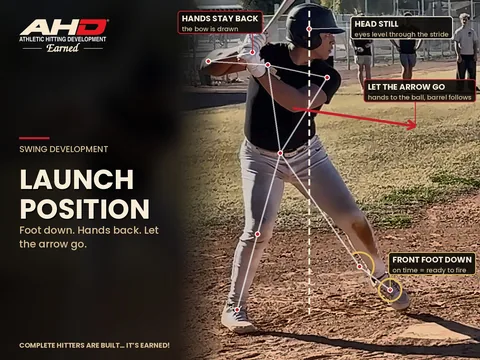
- Launch position.The front foot lands on an athletic front leg with the head quiet and the hands still back.
- The bump.A short move forward from the back side toward the middle, which starts the swing on time.
- Let go of the arrow.The lower half turns and the barrel follows. The upper body doesn't chase the ball.
AHD hitters build Mechanically Advantageous Angles (MAA) at launch. Hitters who land there loaded don't need to lunge, because the energy is already stored. More on that middle move in The Bump: The Middle of the Weight Shift.
KEEP YOUR WEIGHT BACK
LOAD.LAND. BUMP.
- Load into the back side
- Start the load on time
- Land on an athletic front leg
- Bump, then let it go
LOADED BEFORE YOU GO
3. What are the best hitting drills to keep your weight back?
Pick the drill that matches the cause you found. Do it for 10 to 15 swings a day, then test it at speed.
- Pause-at-launch tee.Load, land, hold for a one-count with the head quiet and the hands back, then swing. It teaches the hitter what a loaded landing feels like.
- Step-back drill.Start with the feet together, step back into the load with the back foot, then stride and swing. It forces weight into the back side before anything goes forward.
- Walk-up drill.Two small walking steps into the load, then land and swing. It builds rhythm and a load that goes in line with the pitcher.
- Late-start front toss.The coach shows the ball, pauses, then tosses. The hitter must stay loaded through the pause instead of drifting early.
- High-low change-up toss.Mix firm tosses with slower, higher-arc tosses. The hitter stays loaded and lets the slow one travel. Hard contact on both is the goal.
The last one matters most. Off the tee, almost everybody stays back. Against a change in speed, you find out what the hitter really owns. For more tee work, see The 5 Best Batting Tee Drills.
Load, land, bump, then swing.
4. How do you know the fix is working?
The ball tells you first. "Hard, down the other way means we are on our way!" A hard ball to the opposite field means the hitter waited, stayed loaded and stayed through it instead of lunging out front.
Then check the video. Film from the side and from behind, same angles every time:
- At landing, the head is still over the middle of the body, not past the front knee.
- The hands are still back when the front foot lands.
- On slower pitches, the hitter still lands loaded instead of reaching with the arms.
- The finish is balanced, not falling toward the plate.
If the head still moves a lot, read Head Movement When Hitting. If the stride goes toward third or first, see Stepping in the Bucket.
5. How long does it take to stop drifting?
It depends on how long the habit has been there and how often the hitter trains the fix. A few focused minutes every day beats one long session a week, because the new load has to become the hitter's normal load.
Build it in three steps. First, slow and right on the tee until the landing is loaded every time. Then front toss with mixed speeds. Then live pitching or a machine. If the drift comes back at game speed, go back one step instead of starting over.
Re-film every week or two from the same angles. Progress you can see on video keeps a hitter bought in, and it shows you whether the fix is holding or the hitter just felt good for a day.
6. Is keeping weight back different in softball?
The principle is the same. The time is shorter. From 43 feet, a fastpitch hitter has less time to load, so the load often has to start earlier and stay smaller. The drills above work for both sports; softball hitters should do the change-up toss a lot, because the change-up is where drifting shows up in games.
If a hitter keeps drifting no matter what you try, get eyes on it. Run the free SwingChecker to rank the top priority, or build the load and launch in order with the Swing Structure & Mechanics course. Softball families can also see our online softball hitting lessons.

THELESSON.
- Find why they drift
- One drill per cause
- Test with speed changes
- Hard the other way
Complete Hitters Are Built…Earned.
Want to go deeper? Read How to Stop Lunging at the Ball: Why Hitters Drift Forward and the Fix and The Bump: The Middle of the Weight Shift.
Quick answers
How do I stop drifting forward when I swing?
Load into the back side earlier and land with your head over the middle of your body before you move forward. Pause-at-launch tee work and late-start front toss teach that feel.
Should a hitter stay on the back leg?
No. Staying stuck on the back leg kills power. The weight should gather back, then move forward with a short bump on time.
Why does my kid lunge at changeups?
Usually the hitter committed to fastball speed and had no load left. Mixing speeds in front toss and training pitch recognition daily helps the most.
What is the best drill to keep your weight back in softball?
The high-low change-up toss. Mixing firm and slower tosses forces her to stay loaded and let the slow pitch travel, which is where drifting shows up in games.
Sources: OHSAA: 2010 NFHS softball rule changes (pitching distance to 43 feet)
Don’t collect drills. Build a complete hitter.
Complete Hitters Aren’t Born. They’re Built… and Earned.