By BK, Athletic Hitting Development
Complete Hitters Aren’t Born. They’re Built… and Earned.
Key takeaways
- In a 2026 VR study, college hitters kept their contact rate until time from release to contact fell below roughly 425–400 milliseconds, then it dropped.
- As time got shorter, hitters started their swings earlier. The swing itself didn’t get faster.
- Bat paths still split by location, so hitters kept adjusting inside the swing.
- Great hitters get ready early and adjust inside a tight window. Train the plan, the load and variable locations.
A hitter has less than half a second from release to contact, and a 2026 study found skilled college hitters started losing contact once that time dropped below roughly 425–400 milliseconds. The way to react to pitches faster is to start earlier, not swing faster.
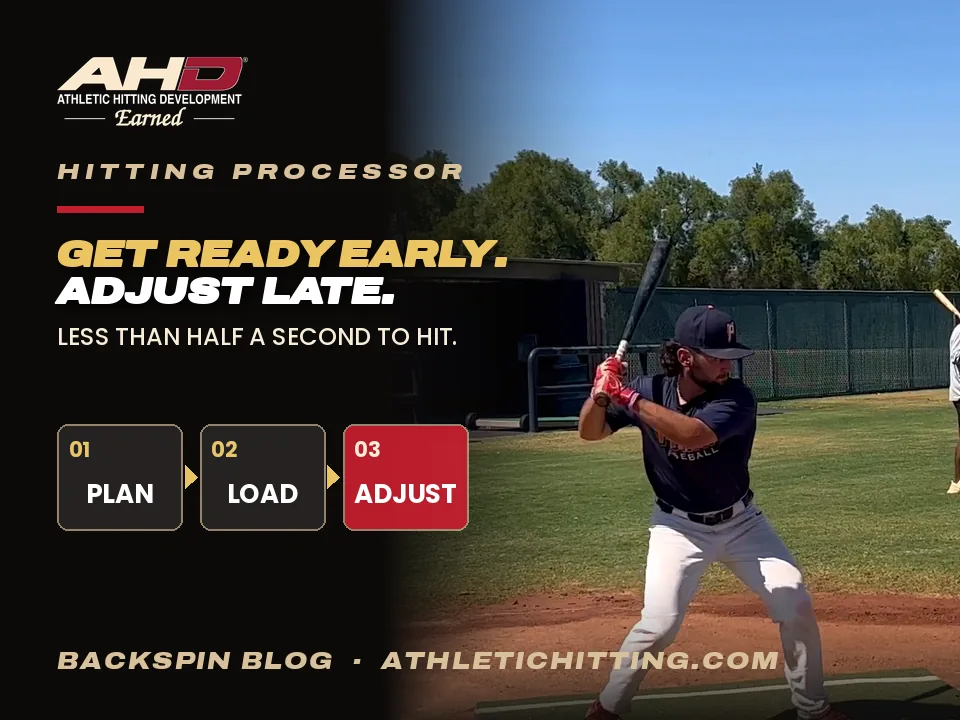
A hitter has less than half a second from release to contact. A 2026 study found skilled college hitters lost contact once that time fell below roughly 425–400 milliseconds, and they coped by starting their swings earlier, so get ready early and adjust late.
Train it: Hitting Processor → Free tool: Bird’s-Eye Timing Trainer →Every parent asks me some version of this. My kid is late. How do I get him to react faster?
Here’s the deal. Reaction time is mostly what it is. What a hitter controls is when he gets ready, what he’s looking for, and how much of the decision he’s already made before the ball leaves the hand.
1. What did the hitting time study find?
In August 2026 the Journal of Experimental Psychology: Human Perception and Performance published a study of 18 skilled college hitters in high-fidelity virtual reality. Researchers changed the time from release to contact, from 500 down to 375 milliseconds, and made pitch location either easy or hard to predict.
- Contact held steady at the longer times.
- Contact dropped once available time fell below roughly 425–400 milliseconds.
- Hitters started their swings earlier as time got shorter, while the swing duration stayed the same.
- Timing error jumped near that boundary.
- Bat paths still split by pitch location, so hitters were still adjusting inside the swing.
It was 18 hitters in VR, not a game, so I hold the exact numbers loosely. But the pattern is the part that matters, and it matches what I see in the cage every day.
THE TIME WINDOW
READY EARLY.ADJUST LATE.
- Plan before the pitch
- Gather and load early
- On time at release
- Adjust the barrel to location
START EARLIER, NOT FASTER
2. Do great hitters react or guess?
Neither, all the way. A purely reactive hitter waits to see everything and runs out of time. A purely pre-programmed hitter decides before the pitch and can’t adjust when it’s somewhere else.
Get ready early. Adjust inside a tight window.
That’s what the hitters in this study did. When time got short, they didn’t speed up the swing. They started it earlier, and they still bent the bat path toward the location. Ready early, adjustable late.
Notice what broke first. It wasn’t the swing. Swing duration stayed the same the whole way. What fell apart near the boundary was timing. The hitters ran out of room to start early enough, and timing error jumped.
That’s the lesson for a late hitter. Speeding up the swing is the hard road. Moving the start is the one he can actually control.
“Pitchers are basically pizza delivery guys.” He’s just delivering it. Your job is to be loaded and on time when it shows up, not scrambling to find the door.
3. How do you react to pitches faster?
You make the reaction smaller. The less a hitter has left to do after release, the more of his short window he can spend on the pitch. Three steps:
- Pitch plan before the pitchKnow the count, know what you’re hunting, know your zone. The decision starts in the on-deck circle, not at release.
- On time earlyGather and load early enough that you’re in your launch position when the ball is on its way, not still getting there.
- Adjust inside the swingLet the barrel approach work to the location: out front on the inside pitch, deeper on the away pitch.
That’s the Hitting Processor: see it, time it, decide, attack it. It’s trained DAILY, just like the swing. The early part, the gather and load, is covered in how to load in the baseball swing. The prediction part is in why great hitters predict, not just react.
A hitter whose load is on time and whose body gets into Mechanically Advantageous Angles (MAA) has a swing that can still adjust late. A hitter who’s still loading at release has already spent his window.
4. What drills train a hitter to adjust in time?
Don’t coach late adjustments like the hitter has all day. He doesn’t. Build drills that give him the plan early and make him adjust to location late.
- Plan-call rounds. Before each round of front toss, the hitter says his plan out loud: “fastball, middle-away.” Score the plan and the swing.
- Load before release. Front toss or machine where the coach watches one thing: is he in his launch position before the ball is released? Five swings, then film.
- Variable location. Mix inside, middle and away with no warning. Score hard contact to the right part of the field for each location.
- Shrink the window. Move the toss closer or speed up the machine a little at a time. If he’s late, start the load earlier before you touch the swing.
Want a quick check? The free Bird’s-Eye Timing Trainer shows where you met the ball versus where you should have, and times every swing in milliseconds. For a deeper look at the window itself, read the 9-millisecond window.
5. Where should a late hitter start?
Before you rebuild the swing, find out whether lateness is a swing problem, a timing problem or a decision problem. They look the same from the bleachers. Run the free SwingChecker™. In about three minutes it ranks your hitter’s top priorities across the 4 Pillars, with cues, drills and matching free lessons.
A quick test at practice: film five fastballs from the side. Pause each one at release. If he’s still lifting, still loading or still getting his hands set, he started late. Fix that first.
If timing and decisions come up, that’s the Hitting Processor course: 16 short lessons on seeing it, timing it and deciding. Lesson 13 is Start Early, Commit Late. Start with Lesson 1, Test Day, free.

THELESSON.
- Less than half a second
- Make the reaction smaller
- Train variable locations
- Fix the start before the swing
Complete Hitters Are Built…Earned.
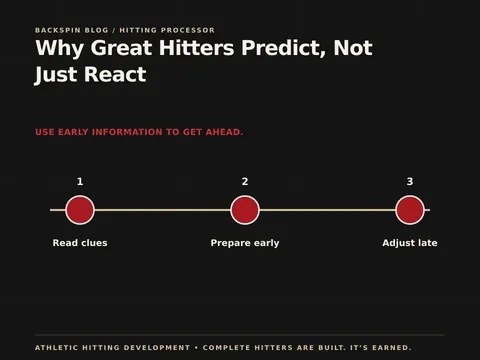
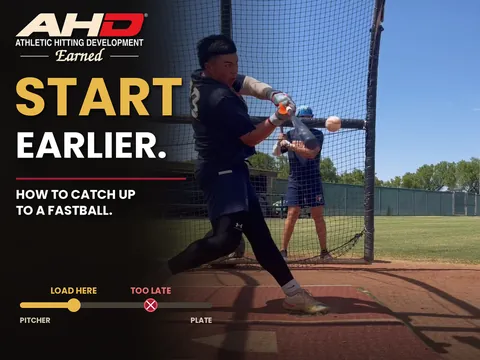
Want to go deeper? Read Why Great Hitters Predict, Not Just React and How to Catch Up to a Fastball: Why You’re Late and How to Fix It.
Quick answers
How much time does a hitter have to hit a pitch?
Less than half a second from release to contact. In a 2026 virtual reality study, skilled college hitters kept their contact rate until that time dropped below roughly 425 to 400 milliseconds.
How can I react faster to pitches in baseball?
Make the reaction smaller. Have a pitch plan before the pitch, gather and load early so you’re on time at release, and train adjusting to different locations.
Do good hitters guess or react?
Both, in a way. Research and coaching both point to hitters who get ready early with a plan, then adjust the bat path to the pitch inside a short window.
Why is my son always late on the fastball?
Often he starts too late, not swings too slow. In the 2026 study, hitters handled shorter times by starting the swing earlier, so check when his load begins before you change his swing.
Don’t collect drills. Build a complete hitter.
Complete Hitters Aren’t Born. They’re Built… and Earned.