By BK, Athletic Hitting Development
Complete Hitters Aren’t Born. They’re Built… and Earned.
Key takeaways
- A good private hitting lesson has a structure: check-in, film a baseline, one priority, constraint drills, live or front toss, retest, homework.
- Pick ONE priority per lesson. Fixing five things fixes nothing.
- Use constraint drills that make the right move the easy move, then test it against live or front toss.
- End every lesson with a retest on video and homework the hitter can do at home.
Run a private hitting lesson in seven blocks: check in, film a baseline, pick one priority, train it with constraint drills, test it against front toss or live pitching, retest on video, and send homework. One priority per lesson, every time.
Run a 60-minute hitting lesson in order: check in, film a baseline, pick one priority, train it with constraint drills, test it against front toss or live pitching, retest on video and assign homework. Fix one thing per lesson, not five, and don’t collect drills.
Train it: AHD Coach Certification → Free tool: AHD Coach Foundations Lesson 1 (free) →I’ve run a lot of hitting lessons. The ones that work look boring from the outside: same structure, one priority, a retest at the end. The ones that don’t work look busy — ten drills, ten cues, a tired kid and a confused parent.
Here’s the 60-minute lesson plan I’d hand any new instructor, including for that first lesson with a new hitter.
1. What does a 60-minute hitting lesson plan look like?
| Minutes | Block | What happens |
|---|---|---|
| 0–5 | Check-in | How did games go? Any soreness? What did homework show? |
| 5–12 | Warm up and film a baseline | Movement prep, then 5 tee and 5 front toss on video, side and behind |
| 12–17 | Pick ONE priority | Watch the video together. Name one thing and why it matters |
| 17–37 | Constraint drills | Two or three drills that force the right move, with one cue |
| 37–50 | Front toss or live | Mix speeds and locations. Add swing-or-take decisions |
| 50–60 | Retest and homework | Re-film the same 10 swings, compare, assign home work |
That’s the frame. Adjust the minutes, but keep the order. The order is what makes the hitter, and the parent, trust the process.
60-MINUTE LESSON
SAME ORDER,EVERY TIME.
- Check in and film a baseline
- Pick ONE priority
- Constraint drills, one cue
- Front toss or live
- Retest and homework
STRUCTURE BUILDS TRUST.
2. How should I start a hitting lesson?
Start with questions, not swings. What happened in the last game? Where did they get out? What did the homework look like? That tells you more than ten tee swings.
Then film. Five off the tee and five front toss, from the side and from behind, chest high, same angles every lesson. This baseline is how you prove progress later.
For a brand-new hitter, have them take the free SwingChecker™ before the first lesson. It takes about 3 minutes and ranks their top priority across the 4 pillars, so you walk in with a starting point.
3. How do I pick what to work on?
One priority. Not five.
Trace the symptom back to the root cause before you give a cue. “Pulling off” is a symptom. The cause could be balance, timing or a bad swing decision. Fix the cause and the symptom goes away.
Coach the whole hitter. The swing is one of the 4 Pillars — Strength & Explosiveness, the Hitting Processor and the Mental Approach matter just as much. When it IS the swing, coach by checkpoints and Mechanically Advantaged Angles (MAA), the strong positions at contact.
Show the hitter the video and say it in one sentence: “This is the thing today, and here’s why.”
4. What drills should I use in a private hitting lesson?
Use constraint drills: drills that make the right move the easy move and the wrong move obvious. Two or three of them, all aimed at the same priority, with the same cue. Don’t change the cue every five swings.
- Slow and cleanTee or soft toss. Get the feel right before you add speed.
- Full speedSame drill, game-speed swings. Aggressive and athletic.
- Add variabilityFront toss with mixed speeds and locations.
- Add decisionsCall balls and strikes. Swing or take. Now the Hitting Processor is involved.
Finish the training block against front toss or live pitching. A change that only shows up off the tee isn’t a change yet. Want swings with controlled violence? They have to hold up against something moving.
5. How should I end the lesson, and what should I avoid?
Re-film the same 10 swings from the same angles and put them next to the baseline. Show the hitter and the parent. Then give homework: one drill, a number of reps, how often, and how to film it. Ten to twenty minutes a day is plenty.
- Fixing five things. The hitter leaves with none of them.
- Drill collecting. Don’t collect drills. Build a complete hitter. A new drill every week isn’t a plan.
- Talking more than they swing. Short cues. Lots of reps.
- No retest. Without one, nobody knows if the lesson worked, including you.
- Ignoring the parent. Tell them the priority, the homework and what you’ll check next time.
This is the AHD coaching sequence in one hour: Assess, Diagnose, Build Roadmap, Train, Reassess. Coach Foundations Lesson 1 is free, and the full AHD Coach Certification teaches the whole system across 8 courses, with a Practical Video Exam I grade myself. Running a team, not one hitter? Use the Team Hitting Practice Plan.
It’s a great day to hit!!
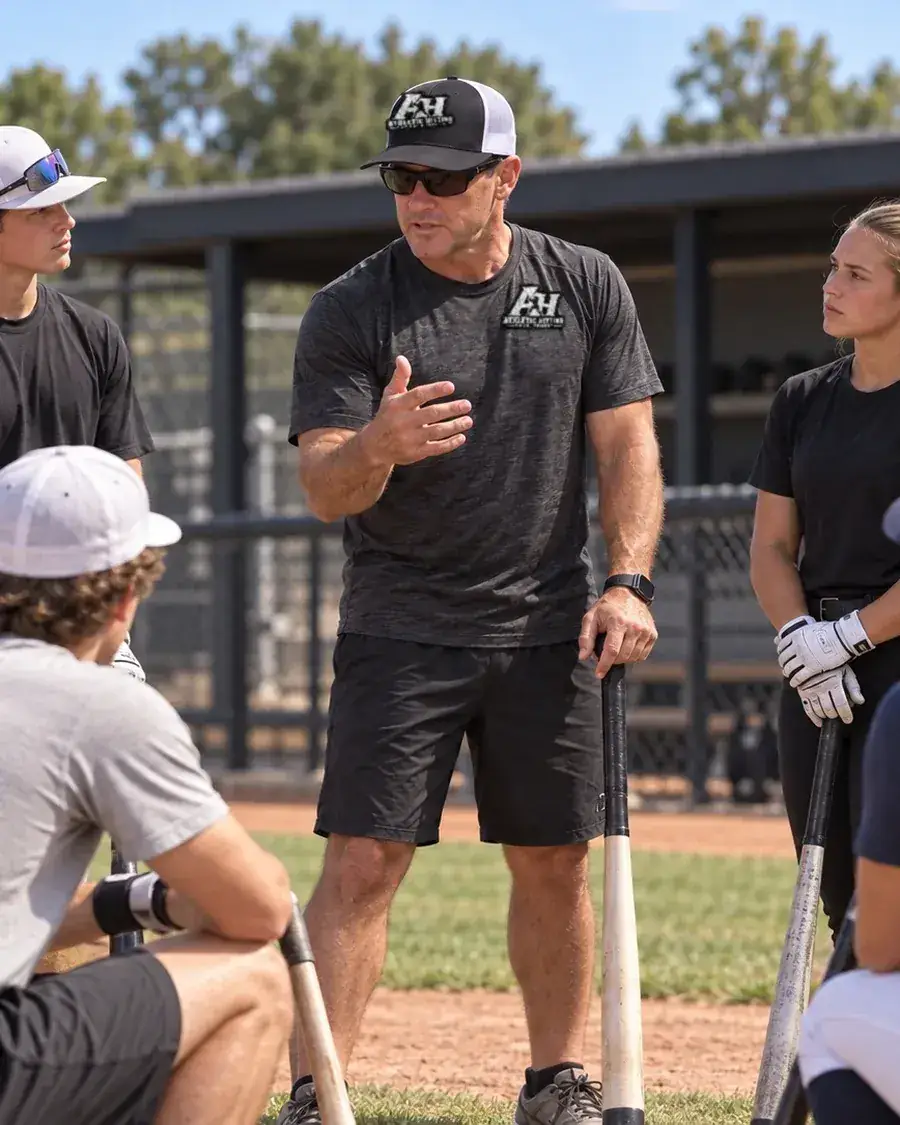
THELESSON.
- Assess before you teach
- One priority per lesson
- Test it against live pitching
- Retest on video, every time
Complete Hitters Are Built…Earned.
Want to go deeper? Read How to Become a Private Baseball Hitting Instructor and Team Hitting Practice Plan for Coaches (60 Minutes).
Quick answers
How do you structure a hitting lesson?
Check in, film a baseline, pick one priority, train it with constraint drills, test it against front toss or live pitching, retest on video, and assign homework. Keep the same order every lesson.
What should a first hitting lesson include?
A conversation about the hitter’s games and goals, a filmed baseline from the side and behind, one priority explained simply, a short training block, a retest and homework. A quick free test like SwingChecker beforehand helps.
How long should a private hitting lesson be?
Thirty minutes works for younger hitters and a single focused fix; an hour gives room for filming, drills, live work and a retest.
How many things should you fix in one hitting lesson?
One. Trace the symptom to the root cause, train that one priority until it holds up against live pitching, then move to the next.
Don’t collect drills. Build a complete hitter.
Complete Hitters Aren’t Born. They’re Built… and Earned.