By BK, Athletic Hitting Development
Complete Hitters Are Built… It’s Earned!
Key takeaways
- In-person lessons win on hands-on feel and instant correction, especially for young hitters under about 10.
- Online lessons win on cost, schedule, consistency between sessions and access to a coach you could not otherwise reach.
- The format matters less than the plan; a lesson with no plan is just a lesson, online or in the cage.
- For most hitters the best answer is both: a written plan, daily work at home, and video checked between sessions.
In-person hitting lessons are better for hands-on feel and young hitters who need a coach's hands and eyes in the cage. Online lessons are better for cost, schedule, consistency and access to a top coach. For most hitters, the best answer is a plan that uses both.
Parents ask me this every week. They expect me to say in-person, because I teach in Scottsdale. Or online, because I sell courses. The honest answer is: it depends on your hitter, and the format is not the main thing.
The main thing is whether there is a plan. A great 60-minute lesson that is never practiced is worth very little. A clear plan, done daily and checked on video, is worth a lot.
1. How do online and in-person hitting lessons compare?
| Factor | In-person | Online |
|---|---|---|
| Cost | Paid per session; one public Scottsdale facility lists $100–$150 an hour | Courses are a one-time price; remote coaching is a flat program fee |
| Feedback speed | Instant, in the moment | Hours to a day, by video review |
| Hands-on feel | Best: a coach can move, place and show | Limited to video, cues and demos |
| Schedule and travel | Fixed times, drive to the cage | Train any day, any time, at home |
| Between sessions | Often nothing until next week | Lessons and drills available daily |
| Access to a top coach | Only if they live near you | Anywhere with a phone |
Neither column wins every row. That is the point. Pick based on what your hitter needs most right now.
2. Who should choose in-person hitting lessons?
- Young hitters, roughly 7 to 10. They learn by feel and need a coach close by. Attention spans are short and video cues can go over their heads.
- Hitters with a fear of the ball. Building trust in the box is easier with a coach standing there.
- A big movement problem. When the body simply cannot get into a position, hands-on work and live correction speed things up.
- Families near a coach they trust. If the right coach is 15 minutes away, use them.
The weak spot of in-person is the six days between lessons. If nothing is assigned and nothing is checked, a lot of what was learned fades by the next session.
3. Who should choose online hitting lessons?
- Self-driven hitters, about 11 and up. They can follow a lesson, film themselves and do the work without a coach in the room.
- Busy schedules. Travel ball, school and two sports leave no fixed lesson slot. Online work fits 10 to 20 minutes a day.
- No good coach nearby. Online gives you access to experience you cannot drive to.
- Families on a budget. A one-time course often costs less than a month of weekly private lessons.
The weak spot of online is feel. If the hitter cannot film, will not practice alone, or needs a hand on their back hip, online alone is not enough.
PICK THE FORMAT
FEEL ORFREQUENCY?
- Under 10: lean in-person
- 11+ and self-driven: online works
- Busy schedule: online
- Best results: a plan using both
THE PLAN MATTERS MORE THAN THE ROOM
4. Why is the best answer often both?
The format is the vehicle. The plan is the engine.
The hitters who improve fastest have three things: a clear priority, daily work on it, and someone checking that it is working. In-person gives you the first lesson and the feel. Online fills the six days in between and keeps everyone on the same plan.
- Assess firstFind the top priority across the 4 pillars before buying anything.
- Build a written planKnow what you are training for the next 4 to 12 weeks, and why.
- Train daily at home10 to 20 minutes a day beats one hour a week.
- Check with videoFilm the same angles every week so a coach can see what changed.
Whichever format you choose, ask the coach three things before you pay. What is the plan for the next 90 days? How will you measure progress? What does my hitter do between sessions? If the answers are vague, the format will not save you.
And be honest about your hitter. Some kids will do 15 minutes a day on their own. Some will not touch a tee unless a coach is standing there. Neither is wrong, but it changes what you should buy. Here is a guide to helping your hitter without guessing.
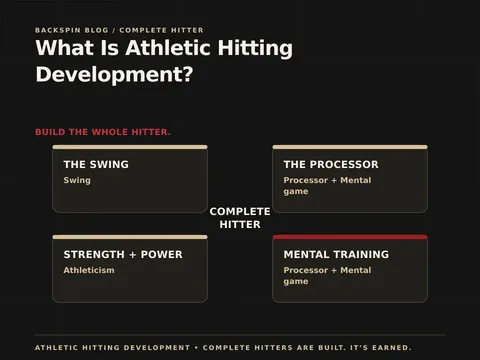
That plan should cover more than mechanics. A complete hitter is built across all 4 pillars: The Swing, Strength & Explosiveness, the Hitting Processor and the Mental Approach. A lesson that only fixes positions is a quarter of the job. See A Swing Change Is Not a Plan.
5. How does AHD offer online and in-person lessons?
We built AHD so families can choose the mix that fits.
- Online courses. One-time price, a year of access, no subscription, and Lessons 1–3 free in every course. Most lessons are 10 to 20 minutes, and all you need is a bat, tee, balls and a phone. The Complete Hitter Masterclass covers all 4 pillars in 24 lessons for $250 (founding price, regularly $349).
- 90-Day Private Hitter Development. Online hitting instruction with me: a starting evaluation, a personal 90-day plan, all 7 courses, ongoing swing and game at-bat video review and direct text access. $1,995, limited to 12 athletes. Here is what it actually looks like.
- In-person in Scottsdale. Private and semi-private Scottsdale hitting lessons for families across the Phoenix area. Contact Coach at athletichitting.com/contact for current rates.
Many local families do both: a lesson in the cage, then course work and video between sessions. If you cannot decide, start with the free SwingChecker. It takes about 3 minutes and tells you what to work on first, whatever format you pick.

THELESSON.
- In-person wins on feel
- Online wins on access
- Daily work wins on results
- A plan ties it together
Complete Hitters Are Built…Earned.
Want to go deeper? Read What 90-Day Remote Hitting Coaching Actually Looks Like and There’s No Secret Sauce: How to Vet a Hitting Coach.
Quick answers
Are online hitting lessons as good as in-person?
They are better for some things and worse for others. Online is strong on cost, schedule and consistency; in-person is strong on hands-on feel and instant correction.
What age is too young for online hitting lessons?
Most hitters under about 10 do better with in-person coaching and a parent helping at home. From around 11 up, a self-driven hitter can do very well online.
How much do in-person hitting lessons cost?
It varies by coach and area. One public Scottsdale facility lists about $100 to $150 for an hour as of October 2026.
Can I combine online and in-person hitting lessons?
Yes, and it is often the best option. Use in-person sessions for feel and online lessons plus video review to keep the plan moving between sessions.
Sources: Scottsdale Batting Cages, instructor lesson pricing (Oct 2026)
Don’t collect drills. Build a complete hitter.
Complete Hitters Are Built… It’s Earned!