By Athletic Hitting Development
Complete Hitters Are Built… It’s Earned!
Ten pitches didn’t beat Jake Bauers. They set up the eleventh.
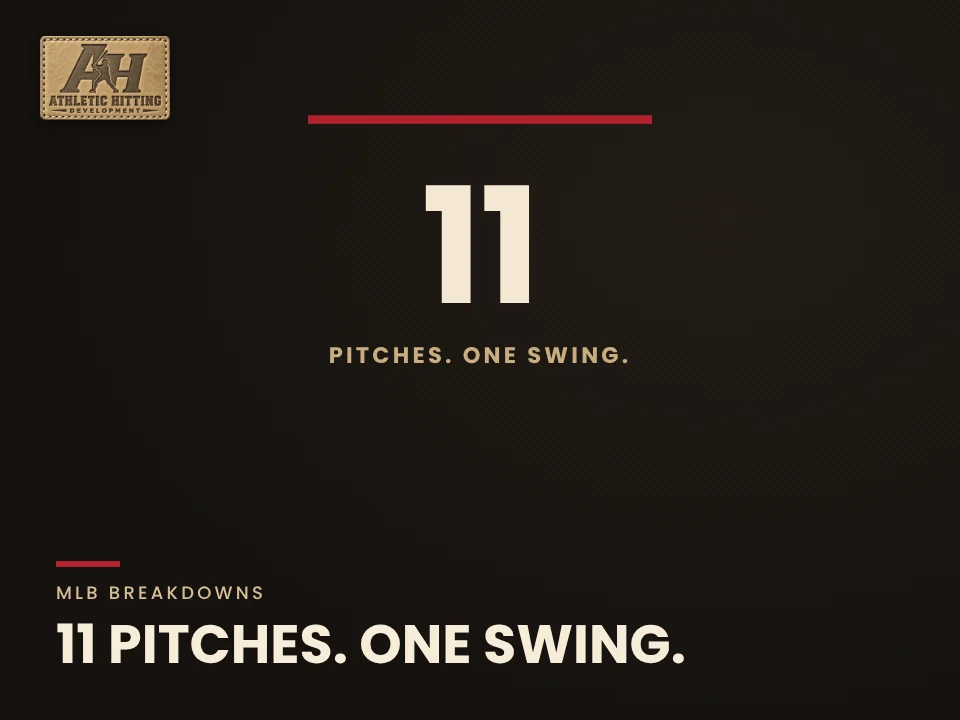
In NLCS Game 3, Bauers battled Blake Snell for 11 pitches, fouled a near-homer just foul down the right-field line, then drove the very next pitch, a 97 mph fastball, out to right to put the Brewers back in front 3-2. The home run made the highlights. The ten pitches before it are the lesson.
Try it: the free Two-Strike Plan →Tonight in Los Angeles, with the Brewers suddenly behind, Bauers stepped in against Snell and turned one at-bat into a clinic. Eleven pitches. One near-miss foul down the line. Then a two-run homer that put Milwaukee back on top.
If you coach hitters or raise one, this is the at-bat to show them. Not because it ended in a home run, but because of everything that happened before it.
The at-bat was earned before the swing ever happened.
1. What happened
The Brewers came into Game 3 up two games to none. Jackson Chourio homered on the first pitch of the night, then Will Smith’s bases-loaded double put the Dodgers ahead 2-1.
In the 7th, Bauers went to work against Snell, a left-hander who had settled in after that first pitch and was getting outs with his curveball and slider.
- The battle: 11 pitches, lefty on lefty.
- The warning shot: he fouled off a ball that would have been a go-ahead homer, hooking it just foul down the right-field line.
- The finish: on the very next pitch, a 97 mph fastball, he drove it out to right for a two-run homer and a 3-2 lead.
- The follow-up: Garrett Mitchell homered on the next pitch Snell threw, an 86 mph changeup. Back-to-back, 4-2, and Snell was done.
Per MLB’s Sarah Langs, it was only the sixth postseason home run on the 11th pitch of an at-bat or later since pitch counts were first tracked in 1988. And it was the second straight game Bauers was rewarded for a textbook at-bat.
JAKE BAUERS • NLCS GAME 3
11 PITCHES.ONE SWING.
- Shrink the zone, stay aggressive
- Spoil his best pitch
- Learn from the near-miss
- Be on time for the fastball
CONTROLLED VIOLENCE.
2. What an 11-pitch at-bat really teaches
Most young hitters see a long at-bat as survival. Elite hitters see it as information. Every pitch Bauers saw was a scouting report on what Snell had that night.
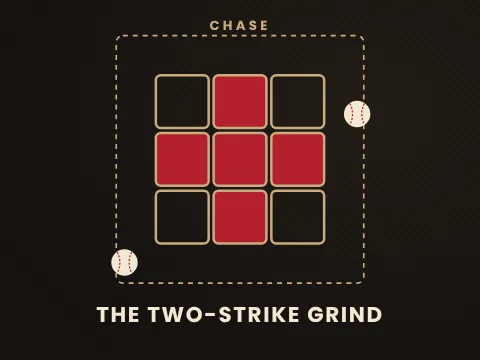
- Shrink the zone with two strikes, but stay aggressive. Two-strike hitting isn’t timid hitting. You take away the pitcher’s edges and still swing to do damage on anything in your zone. That’s controlled violence.
- Spoil the pitcher’s best pitch. Snell was winning with his curveball and slider. A hitter who can foul off the nasty pitch forces the pitcher to come back to something hittable.
- Learn from the near-miss. The foul ball down the line wasn’t a failure. It told Bauers his timing was right there, and he only needed to stay through the ball a hair longer. One pitch later, he did.
- Be on time for the fastball, always. After a steady diet of breaking balls, Snell went to 97. Bauers was ready. You can’t speed up late to catch velocity. Be on time for the heater and adjust to the off-speed.
- Pressure is a pitch-count problem for the pitcher. Every foul adds stress. Long at-bats tire pitchers and help the next hitter, which is exactly what happened when Mitchell homered on the next pitch. More on that grind in Drag Him Down With You.
3. All 4 pillars in one at-bat
This is why AHD trains all four pillars of hitting together. Bauers didn’t win this at-bat with just one of them.
| Pillar | What it looked like |
|---|---|
| The Swing | A repeatable move with Mechanically Advantaged Angles (MAA) that let him foul off tough breaking balls and still turn on 97. |
| Athletic Development | The bat speed and strength to drive a 97 mph fastball out to right, deep into an at-bat. |
| Hitting Processor | Reading spin, spoiling chase pitches and staying on time for the fastball. |
| Mental Approach | Staying calm and aggressive after a near-miss, in the 7th inning of an NLCS game, on the road. |
Take away any one pillar and the at-bat ends differently. A great swing with a slow processor chases the slider. A sharp eye with no bat speed fouls off 97 forever. A strong body with a shaky mind rolls over after the near-miss.
4. For parents and coaches: how to train it
You don’t build a hitter like this by collecting drills. You build him by training the at-bat.
- Start rounds at two strikes. In BP or live at-bats, give hitters a 0-2 or 1-2 count to start. Make them win from behind.
- Score foul balls as wins. A tough two-strike foul off a breaking ball counts. Reward the battle, not just the result.
- Mix velocity and spin. Train hitters to be on time for the fastball and adjust to off-speed. A machine set at one speed won’t teach this.
- Debrief every long at-bat. Ask: what did the pitcher show you? What was he trying to get you to chase? Hitters who can answer that are processing.
- Coach the next pitch, not the last one. After a near-miss or a bad swing, the only question is the plan for the next one.
Coaches: bring the four pillars to your whole roster with team roster pricing, or bring AHD to your town for a Camp or Clinic.
5. The bottom line
That’s what an aggressive, athletic hitter looks like when the game is on the line: patient enough to battle, violent enough to punish the mistake.
- Run SwingChecker™ free to find which pillar is holding your hitter back.
- Build a free Two-Strike Plan and practice calls with the Pitch Recognition Trainer.
- Go deeper in the AHD Academy. Enrollment opens November 15.
Don’t collect drills. Build a complete hitter.
Source note: Game details come from FOX Sports’ NLCS Game 3 live blog, ClutchPoints (pitch speeds) and ESPN. The pitch-11 stat is from MLB’s Sarah Langs. Inspired by USA Today’s coverage of the at-bat. Written during the game, October 14, 2026. This article is AHD’s coaching interpretation.
Quick answers
What made Jake Bauers’ NLCS Game 3 at-bat special?
He saw 11 pitches from Blake Snell in the 7th inning, fouled off a near-homer down the right-field line, then hit the next pitch, a 97 mph fastball, for a two-run homer that put the Brewers ahead 3-2. It was only the sixth postseason home run on the 11th pitch or later since 1988.
How do you teach a hitter to win a long at-bat?
Train at two strikes. Start reps at 0-2 or 1-2, mix fastballs and off-speed, score tough foul balls as wins and debrief what the pitcher showed. Stay on time for the fastball and adjust to the off-speed.
Is a foul ball a good result with two strikes?
Often, yes. Spoiling the pitcher’s best pitch keeps the at-bat alive, adds to his pitch count and forces him to come back with something more hittable.
Why be on time for the fastball first?
You can’t speed up late to catch velocity. A hitter who is on time for the fastball can slow down and adjust to off-speed, which is how Bauers was ready for 97 after a steady diet of breaking balls.
This article is part of the AHD guide Pitch Recognition & Timing. Start there for the full picture and every related article.