By BK, Athletic Hitting Development
Complete Hitters Aren’t Born. They’re Built… and Earned.
Key takeaways
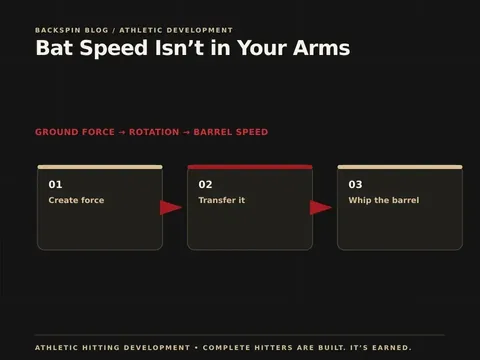
- Leverage is not a pose — it’s a process: ground, move, sequence, barrel, contact.
- More effort is not automatically more effective force. Strong hitters lose leverage when they can’t control that strength through the swing.
- The hitter needs a functional, athletic front side — not a rigid statue or a forced knee-lock picture.
- Usable leverage is the kind you can keep against real pitching: bat speed plus the control to adjust the barrel.
In hitting, leverage describes how body and bat positions help a hitter apply force and create rotation efficiently. At AHD, usable leverage means building bat speed AND keeping the body control and barrel adjustability to put that speed into a real pitch.
Leverage in hitting is how body and bat positions help a hitter apply force and create rotation efficiently. Usable leverage means building bat speed while keeping the body control and barrel adjustability to deliver it to a real pitch.
Train it: Swing Structure & Mechanics →“He gets great leverage.” “She’s losing her leverage.” “You’ve got to hit against a firm front side.” We hear those phrases all the time. But what do they actually mean, and how do they help a hitter square up a moving baseball?
I want hitters to understand why a movement helps — not just memorize somebody else’s swing position. A beautiful position on a frozen video frame doesn’t get a hit. The barrel still has to arrive at the baseball: on time, on a useful path, with some force behind it.
1. Is leverage a position? No — it’s a process.
In physics, a lever lets force produce a turning effect, or torque, around an axis. The amount and direction of force — and where it’s applied — matter.
But a hitter is not a crowbar. The body is a chain of moving segments, the bat has its own mass and inertia, and the swing has to unfold in a fraction of a second. There is no single magic angle that guarantees more bat speed.
- GroundThe hitter pushes against the ground to support and drive the move.
- MoveThe body organizes into an athletic position.
- SequenceRotation unfolds in order and accelerates the bat.
- BarrelThe barrel gets matched to the pitch on a useful path.
- ContactForce shows up where it matters — at the baseball.
The job isn’t to produce force everywhere at once. It’s to organize movement so force shows up where it matters.
2. Where does leverage start? From the ground — but don’t stop there.
Hitters push against the ground as they gather, stride, establish the lead side and rotate. Those ground-reaction forces help support and drive body movement.
Here’s where many athletes get in trouble. They’re plenty strong, but they can’t control that strength through the swing. They drift into launch, lose posture or spin out before the barrel gets to the hitting zone. They look like they’re swinging out of their shoes — and sometimes they literally are.
More effort is not automatically more effective force.
The front side is an especially useful checkpoint. An organized, athletic front leg helps the hitter manage forward movement and rotation, and that may include a firming or extending knee. But I’m not interested in teaching every kid to lock the front leg at exactly the same moment. The hitter needs a functional front side, not a rigid statue.
What I’m looking for: can this athlete move forward, establish an athletic position, turn aggressively, and still control the barrel?
3. What are Mechanically Advantaged Angles (MAA)?
At AHD we talk about Mechanically Advantaged Angles (MAA) — positions and movements that create better opportunities for an efficient swing. Not rules. Advantages. Every hitter has a different body, strength, rhythm and way to compete.
- At setup: athletic posture. Hips hinged, knees flexed, useful spine tilt — a body that can move and rotate without having to stand up first.
- During the gather: pull back the bow. Load with rhythm while keeping the hands, back arm and torso organized. Create room to move without reaching or disconnecting.
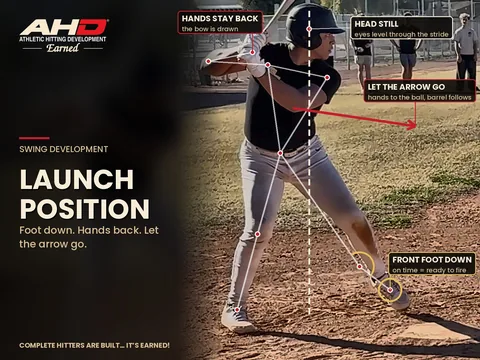
- At launch: a strong starting point. Arrive athletic, hands back and up, barrel under control, so the hitter can deliver the bat directly instead of rescuing a poor position.
- Into the zone: bat lag without dumping. Let the barrel work behind the hands as the swing accelerates. Don’t throw it away from the body or dump it too early.
- Through contact: a controlled front side. Manage forward drift, keep useful rotation, and deliver the barrel. The goal is effective force and accurate contact, not a forced knee-lock picture.
Here’s the trap: a coach sees one great hitter using a certain angle and turns it into an absolute for every kid. We don’t do that. We identify the advantage this hitter needs — and then prove it improves contact.
MAA · FIND YOUR EDGE
NOT RULES.ADVANTAGES.
- Athletic posture at setup
- Pull back the bow
- Strong launch position
- Bat lag without dumping
- Controlled front side
PROVE IT IMPROVES CONTACT
4. Why do the hands and barrel decide everything?
Now we’re getting to the part I love. You can win a weight-room contest. You can look explosive in a rotational medicine-ball throw. You can have a beautiful hip turn. None of it counts if the barrel can’t get to the pitch.
| Hitter A | Hitter B | |
|---|---|---|
| The move | Rotates hard | Moves into an athletic launch |
| Hands & barrel | Casts the hands, drops the barrel | Stays organized, accelerates the bat on a useful route |
| Looks like | Violent | Controlled and fast |
| Contact | Inconsistent | Adjusts to location |
Which hitter owns more usable leverage? The one who can repeatedly deliver it to the baseball.
There’s real research behind the idea that swinging a bat is more complicated than spinning the hands around a hinge. In a 2018 bat-kinetics study of 306 swings from 22 male baseball players ages 13–18, researchers found that forces along the length of the bat were prominent through much of the swing, while rotational moments on the bat rose sharply near impact.
That’s evidence about how forces act on a bat — not a prescription for a single hand cue. The coaching takeaway is simpler: don’t confuse throwing the barrel out early with making a powerful swing.
The swing has two jobs: produce bat speed, and deliver it on time.
5. How do hitters lose leverage? Five ways they give it away
- Losing balance and body control. Drifting, falling or spinning off the pitch makes an otherwise powerful swing harder to repeat.
- Opening the front side too early. When the shoulders race ahead of the sequence, timing and barrel direction suffer.
- Dumping the barrel. An early barrel drop forces a long or poorly directed path into the zone.
- Casting the hands. Sending the hands away from the body too early makes late adjustments harder.
- Reaching for contact. Premature arm extension is not the same as delivering the barrel through the baseball.
Notice what’s NOT on the list: failing to look exactly like a major leaguer in a screenshot.
At AHD we evaluate the whole sequence, from the athletic setup and gather through launch, contact, extension and finish. If a hitter loses the athletic position before launch, the rest of the swing can become one big compensation. Launch position timing is where many of those leaks start.
6. Can you keep your leverage against real pitching?
Put a ball on a tee, belt high, middle of the plate. Give the hitter all day to load and go. Plenty of swings look impressive.
Now bring in a pitcher. Fastball up. Changeup away. A breaking ball that starts in the zone. A pitch a little farther inside than the hitter expected. Can the hitter recognize it, get on time, make a decision, and still deliver the barrel?
A swing that only works when the pitch cooperates isn’t finished.
The hitter has to keep enough barrel control and adjustability to cover a useful contact window. That doesn’t mean giving up bat speed. It means building athletic movement that can produce speed and survive an imperfect pitch prediction. That’s why we train the Hitting Processor with the swing, not after it: See It → Recognize It → Time It → Decide → Attack It.
7. What drills build leverage that shows up in games?
1. Launch Position → Turn. Setup: tee at a comfortable contact point; gather and stride into launch, pause briefly, then swing through. Coach it: athletic posture, hands back and up, balance under control, turn without standing up or leaking forward. Prove it: film from the side and check whether the hitter owns the position, then remove the pause and let the sequence flow.
2. Three-Location Line Drives. Setup: inside, middle and outside locations with the right contact depths, off a tee or short toss. Coach it: same athletic intent, different barrel solutions — don’t force identical contact points or extension. Prove it: track hard, square line drives at all three. Can the hitter move the contact point without losing the whole swing?
3. Controlled Speed → Game Speed. Setup: start with several controlled swings, then raise intent while keeping the movement organized; progress to variable locations and speeds. Coach it: aggressive is good, out of control is not. Add explosiveness without dumping the barrel or spinning off. Prove it: compare solid contact, balance and — if you have it — bat speed or exit velocity under the same measuring conditions. Don’t award the drill to the wildest swing.
These are practical AHD coaching progressions, not drills tested in the bat-kinetics study. Progress them based on the athlete’s age, skill and comfort. If you want the measuring side, see bat speed by age and how to increase bat speed with rotational power.
8. Why does leverage need all four pillars?
Leverage isn’t a stand-alone trick. It only makes sense when you develop the complete hitter — aggressive and athletic, with controlled violence.
| Pillar | What it builds |
|---|---|
| 1 · The Swing | Movement, sequence, bat path, adjustability — organize and deliver the barrel |
| 2 · Strength & Explosiveness | Force, speed, power, athleticism — more physical capacity to use |
| 3 · The Hitting Processor | See It → Recognize It → Time It → Decide → Attack It — solve the pitch |
| 4 · Mental Approach | Confidence, approach, focus, resilience — trust the work and compete |
I’ve seen big, strong hitters who can launch a medicine ball and still get beat by a good fastball. And I’ve seen smaller hitters hammer line drives over and over because their movement, timing and barrel are so well organized.
Do we want hitters stronger? Absolutely. Bat speed? Every day. Mechanically advantaged positions? When they actually help that hitter. But the goal has always been bigger than winning a swing contest: create the largest practical margin for solid contact while generating maximum usable force and an effective bat-to-ball angle.

THELESSON.
- Produce bat speed
- Deliver it on time
- Keep it against pitching
- Keep what transfers
Complete Hitters Are Built…Earned.
Find the movement that helps this hitter. Train it. Add speed. Challenge it with real pitch decisions. Keep what transfers to games. Start by running SwingChecker™ free, then train it in the Swing Structure & Mechanics course and build the engine with Athletic Development.
Want to go deeper? Read MAA: Mechanically Advantaged Angles and Let the Arrow Go: Launch Position Timing.
Quick answers
What does leverage mean in a baseball swing?
Leverage describes how body and bat positions help forces create rotation. In practical coaching, good leverage means producing and controlling bat speed in positions that help the hitter reach the ball.
Is a straight front leg the secret to leverage?
No. Front-side support and the timing of lead-leg extension can matter, but forcing a locked knee is not a universal solution. AHD teaches an athletic front leg, and the whole sequence and the hitter's balance matter more.
Does hip-to-shoulder separation create power?
Pelvis-to-torso coordination can add rotational speed, but forcing maximum separation is not the goal. It has to work with the hitter's timing, posture and ability to deliver the barrel.
How do you teach leverage to youth hitters?
Start with athletic setup and body control. Teach a repeatable launch, a useful barrel path and hard contact before adding more speed, using tee work, location changes and age-appropriate live pitching.
Don’t collect drills. Build a complete hitter.
Complete Hitters Aren’t Born. They’re Built… and Earned.