By BK, Athletic Hitting Development
Complete Hitters Are Built… It’s Earned!
Key takeaways
- In 2026 the Athletics’ Zack Gelof posted a career-best 73.8 mph bat speed and a career-best 72.9% contact rate.
- He did it while swinging less, at a 46.5% swing rate, about three points below his career norm.
- Real aggression is attacking your pitch with intent, not swinging at everything.
- Train force, barrel, decisions and composure together. That’s a complete hitter.
A hitter doesn’t get better just because the bat moves faster. He gets better when he brings that speed to a pitch he can hit.
More bat speed only helps when you bring it to a pitch you can hit. Zack Gelof’s 2026 paired career-best bat speed and contact with fewer swings, so train force, barrel path, decisions and composure together, because aggression means attacking your pitch with intent, not swinging at everything.
Train it: Complete Hitter Masterclass →1. What Gelof’s numbers say
A FanGraphs look at five 2026 breakout hitters included the Athletics’ Zack Gelof, coming off a 2025 season hurt by wrist, rib and shoulder injuries. Three numbers jump off the page:
73.8 mph
Career-best bat speed.
72.9%
Career-best contact rate, with a 12.6% swinging-strike rate.
46.5%
Swing rate, about three points below his career norm.
More speed. More contact. Fewer swings. That’s not a hitter trying to do more on every pitch. That’s a hitter doing more with the right pitches. The author is honest that skeptics expect some of the discipline gains to slip, and that’s fair. But the combination is the lesson.
Speed only counts on a pitch you can hit.
2. “Swing harder” isn’t a plan
Kids hear “be aggressive” and translate it into one thing: swing more. That isn’t aggression. That’s handing the pitcher free outs.
Real aggression is being ready for your heater in your damage zone, early enough to attack it with conviction. It’s also being disciplined enough to let the pitcher’s pitch go. A hitter who attacks the right pitch with intent is dangerous. A hitter who attacks every pitch is easy to pitch to.
CONTROLLED DAMAGE
GO HARD.STAY SMART.
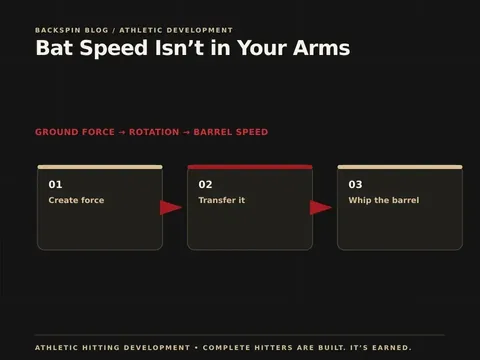
- Build force from the ground up.
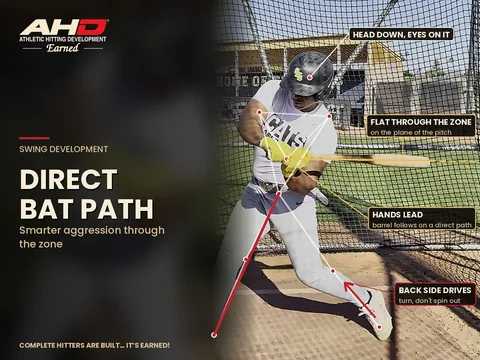
- Keep the barrel in the zone.
- See it, time it, decide.
- Keep your plan under pressure.
MORE SPEED. FEWER BAD SWINGS.
3. The AHD definition of controlled damage
- Build forceUse the ground, stay athletic and sequence the swing: ground, hips, core, then hands.
- Keep the barrel in the zonePower without a playable bat path doesn’t travel. Mechanically Advantaged Angles keep the barrel on plane longer.
- Train the processorSee It → Recognize It → Time It → Decide → Attack It.
- Keep your plan under pressureOne bad pitch doesn’t make you abandon the next good one.
4. What to train this week
Run two five-pitch rounds. In Round 1, call the pitch you’re hunting before it’s thrown: “fastball, middle-in.” You can only swing at a pitch that matches the plan. In Round 2, keep the same plan and score the quality of each swing: on time, balanced, barrel through the zone.
The hitter earns a point for a good take, a point for a good swing decision and a point for a hard ball in the intended window. Don’t reward a bad swing that happens to find grass. Train the process that creates repeatable damage.
5. Where SwingChecker™ fits
SwingChecker™ helps find whether a movement or bat-path priority is keeping a hitter from being on time and powerful. It can’t tell you whether he chased. Use SwingChecker™ for the swing and a decision scorecard for the at-bat. Complete hitters need both.
We want hitters to swing hard, with control. More force, a better barrel, a better plan and a calmer mind. That’s harder without wilder.
Quick answers
Does more bat speed mean more strikeouts?
Not if decisions improve with it. Zack Gelof posted his best bat speed and his best contact rate in the same season while swinging less often.
What does an aggressive hitter really look like?
Ready early for his pitch in his damage zone and willing to let the pitcher’s pitch go. Aggression is intent on the right pitch, not swinging at everything.
How do I train plate discipline in practice?
Call the pitch you’re hunting before it’s thrown, only swing at pitches that match, and score good takes and good swing decisions, not just hits.
Can SwingChecker tell if my hitter chases?
No. SwingChecker™ looks at the swing. Use a decision scorecard in live rounds to track chases and takes.
What does controlled damage mean in hitting?
It’s swinging hard with control. Build force from the ground up, keep the barrel in the zone, train the processor and keep your plan under pressure.
Source: FanGraphs, “Can We Trust These Five Breakout Hitters From 2026?” (October 2026). MLB examples illustrate a principle; they don’t prove a one-size-fits-all swing change. More breakdowns in MLB Breakdowns and Swing Development.
Don’t collect drills. Build a complete hitter.
Complete Hitters Are Built… It’s Earned!
This article is part of the AHD guide Pitch Recognition & Timing. Start there for the full picture and every related article.