By BK, Athletic Hitting Development
Complete Hitters Aren’t Born. They’re Built… and Earned.
Key takeaways
- Real baseball is strikes, line drives, bunts, moving runners, stolen bases and good defense, and the two 2026 World Series teams play it.
- The 2026 Rays had the lowest strikeout rate in the Majors; both World Series teams stole 160+ bases.
- Power still matters. What doesn’t work is a lineup that only knows one way to score.
- Young hitters should be able to drive the ball, handle two strikes, bunt, run and play defense. That’s a complete hitter.
Real baseball is back. The beautiful game of pitchers throwing strikes, hitters hitting line drives, bunting, moving runners, stealing bases and playing good defense is finally coming back, and the 2026 Rays and Brewers are the proof.
Real baseball is back. The 2026 Rays and Brewers reached the World Series with strike-throwing pitching, contact, line drives, speed and defense instead of relying only on home runs and strikeouts. Young hitters should build that complete game.
Train it: Complete Hitter Masterclass → Free tool: At-Bat Approach Trainer →For about a decade we got what I call “arena-baseball.” Home runs, strikeouts, pitchers throwing balls instead of attacking the zone. Everything opposite of what I just described took over the game. It was a boring product, built by people who aren’t baseball people.
Then look at this year’s playoffs. Look at who is playing for a ring. Real baseball is back.
1. What Do I Mean by “Real Baseball”?
I’ve spent 52 years playing, coaching and scouting this game. When I say real baseball, I mean the game that rewards players who know how to play, not just swing hard and hope.
- Pitchers who throw strikes and attack the zone.
- Hitters who hit line drives and put the ball in play with two strikes.
- Bunting and moving runners when the game asks for it.
- Stealing bases and taking the extra 90 feet.
- Good defense that turns balls in play into outs.
None of that is old-fashioned. It’s winning. And it’s the game I fell in love with as a kid.
REAL BASEBALL
THE BEAUTIFULGAME.
- Pitchers throw strikes
- Hitters hit line drives
- Bunt and move runners
- Steal bases
- Play good defense
IT NEVER LEFT. IT'S BACK.
2. What Is “Arena-Baseball,” and Why Did I Hate It?
Arena-baseball is three outcomes and a lot of standing around. Homer, walk, strikeout. Deep counts, pitchers nibbling, nobody running, nobody bunting, nobody moving a runner from second to third with nobody out.
It trickled all the way down. I watched travel ball and high school hitters copy it: big launch, huge leg kick, and a strikeout was “no big deal.” Kids who couldn’t lay down a bunt or hit behind a runner because nobody ever asked them to.
Home runs, strikeouts, balls instead of strikes… everything opposite of real baseball took over the game.
Here’s where I want to be clear: I LOVE power. Every AHD hitter trains to hit the ball hard. What I hated was a game that only knew one way to score, and a generation of hitters taught that the only swing that counts is the one that leaves the yard.
3. How Did the Rays and Brewers Prove It in 2026?
Look at the two teams in the World Series.
The Rays made a choice to become a contact offense. They had MLB’s lowest strikeout rate (18.8%) and lowest whiff rate, after more than a decade in the bottom half of the league in strikeout rate. They stole 164 bases, tied for second in the Majors, and they won the American League’s best record.
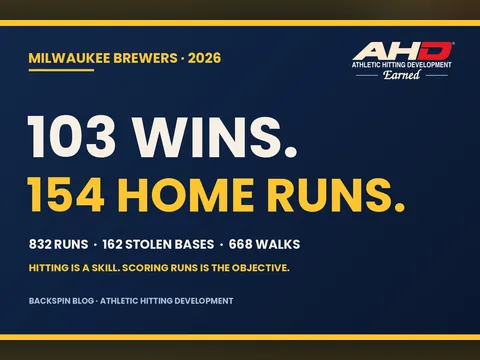
The Brewers finished with the best record in baseball, 103–59. Their lineup works walks and doesn’t swing and miss very often. They are MLB’s fastest team, stole 162 bases, and seven different players stole at least 11.
Both teams have pitchers who pound the zone and deep bullpens. Both manufacture runs. Both were the two best home teams in baseball. I already wrote about why I love this Brewers team, and Milwaukee leads the Series 3–1 heading into Game 5 tonight. Whoever wins it, real baseball already won.
The two best teams in baseball put the ball in play, run, and throw strikes. That’s not an accident.
One honest note: two teams don’t prove the whole league changed overnight. But they prove it can be done at the highest level, in October, against the best pitching on the planet.
4. What Does This Mean for Young Hitters?
If you’re a high school, travel or college hitter, this is your green light to be a complete hitter. Coaches at the next level want players who can help them win a game more than one way.
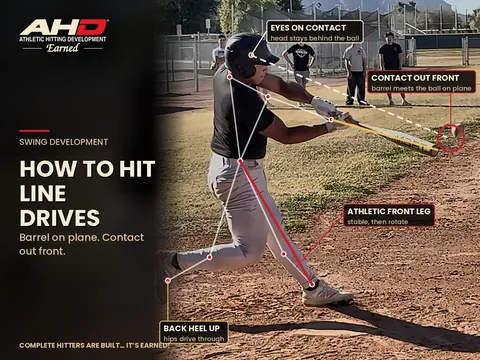
As I tell every hitter: “Hard, down the other way means we are on our way!” A hard line drive to the opposite field means you were on time and stayed through the ball, and that’s the swing that holds up against good pitching.
- Hit line drives on purposeTrain a barrel that matches the plane of the pitch, so hard contact is the plan, not luck. Start with how to hit line drives.
- Own two strikesShorten up, widen the zone a little and put it in play. Here is my two-strike approach.
- Learn to buntA sac bunt, a drag, a push. Pick the right one and execute it under pressure.
- Run the bases like it mattersRead the pitcher, take the extra base, make the defense throw.
- Decide betterKnow heater or hanger early and swing at pitches you can drive. That’s the Hitting Processor, trained daily.
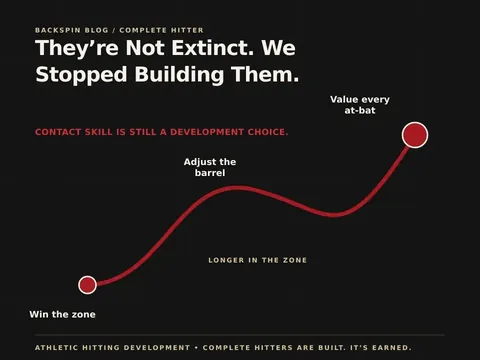
The hitters I see do this best have Mechanically Advantaged Angles (MAA) in their swing. That gives them a barrel that stays in the zone longer, so they can still do damage while putting the ball in play.
5. How Do You Train a Hitter for Real Baseball?
Not by collecting drills. You build it across the 4 Pillars of a Complete Hitter: the Swing, Strength & Explosiveness, the Hitting Processor and Mental Approach. Aggressive and athletic. Controlled violence. A swing that can hit the ball hard and adjust.
The small game counts too. Our Bunting & Small Ball course teaches the bunts and situational hitting most hitters never get taught anymore. The Complete Hitter Masterclass puts all 4 pillars together in 24 daily lessons.
And it starts with effort and preparation. “Two choices: A. Do everything in your control. B. Anything but A.” Moving a runner, running hard on a ground ball, taking a walk instead of chasing: those are all in your control.
Not sure where your hitter stands? Take SwingChecker™. It’s free, about 3 minutes, and it ranks your hitter’s top priority across all 4 pillars.
THELESSON.
- Contact beats strikeouts
- Speed is a weapon
- Power is one way, not the only way
- Be a complete hitter
Complete Hitters Are Built…Earned.
Want to go deeper? Read I Love This 2026 Milwaukee Brewers Team! and How to Hit Line Drives (and Stop Popping Up or Rolling Over).
Quick answers
What is small ball in baseball?
Small ball is scoring runs without relying on the home run: bunting, stealing bases, hitting behind runners, sacrifice flies and putting the ball in play. It works best alongside a lineup that can still hit the ball hard.
Are strikeouts bad for young hitters?
A strikeout can’t move a runner or make the defense work. Young hitters should learn a two-strike approach that keeps them aggressive but puts the ball in play, because a ball in play can move runners and force the defense to make a play.
Should my son still try to hit for power?
Yes. Power is a real weapon and every AHD hitter trains to hit the ball hard. The goal is a hitter who can drive the ball and also handle two strikes, bunt and run, not a hitter with only one way to help the team.
How did the Rays and Brewers win in 2026?
Both teams paired strike-throwing pitching with contact, speed and good defense. The Rays had the lowest strikeout rate in MLB, and both teams stole more than 160 bases during the regular season.
Sources: MLB.com: Explaining the Rays’ contact-oriented approach in 2026 (Sept. 29, 2026) · MLB.com: Brewers, Rays stolen base potential at the 2026 World Series (Oct. 22, 2026) · Dodger Blue: 2026 World Series schedule, Rays vs. Brewers (Oct. 19, 2026) · TVLine: How to watch the 2026 World Series · SeatGeek: Brewers vs. Rays World Series preview · MLB.com: Rays win World Series Game 4 (Oct. 28, 2026)
Don’t collect drills. Build a complete hitter.
Complete Hitters Aren’t Born. They’re Built… and Earned.