By BK, Athletic Hitting Development
Complete Hitters Are Built… It’s Earned!
Key takeaways
- To hit line drives, get the barrel on the plane of the pitch early, keep it there through the zone and meet the ball at the right contact point for its location.
- Attack angle in plain English: the barrel should be traveling slightly up through the ball, matching the pitch, not chopping down or scooping hard up.
- Pop-ups usually come from being late, dropping the back side or swinging under a high pitch; ground-ball rollovers usually come from being early, reaching out front or pulling off.
- Fix the cause, not the result. Telling a kid to “swing down” or “get it in the air” usually trades one problem for the other.
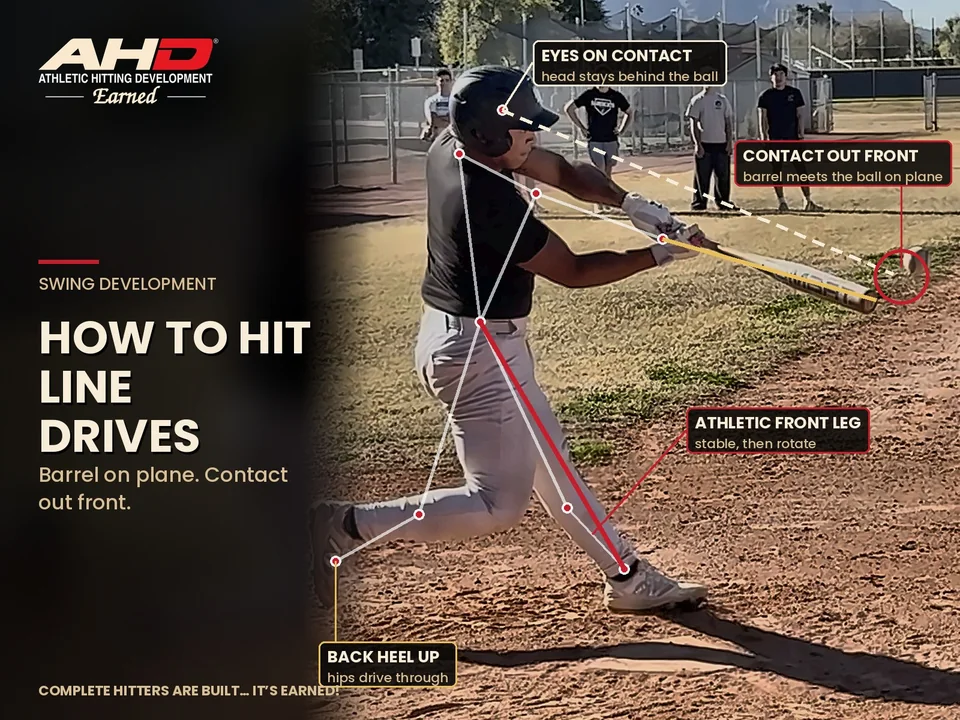
To hit line drives, get the barrel on the plane of the pitch early, keep it there through the hitting zone and meet the ball at the right contact point for where it’s pitched. Pop-ups and rolled-over grounders both come from missing that plane or that contact point.
To hit line drives, get the barrel on the plane of the pitch early and meet the ball at the right contact point: out front for inside pitches, deeper for outside ones. Pop-ups usually mean late or under it; rolled-over grounders usually mean early or reaching.
Train it: Swing Structure & Mechanics →Every parent has watched it: a great-looking swing that produces a sky-high pop-up, then a two-hopper to short. Same kid, same at-bat.
The good news is those two results usually come from the same few causes. Here’s what a line-drive swing actually does, why hitters miss it, and the drills I use to fix it.
1. How do you hit line drives consistently?
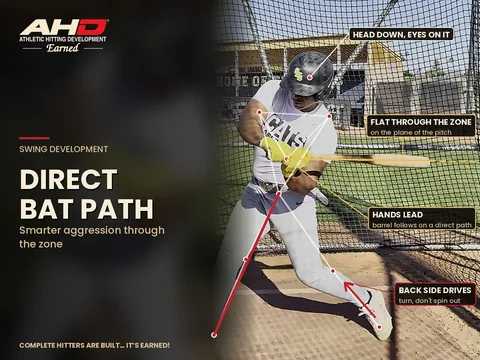
A line drive happens when the center of the barrel meets the center of the ball with the bat traveling on, or just slightly under, the path of the pitch. Get two things right and you’ll see more of them: barrel on plane and contact point.
MLB’s Statcast sorts batted balls by launch angle, the vertical angle the ball leaves the bat. It’s a useful way to picture the target:
| Batted ball | Launch angle (Statcast) | What it usually means |
|---|---|---|
| Ground ball | Lower than 10° | Barrel on top of the ball, often early or rolled over |
| Line drive | 10° to 25° | Barrel on plane, squared up |
| Fly ball | 25° to 50° | Slightly under the ball |
| Pop-up | Higher than 50° | Well under the ball, often late |
You don’t need a sensor to use this. Watch where his misses go. If most are on the ground, he’s on top of it. If most are in the air and weak, he’s under it. That tells you which section below to read first.
LINE DRIVES
ON PLANE.ON TIME.
- Barrel matches the pitch
- Slightly up through the ball
- Inside: out front
- Outside: let it travel
SQUARE IT UP
2. What is attack angle in baseball?
Attack angle is the direction the sweet spot of the bat is moving, up or down, at the moment it hits the ball. Statcast defines it that way and lists 5° to 20° as the ideal range.
In plain English: the pitch is coming in on a slight downward angle, so the barrel should be moving slightly UP to meet it. When the two paths match, the barrel stays in line with the ball longer. That gives him more room for error on timing, which is where most line drives are won.
Match the plane. Stay in the zone longer.
This doesn’t mean “uppercut.” A barrel that swoops steeply up only meets the ball at one tiny spot. Neither does it mean “swing down,” which puts the barrel on top of the ball. Good hitters get the barrel on plane early and keep it there. AHD hitters build Mechanically Advantaged Angles (MAA) so the body puts the barrel there without forcing it. For the full picture of path and positions, read direct bat path.
3. Why does my son keep popping up?
Pop-ups mean the barrel got under the ball. These are the usual reasons, most common first.
- He’s late. The ball gets deep, the barrel is still rising and catches the bottom half. Start the load earlier.
- The back shoulder drops. He collapses onto the back leg trying to lift the ball, and the barrel dives under the pitch.
- He’s swinging at the high pitch. Fastballs above the hands are tough to get on top of; often the fix is NOT swinging. See how to hit a high fastball.
- The barrel drops early. The bat falls behind him before he turns, so it has to scoop up through the zone.
- He’s trying to hit home runs. Swinging for the fences makes the path steep. Line drives come first; power comes from squaring them up harder.
When he does want more distance, our how to hit for power post covers it the right way: bat speed and strength on a good path, not a bigger uppercut.
4. Why does he keep hitting ground balls?
Weak grounders, especially to the pull side, usually mean he’s rolling over: the top hand turns over too soon and the barrel comes across the top of the ball.
- He’s early. Out on his front foot, he meets the ball too far out front where the barrel is already turning over. Common against changeups.
- Reaching for the outside pitch. Outside pitches should be hit deeper; reaching out front for them produces rollovers to the pull side.
- Pulling off. The front shoulder and head fly open, dragging the barrel across the ball. Often tied to stepping in the bucket.
- Chopping down. He’s been told to “swing down on it,” so the barrel is on top of the ball from the start.
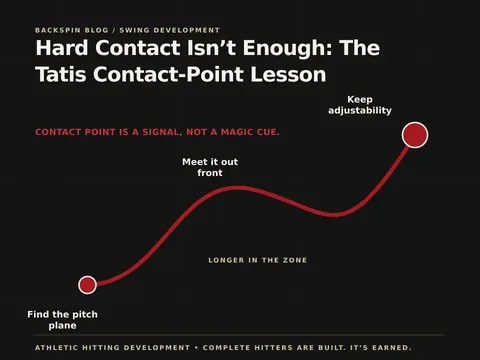
Contact point is the big fix here. Inside pitches are hit farther out front, outside pitches deeper, closer to the plate. Learning to let the ball travel and use the middle of the field is covered in barrel behind the hands and our contact point lesson. If changeups are causing the rollovers, read how to hit a changeup.
5. What drills help you hit more line drives?
Don’t collect drills. Pick a few that train the plane and the contact point, film them, and do them often. Ten to fifteen minutes a day is plenty, as long as every swing has a target and a purpose.
- Two-tee drill.Set one tee at the contact point and a second tee a few inches behind it, slightly lower; he hits the front ball without touching the back tee, which trains a barrel that stays on plane instead of chopping or scooping.
- Line-drive target.Hang a target or tape a line on the net about head-high; on the tee, every miss below it is a ground ball and every miss far above it is a fly ball. Count hits in the band out of 10.
- Contact-point tees.Move the tee: out front for the inside pitch, deeper for the outside pitch; 5 swings each, middle of the field.
- Firm front toss up the middle.Short, firm tosses with a goal of hard line drives back through the middle; anything pulled on the ground means he was early or reaching.
- Mixed-speed toss.Mix firm and slower tosses so he learns to stay back on the slow one without rolling over.
Line drives against live pitching also need timing, so pair this with how to hit a fastball. For age-appropriate versions, see hitting drills for 12-year-olds, and for the whole swing in order, how to hit a baseball.
Film from the side and from behind, then run the free SwingChecker to find his top priority across the 4 pillars. The Swing Structure & Mechanics course builds a path that stays on plane, and if you want me breaking down his swings and game at-bats directly, that’s our online hitting instruction.

THELESSON.
- Pop-ups: late or under it
- Grounders: early or rolling over
- Fix the cause, not the result
- Film it, then fix one thing
Complete Hitters Are Built…Earned.
Want to go deeper? Read A Direct Bat Path Is Not Enough and Stepping in the Bucket: Why It Happens and the Fix.
Quick answers
Should you swing down to hit line drives?
No. Swinging down puts the barrel on top of the ball and produces ground balls. The barrel should match the plane of the pitch, which means traveling slightly up through contact.
What launch angle is a line drive?
MLB’s Statcast classifies a line drive as a batted ball with a launch angle of 10 to 25 degrees. Below 10 is a ground ball, and above 25 is a fly ball or pop-up.
Why do I hit the bottom of the ball?
Usually because you’re late, your back shoulder drops, or your barrel falls behind you and scoops up. Starting your load earlier and keeping your posture through the turn are the first fixes.
Is it better to hit line drives or fly balls?
For most young hitters, hard line drives are the goal because, in my experience, they turn into hits most often. Power comes from squaring line drives up harder, not from lifting the ball on purpose.
Sources: MLB.com Statcast glossary: Launch Angle (batted-ball types) · MLB.com Statcast glossary: Attack Angle
Don’t collect drills. Build a complete hitter.
Complete Hitters Are Built… It’s Earned!
This article is part of the AHD guide Baseball Swing Mechanics. Start there for the full picture and every related article.