By BK, Athletic Hitting Development
Complete Hitters Are Built… Not Given. Earned!
There is something baseball and softball teach better than almost anything else:
Baseball and softball always give you another chance, and your last at-bat doesn’t own this one. Treat the last pitch as information, not baggage, keep preparing, and compete in the next at-bat.
Train it: Mental Approach Masterclass →You can struggle badly—and still get another chance.
You can strike out. You can go 0-for-4. You can make an error. You can have a terrible weekend. You can slump for a month. You can go through a season that does not look anything like the player you believe you are.
And then the game puts you back in the batter's box.
The game does not ask what happened five minutes ago. It asks: what are you going to do with this pitch?

BASEBALL AND SOFTBALL TEACH THIS
ANOTHERCHANCE.
- You can strike out.
- You can go 0-for-4.
- You still get another at-bat.
STRUGGLE BADLY. STILL GET UP.
Even the best hitters in the world struggle
Young hitters need to understand this because highlights can lie to you.
Professional hitters are not professional because they never struggle. They struggle against the best pitching on earth. They get beat by velocity. They chase breaking balls. They lose their timing. They make adjustments that do not immediately work. They go through stretches where the box score gives them very little reassurance.
The difference is not an immunity to failure. The difference is their ability to keep preparing, keep learning and keep competing long enough for another opportunity to arrive.
Austin Riley: a reminder, not a fairy tale
A recent Sports Illustrated story used an Austin Riley big moment to make an important point: an elite player can endure a difficult stretch and still be asked to deliver in a huge moment.
Official MLB game logs provide a perfect snapshot of that reality. On September 23, 2026, Riley hit a game-tying home run against Cincinnati. The next night, he homered again. Those swings did not erase every difficult at-bat that came before them. They showed why a hitter has to remain available for the next one.
That is redemption in hitting.
Not pretending the struggle never happened. Not magically deleting the strikeouts. Not proving that one swing fixes everything.
Redemption means the struggle does not get the final word.
Your previous at-bat does not own this one
You struck out last time.
Okay.
What does that have to do with the ball currently traveling toward home plate?
Almost nothing—unless you carry the previous at-bat into this one.
The pitcher does not get bonus credit because you chased a slider two innings ago. The umpire's call from the third inning is not part of the next pitch. That ugly swing is already gone.
Your attention belongs here:
If your brain is still arguing with the last at-bat, worrying about your average or trying desperately not to fail again, you are spending processing power on a pitch that no longer exists.
YOUR LAST AT-BAT DOESN'T OWN THIS ONE
LAST PITCH ISINFO.
- Not baggage.
- Take the lesson.
- Give the next pitch everything.
0-FOR-3 CAN BECOME 1-FOR-4.
0-for-3 can become 1-for-4
Hitters often decide too early what kind of day they are having.
Three bad at-bats become: Today is terrible.
But then the seventh inning arrives. Runners are on second and third. Your team needs one swing.
Nobody needs you to rewrite your first three at-bats. They need you to compete in the fourth one.
An 0-for-3 day can still become a 1-for-4 day with the swing everybody remembers.
A difficult tournament can still contain the biggest at-bat of the weekend. A bad week can still end with a great decision. A disappointing season can still hand you a moment you have spent years preparing for.
That is why a hitter cannot emotionally leave the game before the game is over.
The best players do not get to skip failure
This is where highlights create a dangerous illusion for young players.
You see the home run. The bat flip. The dogpile. The interview. The championship.
You do not see enough of the 0-for-18, the missed fastball, the ugly strikeout, the video review, the adjustment that took three weeks, the early work, the hotel-room frustration or the uncertainty that had to be carried into another day.
Great hitters are not escaping the cycle.
Prepare. Compete. Learn. Adjust. Prepare again.
They are simply learning how to live inside that cycle better and longer.
Redemption has a price
You do not know when the next opportunity is coming.
That means you have to continue preparing before you know whether the game is going to reward you.
You cannot decide in the eighth inning that now you would like your confidence back. You cannot suddenly build six months of strength in the on-deck circle. You cannot manufacture pitch recognition because this at-bat feels important.
The work has to exist before the opportunity arrives.
Discipline and redemption are connected.
The disciplined athlete keeps building while results are uncomfortable. Then, when the game says “Here. One more chance.”, that athlete has something real to trust.
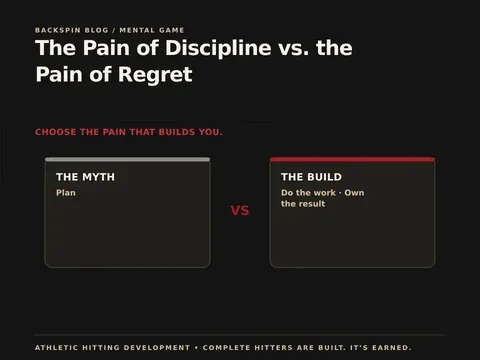
Read next: The Pain of Discipline vs. the Pain of Regret →
Heater, Hanger: do not turn redemption into hero-ball
Another chance does not mean you have to save your season with one swing.
That mindset usually creates even more pressure.
Simplify the job.
- What is the situation?
- What heater are you hunting?
- Where do you do damage?
- What mistake pitch can you adjust to?
Heater, Hanger.
Anticipate the heater you want. Recognize the mistake. Adjust when necessary. Attack the pitch you prepared for.
Your job is not to manufacture a movie ending. Your job is to make a good decision and put a good swing on a pitch you can handle.
Sometimes that is enough to create the movie ending.
DON'T TURN IT INTO HERO-BALL
HEATER.HANGER.
- Know the situation.
- Hunt your heater.
- Recognize the mistake.
SIMPLIFY THE JOB.
True confidence is not “I know I will succeed”
Nobody knows that.
A hitter can make the correct decision, hit the ball 100 mph and still make an out.
Real confidence is different:
I have prepared for another opportunity.
You know your plan. You know the work you have done. You know what the last at-bat taught you. You know how to reset. And even after failure, you remain willing to attack again.
That is confidence built on evidence instead of emotion.
What if you fail again?
You might.
That is hitting.
You might strike out again. You might smoke a line drive directly at the shortstop. You might do almost everything right and receive nothing statistically for it.
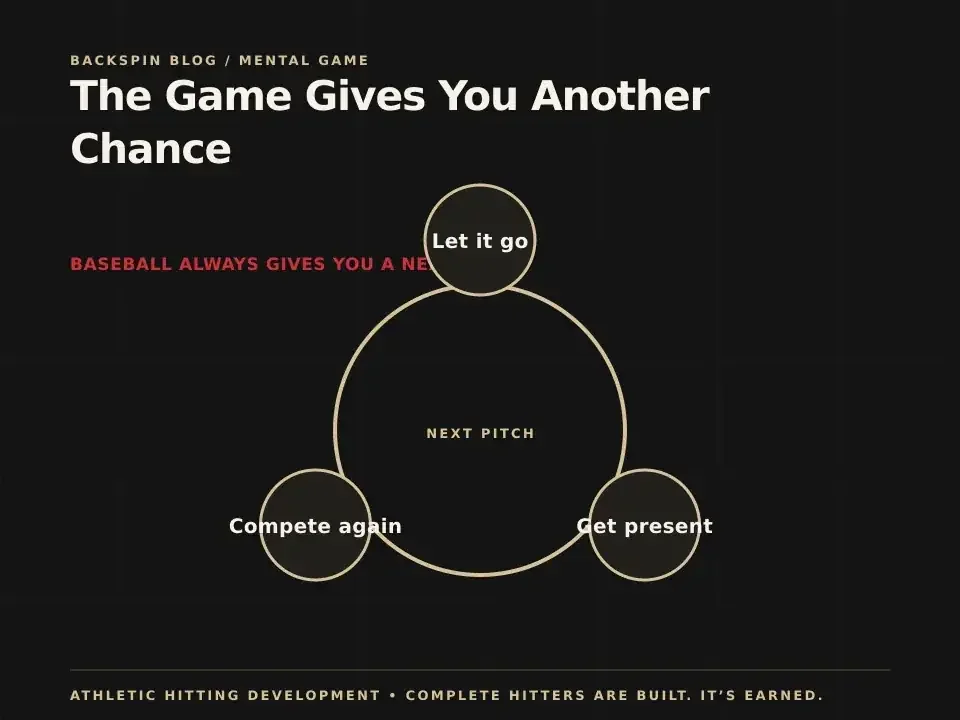
Then the process starts again.
Reset
The last pitch is information, not baggage.
Learn
Take the useful lesson without turning one result into your identity.
Prepare
Keep building the swing, athlete, processor and mental approach.
Compete again
When the next pitch arrives, give it your full attention.
The game does not owe you redemption
This matters.
Hard work does not guarantee a walk-off home run. Baseball and softball do not promise anyone a championship, a scholarship or the perfect final chapter.
That is exactly why preparation matters.
Redemption is not guaranteed.
But another opportunity often is:
- another pitch,
- another at-bat,
- another game,
- another weekend,
- another practice,
- another chance to become a better hitter than you were yesterday.
For the young hitter who is struggling right now
You are going to struggle at some point. That is not pessimism. That is the game.
Eventually there will be pitching good enough to beat you. There will be stretches when timing feels wrong. There will be teammates who look better. There will be moments when you are embarrassed. There may be a point when you wonder whether you are good enough.
None of that means the story is finished.
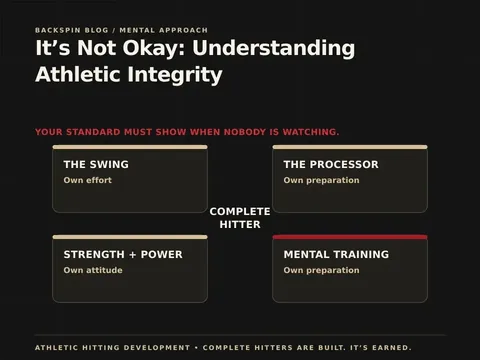
All four pillars prepare you for the next chance
The swing gives you a movement solution. Strength and explosiveness give you physical capacity. The processor helps you gather and act on information. Mental training helps you remain available after failure.
Redemption is rarely one skill.
It is the complete hitter still being ready when the moment returns.
THELESSON.
- Reset.
- Learn.
- Keep preparing.
- Build all four pillars.
- Stay ready.
Complete Hitters Are Built…Earned.
Do not let a bad chapter write the ending
A big swing does not erase a difficult stretch.
It proves something more useful:
A difficult stretch does not prevent a great moment.
You are not guaranteed redemption.
But you can stay ready for it.
Build the swing. Build the athlete. Build the processor. Build the mental approach. Keep preparing. Keep competing.
And when the game puts you back in the batter's box—
Quick answers
How do hitters get over a bad at-bat?
Your last at-bat does not own this one. The last pitch is information, not baggage. Reset, take the useful lesson and give the next pitch your full attention. If your brain is still arguing with the last at-bat, you are wasting focus on a pitch that no longer exists.
Do professional hitters struggle too?
Yes. Pros get beat by velocity, chase breaking balls, lose timing and go through long stretches with little to show for it. Highlights hide that. The difference is they keep preparing, learning and competing long enough for the next opportunity to arrive.
What is real confidence for a hitter?
Real confidence is not knowing you will succeed. Nobody knows that. It is knowing you have prepared for another opportunity. You know your plan, you know your work and you know how to reset. Confidence built on evidence holds up better than confidence built on emotion.
How do I stop pressing to make up for a bad game?
Don’t turn your next chance into hero-ball. Simplify the job: know the situation, hunt your heater, recognize the mistake pitch and put a good swing on a pitch you can handle.
No subscription. No login. Learn one thing, train it, and own it.
Baseball example: Inspired by Sports Illustrated's Austin Riley feature and checked against official MLB game logs from September 23–24, 2026. Read the SI story · MLB Sept. 23 game log · MLB Sept. 24 game log
This article is part of the AHD guide The Mental Game of Hitting. Start there for the full picture and every related article.