By BK, Athletic Hitting Development
Complete Hitters Aren’t Born. They’re Built… and Earned.
Key takeaways
- You can’t hit the last pitch. The reset gets a hitter back to the next one before it’s on him.
- A good reset is four steps and a few seconds: exhale, release, plan, ready. Same routine, every pitch.
- Train it in the cage. Score the routine and the decision, not just the result.
- A 2026 trial found mindfulness training partly improved focus tests in baseball players, but it didn’t measure hits. Mental work supports the swing; it doesn’t replace it.
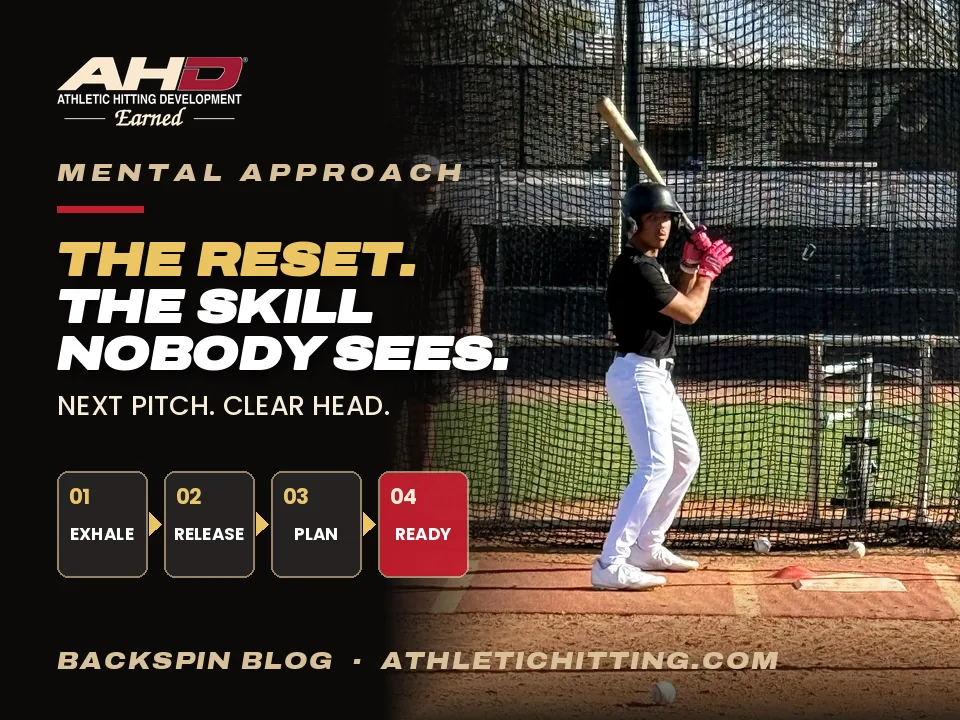
To reset between pitches, a hitter needs a routine short enough to use in a real game: exhale, release the last pitch with one word, name the next-pitch plan, and get back to an athletic ready position. Four steps, a few seconds, every pitch.
To reset between pitches, use a four-step routine: exhale, release the last pitch with one word, name the next-pitch plan, and get back to an athletic ready position. Train it in cage games so it holds up when the game speeds up.
Train it: Mental Approach → Free tool: Breathe & Reset →The last pitch can stay with a hitter for a whole at-bat. A bad call. A foul ball he should have smoked. A swing-and-miss. A line drive caught right at somebody.
Hitters carry that into the next decision, then the next, then the rest of the game. Great competitors learn a quieter skill. Nobody in the stands sees it. It’s the reset.
1. Why do hitters fall apart after one bad pitch?
Because the pitch is over and the hitter isn’t. He’s still arguing with the umpire in his head, still replaying the swing, still trying to fix his hands while the pitcher is already in the set.
The next pitch needs a clear head: see it, time it, decide, attack it. That’s the Hitting Processor, and it doesn’t work well when the brain is still busy with the last pitch.
I love this one for the bad-call moment: “Pitcher gets one, hitter gets one, umpire gets one… two of those aren’t in your favor. Roll the pole!!” The bad call is part of the game, and when the next one is your pitch, you still swing it.
You can’t hit the last pitch. You can only hit the next one.
BETWEEN PITCHES
THERESET.
- Exhale
- Release: “next”
- Plan: name the job
- Ready: athletic and committed
FOUR STEPS. A FEW SECONDS.
2. What is a good between-pitch routine for hitters?
A reset is not a speech. It has to fit between pitches, and it has to be the same every time so it still works when the heart rate is up. Here’s the one I teach:
- Exhale.One long breath out. Let the last pitch leave with the air.
- Release.One word to yourself: “next,” “compete” or “clear.” Pick one and keep it.
- Plan.Name the next job in three words or fewer: “see it up,” “middle,” “yes in my lane.”
- Ready.Back to an athletic, committed posture, loaded early and ready to be aggressive and athletic.
That’s it. No long conversation with yourself. No trying to rebuild the swing in the box. Mechanics get fixed in the cage. In the box, you compete with what you’ve built.
Practice the breath with the free Breathe & Reset tool. If you want the research on breathing for hitters, I covered a college study in Breathing Routine for Hitters. The reset also pairs with what happens before the at-bat: your on-deck circle routine sets the plan, and the reset keeps it alive pitch to pitch.
3. How do you practice a reset before game day?
Mental performance is a practice skill. If the first time a hitter uses his reset is with the bases loaded in a playoff game, it won’t be there. Put it inside the drill.
- Cage game with a reset rule. After any bad rep, a foul, a miss or a weak ball, the hitter steps out, runs the four steps and says his next-pitch plan out loud before the next ball comes.
- Score the routine, not just the result. One point for a full reset, one for a good decision, one for a hard-hit ball. A hitter can win the round without a hit.
- Add pressure on purpose. Two-strike counts, a coach making “bad calls,” a scoreboard. Train the reset when the stakes feel real.
- Time it. If the routine takes longer than the gap between pitches, it won’t survive a game. Shorten it until it fits.
Over time the hitter learns that one ugly swing doesn’t have to become an emotional spiral. That’s the whole point. A hitter who is hitting well in practice but not in games often has the swing. He doesn’t have the reset.
Here’s another one I use: “Swing at a bad pitch? No biggie. Take a good pitch to hit? Not happening.” A chase is forgivable. Reset, and don’t let it make you passive on the next pitch you can drive.
4. What should parents and coaches say after a bad pitch?
Change the language and you change the hitter. Most of what gets yelled from the stands just adds to the pile he’s already carrying.
| Instead of… | Try… |
|---|---|
| “Don’t strike out.” | “What’s your plan?” |
| “Fix that swing.” | “Reset. See one. Compete.” |
| “That was a terrible call!” | “Next pitch.” |
| “Come on, swing the bat!” | “Get your pitch.” |
Coaches, build the reset into team language so every hitter hears the same words from the dugout. I go deeper on that in how to coach the mental game.
5. Does mindfulness help baseball players hit?
Honest answer: nobody has shown it adds hits. Here’s what we do know. A 2026 randomized controlled trial in Psychology of Sport and Exercise split 34 baseball players into a 12-week mindfulness program or a control group.
The mindfulness group partly improved on tests of working memory, inhibitory control and cognitive flexibility, and showed lower levels of cortisol, a stress-related hormone. The study didn’t measure batting, so it doesn’t prove mindfulness creates more hits.
But it supports what coaches see every day: a calmer, more present player has a better chance to use his training when the game speeds up.
Mindfulness isn’t magic. A reset won’t build your Mechanically Advantaged Angles (MAA), add strength or replace daily pitch-recognition work. What it does is make the skills you’ve built more available when you’re nervous, frustrated or tired. That’s the right promise.
6. Where does the reset fit in a complete hitter?
The reset lives in the Mental Approach pillar, but it protects all four. It keeps the swing you’ve built, the strength you’ve earned and the processor you’ve trained from getting hijacked by the last pitch.
Not sure the mental side is your hitter’s biggest need? Run the free SwingChecker™. In about three minutes it ranks his top priorities across all 4 Pillars, with cues, drills and matching free lessons.
If it is, the Mental Approach course has 16 lessons, including one that builds your own reset script and one on a pressure plan. Lesson 1 is free.

THELESSON.
- You can’t hit the last pitch
- Train the reset in the cage
- Score the routine, not the result
- Mental work supports the swing
Complete Hitters Are Built…Earned.
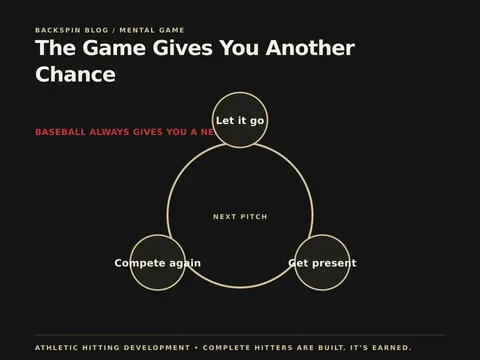
Want to go deeper? Read Breathe to Hit and The Game Gives You Another Chance.
Quick answers
How do you reset between pitches in baseball?
Use a short routine every pitch: exhale, release the last pitch with one word, name your plan for the next pitch, and get back to an athletic ready position. Practice it in the cage so it holds up in games.
How do I stop getting mad after a bad at-bat?
Give the frustration an exit. Run your reset, focus on the next pitch, and save the review for after the game when you can look at it calmly.
Does mindfulness help baseball players?
A 2026 randomized trial found a 12-week mindfulness program partly improved executive-function tests and lowered stress markers in baseball players. It didn’t measure hitting, so treat it as support for focus, not a guarantee of hits.
Does my hitter need to step out of the box to reset?
Not necessarily. The reset can happen in the few seconds he has, even while he gets the sign. What matters is that it’s short, the same every time, and fits the pace-of-play rules at his level.
Don’t collect drills. Build a complete hitter.
Complete Hitters Aren’t Born. They’re Built… and Earned.