By Athletic Hitting Development
Complete Hitters Are Built… It’s Earned!
Not because every team is going to hit .800. Not because effort guarantees a championship. Not because we should make up wild promises and call it belief.
An average team doesn’t have to accept a ceiling. Build the athlete, develop the swing, train the Hitting Processor and build the competitor, and your team finds out how good it can really be.
Train it: Camps & Clinics →1. Why “limits” makes me sick
It makes me sick because somebody, somewhere, decided that a team is supposed to be this good — and too many coaches and players quietly agree to live under that number.
“That is about as good as we can be.” “We do not have enough athletes.” “We are in a tough league.” “Those teams are just better.”
Maybe. Maybe not.
But what if your team actually develops every part that matters?
What if you have 15 hitters who get stronger, more explosive, more athletic, more coordinated and more in control of their bodies?
What if their swings become clean — not identical, but clean? Efficient movements. Good sequence. Real force. A bat that gets on plane early, stays on plane late and moves through the baseball with good angles and adjustability.
What if they learn that hitting is not only a swing?
What if they learn to See It → Recognize It → Time It → Decide → Attack It — and they train that process until it changes what happens in the box?
What if they find a mental approach that makes their good stretches longer and their bad stretches shorter?
Then what?
2. You do not need one magic answer. You need a complete system.
Most teams spend almost all their time chasing the swing. A few cues. A few drills. A different video. A new bat. More batting practice.
That is not enough.
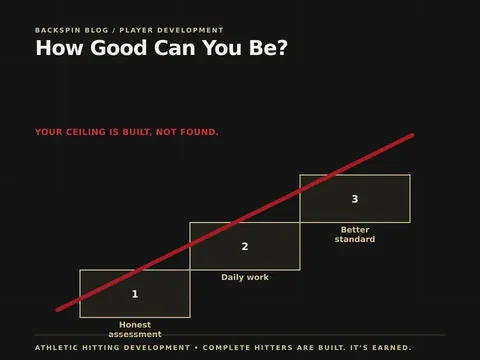
Great hitting is built, not found.
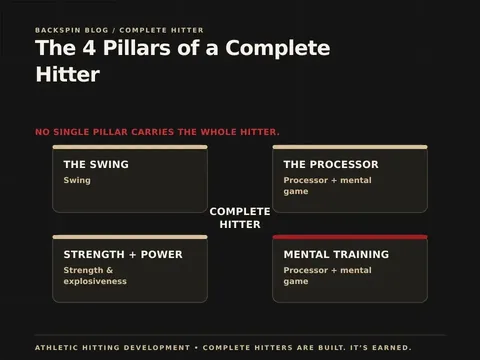
And it is built by addressing the entire hitter — all four pillars of a complete hitter.
NO BORROWED LIMITS
BUILDIT ALL.
- Build the athlete
- Develop the swing
- Train the processor
- Build the competitor
NO MAGIC. NO GUESSING.
3. 1. Build the athlete
Can your hitters create force? Can they move fast? Can they control their bodies? Can they stay athletic through contact instead of standing up, leaking, falling or losing balance?
Strength and explosiveness do not replace skill. They give skill more horsepower. Athleticism gives hitters more options. Better body control lets them repeat their movement under pressure.
The hitter who is strong, mobile, explosive and balanced has a better chance to create a powerful, adjustable swing. (Want to know where your athletes stand? Here’s what strength training should look like at every age, with benchmarks.)
4. 2. Develop the swing
Every good hitter is different. The best swings are not clones. But clean swings have things in common:
- They stay athletic long enough.
- They create force in the right sequence.
- They get the barrel into the zone early.
- They keep it through the zone late.
- They give the hitter a large margin for error on solid contact.
- They can adjust to location and speed.
That is not cosmetic. It is not “pretty” just to look pretty. It is a swing built to hit the ball more often, harder and farther.
5. 3. Train the Hitting Processor
This is where most players leave the biggest gains on the table.
The pitch is not waiting for your perfect move. You have to pick it up, identify it, time it, make a decision and attack it — fast.
See It → Recognize It → Time It → Decide → Attack It.
Train vision. Train tracking. Train pitch recognition. Train timing. Train decision-making. Use live looks. Use varied speeds. Use spin. Use uncomfortable drills. Use mental reps.
Do not just prepare players for perfect batting practice. Prepare them for a game.
The heater comes. Destroy it. The hanger shows up. Punish it.
The hitter who sees more and decides better gives the swing a real chance to work. (Start with the free 5-Minute Daily Hitting Processor Plan.)
6. 4. Build the competitor
Confidence is not pretending everything is going great.
Real confidence is earned through preparation. It is knowing you have worked. It is having a plan. It is competing through a bad at-bat, a bad inning or a bad weekend without becoming a different person.
The right mental approach does not mean players never struggle. It means their lows are shorter, their response is better and they get back to their game faster. That matters over a season.
7. What if it all connects?
What if your team throws strikes, plays defense, runs the bases and competes with energy?
What if the lineup is full of athletes who can hit, not just a couple of kids everybody hopes will come through?
What if one through nine understands that preparation matters, that the pitch matters and that every at-bat belongs to the whole team?
Now you are not waiting for a miracle. You are building a dangerous team.
Not because you talked about being special. Because you did things most teams will not do consistently:
- You built the body.
- You developed the swing.
- You trained the processor.
- You strengthened the mind.
- You competed with passion, energy and effort.
That formula can produce things people do not expect.
I have seen it. Teams do not have to look like everybody else. They do not have to accept the story written about their league, their roster, their age group or their history.
They have to get honest about what needs work — and then get after it.
8. Stop borrowing somebody else’s ceiling
Do not promise .800 as a team. Do not pretend that hard work makes the game easy.
But do not hand your players a limit before they have done the work to discover what they can become.
Build the complete hitter. Build the complete team. Address every part that affects performance. Practice with purpose. Compete hard. Have fun.
Because when a team starts raking, playing clean baseball or softball and believing in each other? That is fun.
And that is when special becomes possible.
No magic. No guessing. No borrowed limits.
Complete Hitters Are Built… It’s Earned!
9. Ready to find the first priority?
Start with SwingChecker™. It’s free, it takes about three minutes, and it ranks what is holding each hitter back across all four pillars, so you build the swing, the athlete, the processor and the competitor in the right order.
Coaching a whole team? Run the 4-pillar preseason evaluation with your roster, then build practice around what you find with the 60-minute team hitting plan.
Find what is holding your hitters back — free →

THELESSON.
- Get honest about the work.
- Practice with purpose.
- Compete hard.
- Have fun.
Complete Hitters Are Built…Earned.
Quick answers
What makes a team hit well?
Developing all four parts of the hitter, not just the swing: the athlete (strength, speed and body control), a clean and adjustable swing, the Hitting Processor (seeing, recognizing, timing, deciding and attacking the pitch) and a mental approach that shortens slumps.
Can an average team become a great hitting team?
A team does not have to accept the ceiling written for its league, roster or history. Teams that honestly assess what needs work and train every pillar consistently often outperform expectations.
Where should a coach start?
Find each hitter’s first priority. A free SwingChecker™ or a 4-pillar preseason evaluation shows which part of the hitter to train first, so practice time goes where it matters most.
Why does my team hit well in batting practice but not in games?
Most teams spend almost all their time on the swing. Train the Hitting Processor too, with live looks, varied speeds and spin, so players are prepared for a game, not just perfect batting practice.
This article is part of the AHD guide The Mental Game of Hitting. Start there for the full picture and every related article.