
By BK, Athletic Hitting Development
Complete Hitters Aren’t Born. They’re Built… and Earned.
Key takeaways
- A good athletic position is the body position that creates the most efficient combination of visual effectiveness, body control, speed and power for the task at hand.
- It is not one batting stance or one frozen pose. It is a functional position and a series of controlled movements.
- The 8 athletic hitting checkpoints: Trigger → Gather energy → Energy direction → Athletic base → Bump → Launch → Rotate/Extend → Controlled finish.
- At launch, own the 2 core MAA angles: stay INSIDE the ball and ABOVE the ball.
- The big byproduct is adjustability: the largest possible margin for error for solid contact while generating maximum useful force.
Why do we call our program Athletic Hitting Development? Because we’re not simply teaching a hitter to swing a bat. We’re developing an athlete whose body can see, move, control, accelerate and adjust efficiently enough to become a better hitter.
Athletic hitting means moving through good athletic positions so the body can see the ball, stay in control, produce usable bat speed and transfer power. At AHD it is 8 moves: trigger, gather energy, energy direction, create an athletic base, bump, launch, rotate and extend, and a controlled finish.
Train it: Complete Hitter Masterclass → Free tool: SwingChecker™ →There’s a reason I put the word ATHLETIC first. Before exit velocity, launch angle, hitting gadgets and the latest mechanical theory, there’s a more fundamental question: Can the hitter get into—and move through—good athletic positions?
1. What is a good athletic position?
A good athletic position is the body position that creates the most efficient combination of visual effectiveness, body control, speed and power for the athletic task being performed.
It is not one batting stance or one frozen pose. It is a functional position—and a series of controlled movements—that lets the hitter accomplish the job at hand.
2. Caveman athleticism: we use it in every sport and every day
Hand an athlete a sledgehammer and a tractor tire, and watch. Nobody has to teach anyone to widen the feet, load, turn the body and let the hands deliver the force. Hand an athlete an axe and a stump, and the athlete loads, shifts, turns and drives it through. That is natural Caveman athleticism, and it's already in every athlete.


We use the same moves in every sport: throwing a ball, a golf swing, a tennis forehand, a hockey slap shot, a boxer's punch. And we use them in daily activities: swinging a sledgehammer, chopping wood, shoveling, tossing a bag into the truck. Load, shift, turn, deliver.
Here's what the body is doing in each one:
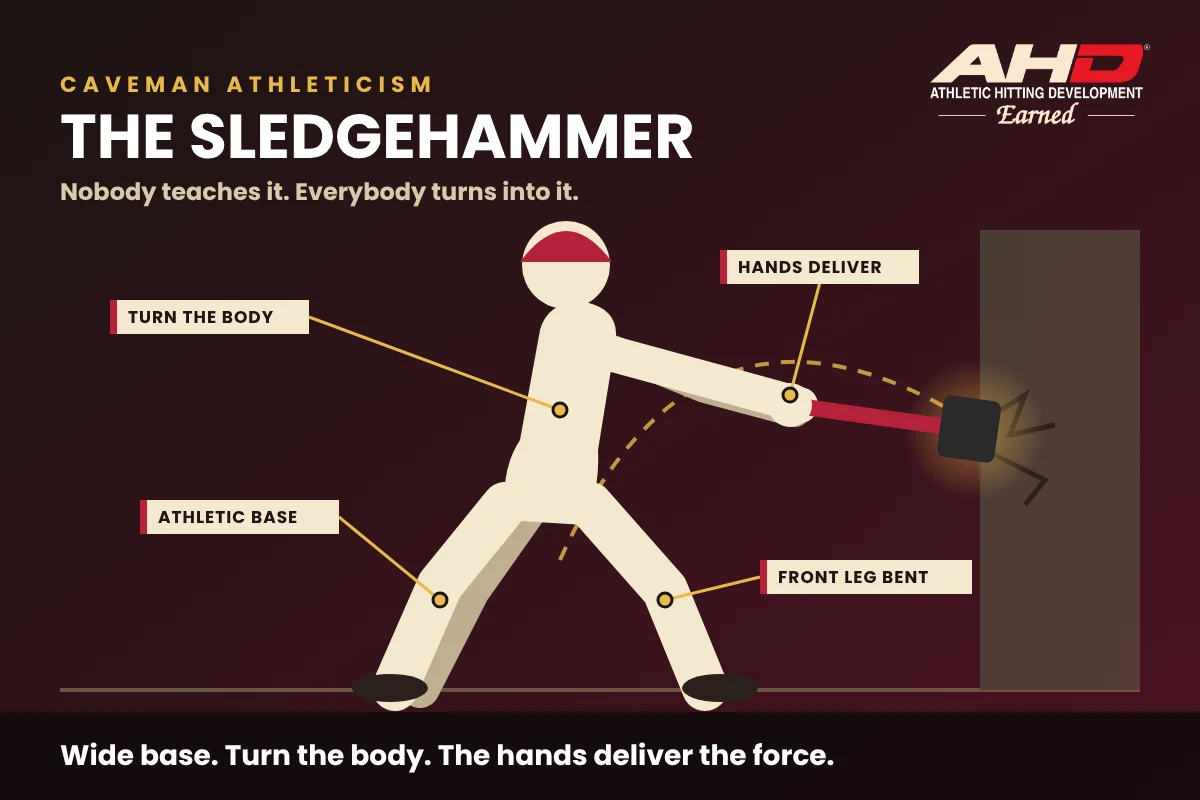
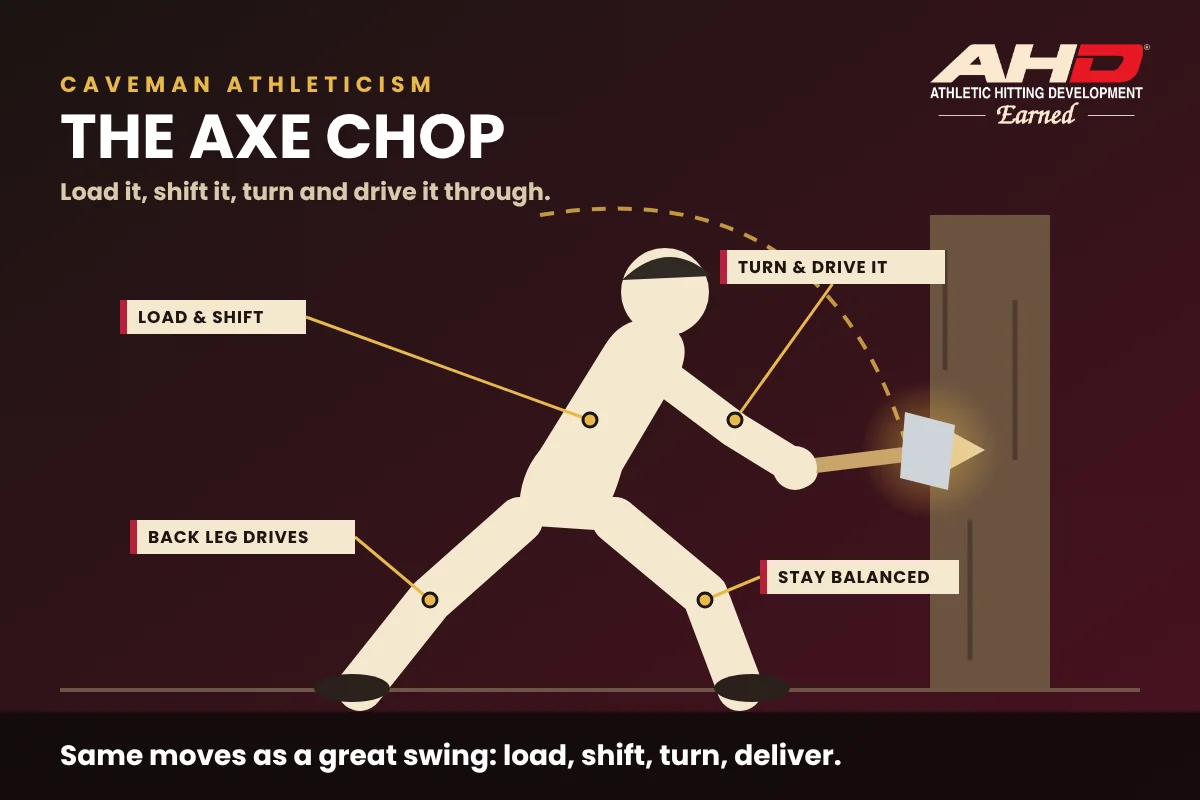
Combining your natural Caveman athleticism with modern skill and strength development is athletic hitting.
Too many hitters get coached OUT of that athleticism. They get frozen into positions, stiff front legs and robot swings. My job is to keep the caveman and add the modern skill and strength development on top of it. That's what the 8 athletic hitting checkpoints below are for.
3. The four big benefits
1. Visual effectiveness: see the baseball. Hitting starts with useful information. A functional head position and controlled body movement can help a hitter maintain an effective visual perspective on the pitcher. That does not change the hitter’s underlying eyesight, but it may help the hitter make better use of their visual skills. At AHD, our Hitting Processor is simple: See It → Recognize It → Time It → Decide → Attack It.
2. Body control: own your movement. We need the hitter to manage their center of mass, maintain functional posture, move forward and rotate without losing control. Balance doesn’t mean standing still.
Balance means staying in control while moving.
3. Speed: develop usable bat speed. Bat speed matters, but the job isn’t to swing as fast as possible in empty space. The job is to organize the body and bat so the hitter can accelerate while still finding the baseball. The best speed is usable speed.
4. Power: produce and transfer force. The hitter must develop force, coordinate movement and transfer that energy into the bat. That’s why AHD teaches Strength & Explosiveness alongside swing development. Looking athletic alone doesn’t make a hitter powerful; strength, coordination and sound sequencing matter.
4. The 8 athletic hitting checkpoints
These are the athletic hitting checkpoints I look for in every swing:
- TriggerStart the move in rhythm with the pitcher, on time, not late.
- Gather energyLoad the body and the bat so there is something to deliver.
- Energy directionPoint that energy toward the pitcher, not around the corner or up and down.
- Create an athletic baseLand in a base that lets the hitter control movement and produce force.
- The BumpA controlled forward move that keeps the hands back and options open.
- LaunchLet the bat go, with the barrel on an effective path to the baseball.
- Rotate / ExtendTurn hard through contact and extend through the ball.
- Controlled finishFinish in balance. If you can't hold the finish, you weren't in control.
Trigger. Gather. Direct. Base. Bump. Launch. Rotate and extend. Finish. THAT is athletic hitting.
These ideas go back to the teaching in my original What Every Hitter Must Know. They're still how I explain athletic hitting today.
THE 8 CHECKPOINTS
TRIGGER.GATHER. BUMP. LAUNCH.
- Trigger · Gather energy
- Energy direction · Athletic base
- The Bump · Launch
- Rotate/Extend · Controlled finish
THAT IS ATHLETIC HITTING.
5. 1–2. Trigger and gather energy
Everything starts with the trigger: the hitter begins the move in rhythm with the pitcher. Start late and every move after it gets rushed.
Then we gather energy. The body and the bat load so there is something to deliver. I've long called the loaded, prepared position the Power-Load: the body has gathered, and now it has to organize itself to move forward and attack.
- Athletic base and posture.
- Hands behind the back shoulder.
- Functional arm–torso separation.
- A back elbow that supports the intended bat path.
- Wrists and bat prepared for launch, with the knob generally oriented toward the catcher.
- A useful, stable head position.
I've also used the phrase “choke effect” to explain the relationship of the chin and front shoulder in a loaded position. The objective is not to force every athlete into the exact same geometry. The objective is to help the body and bat get organized to swing.
6. 3. Energy direction
Gathering energy isn't enough. It has to go the RIGHT way. A directionally sound load points the hitter's energy toward the pitcher, so it can be delivered through the baseball instead of leaking around the corner, up, or down.
Poor positioning before launch often creates problems the hitter must somehow fix after the swing has already begun.
7. 4. Create an athletic base
Before launch, the hitter needs a base that allows them to control movement and produce force. A useful starting guideline is a stance after the stride with the feet roughly a bat’s length apart, some functional knee flex and a slight forward athletic posture.
That distance isn’t a law. Different heights, strengths and movement styles call for adjustments. The important questions are: Can the hitter move? Can they control their center of mass? Can they rotate and adjust without falling out of position?
A narrow, unstable base makes those jobs harder. A wide but immobile base can cause problems, too. We’re looking for a functional athletic base, not a measurement contest.
8. 5. The Bump: a controlled forward move
Here is one of my favorite—and sometimes most difficult to explain—hitting concepts: THE BUMP.
The Bump is the controlled movement of the body toward the pitcher as weight and pressure begin transitioning forward. The hitter moves while maintaining a functional front leg, athletic posture and hands that stay back relative to the body, rather than rushing toward the pitch.
In the original book I described it as a small linear move before the hitter fully commits to rotating and delivering the bat. The key is control, not lunging or drifting helplessly.
Why the Bump matters. Young hitters may straighten the front leg prematurely, open their shoulders too soon, cast the hands, dump the barrel or lose posture. Those faults can narrow the hitter’s options for making solid contact. A controlled forward move can help preserve functional separation, organize launch timing and avoid premature commitment of the bat.
Buying time against off-speed pitches. Picture a hitter anticipating a fastball and getting a changeup instead. If the body has already opened, the front side has lost control and the barrel has committed too early, there may be little opportunity left to adjust. A hitter who maintains posture and control may have more options to recognize the pitch and make a late adjustment.
We are not teaching hitters to start their entire swing after the decision. The body must prepare while the pitch is in flight. We are teaching hitters to sequence preparation and commitment so they can adjust.
9. 6. Launch: turn preparation into an effective swing
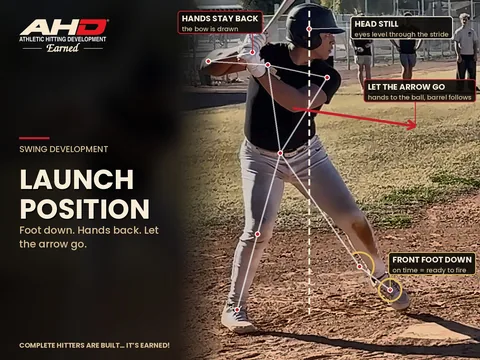
The purpose of the trigger, the gather, the direction, the base and the Bump isn't to collect pretty positions. It's to set up an explosive, coordinated launch. The hands and barrel accelerate, and the hitter delivers the bat on an effective path to the incoming baseball.
As the bat launches, the hitter has to own the 2 core MAA (Mechanically Advantaged Angles):
- Stay INSIDE the ball. The hands and barrel work inside the baseball, close to the body, instead of casting out and around it.
- Stay ABOVE the ball. The hands and barrel stay above the baseball until it's time to hit it, instead of dropping under it early.
Inside and above. Those are the 2 core MAA angles every athletic hitter has to own.
Get inside and above, and the barrel can turn on an effective path into the baseball. Lose either one, and the hitter is trying to fix the swing after it's already started.
10. 7. Rotate and extend
Rotation is necessary. The hips and torso turn hard through contact. The goal is not to eliminate rotation but to avoid mistiming it or losing useful posture and barrel control.
Then extend through the baseball. The barrel keeps working through the hitting zone instead of cutting off early, which gives the hitter a longer window for solid contact.
11. 8. A controlled finish
The finish tells you the truth about everything before it. A hitter who swings aggressively and still finishes in balance was in control the whole way. A hitter who falls off, spins out or can't hold the finish lost control somewhere earlier in the move.
That's controlled violence: aggressive and athletic, but in control from the trigger to the finish.
12. The big byproduct: adjustability
Pitchers change speed, height and location. That is why I don’t want a hitter who can only produce the perfect practice swing on a tee. I want an athlete who can handle uncertainty.
Good movement positions support rhythm, tempo, visual effectiveness, barrel accuracy and the ability to make adjustments. No single move guarantees any of those outcomes, but better athletic control provides a foundation for developing them.
My goal: the largest possible margin for error for solid contact while generating maximum useful force and an effective bat-to-ball angle.
13. Three drills to start building it
- Mirror drillWork through the trigger, the gather, the athletic base and hand position. Learn what a controlled setup and launch preparation feel like.
- Gather and launch drillRehearse swinging from a loaded, directionally sound position so the athlete can feel the relationship between the base, posture and bat.
- Bump and hold drillMake a small forward move without rushing the hands or losing front-leg control. Once the movement is understood, blend it into a continuous swing. The pause belongs to the learning drill—not game-time timing.
Not sure where your hitter’s base, load or Bump is breaking down? Run the free SwingChecker™ and start with the top priority.
14. Why the whole AHD system matters
These movement lessons live inside four connected parts of complete hitter development:
- The Swing. Movement, sequence, bat path and adjustability.
- Strength & Explosiveness. Force, speed, power and athleticism.
- The Hitting Processor. See It → Recognize It → Time It → Decide → Attack It.
- Mental Training. Confidence, approach, focus and resilience.
We use science, experience, observation and common sense to figure out what actually helps hitters. No magic stance, no secret sauce, and no need for every athlete to imitate the same swing. That’s the whole idea behind the Complete Hitter Masterclass.
THELESSON.
- See the baseball
- Own your movement
- Usable bat speed
- Adjust when the pitch changes
Complete Hitters Are Built…Earned.
15. The bottom line
Trigger, gather energy, and point it in the right direction. Create an athletic base. Bump to organize the forward move and preserve options. Launch inside and above the ball, rotate and extend through it, and finish under control.
That’s why I call it ATHLETIC Hitting Development. We’re not just teaching a swing. We’re developing athletes who can control their bodies, track the baseball, produce usable bat speed, generate power and adjust when the pitch doesn’t go exactly as planned.
GREAT HITTING IS BUILT, NOT FOUND.
Want to go deeper? Read Let the Arrow Go: Launch Position Timing and Center of Mass in Hitting: Control the Body, Control the Swing.
Quick answers
What is a good athletic position in hitting?
It is the body position that creates the most efficient combination of visual effectiveness, body control, speed and power for the task. It is a functional position and a series of controlled movements, not one batting stance or frozen pose.
What is the Bump in the baseball swing?
The Bump is a controlled movement of the body toward the pitcher after the athletic base is set, with a functional front leg, athletic posture and hands that stay back. The key is control, not lunging or drifting.
What are the 8 athletic hitting checkpoints?
Trigger, gather energy, energy direction, create an athletic base, the Bump, launch, rotate and extend, and a controlled finish. Each move sets up the next one.
How far apart should a hitter's feet be?
A useful starting guideline is roughly a bat's length apart after the stride, with some knee flex and a slight forward posture. It is not a law; height, strength and movement style call for adjustments.
Don’t collect drills. Build a complete hitter.
Complete Hitters Aren’t Born. They’re Built… and Earned.