
By BK, Athletic Hitting Development
Complete Hitters Aren’t Born. They’re Built… and Earned.
Key takeaways
- The goal isn’t to keep your center of mass still. It’s to control where it goes, how fast it moves and what positions it lets you create.
- Controlled movement is what we’re after — not the absence of movement.
- Moving more body mass forward doesn’t automatically create power. Usable force comes from movement, timing, leverage and sequencing working together.
- It’s awfully difficult to make an adjustable swing with an uncontrollable body.
When you control your center of mass, you control your swing. Great hitters aren’t the ones who stand still — they’re the ones who can move aggressively forward, land in a position they can hit from, and still adjust when the pitcher messes with their timing.
Center of mass is where your body’s mass is concentrated, around the pelvis in an athletic stance. Hitters shouldn’t keep it still — they should control its forward movement, so they can land in a hittable position, produce usable force and still adjust to off-speed.
Train it: Swing Structure & Mechanics →I’ve watched a lot of hitters who can absolutely crush a baseball in batting practice but struggle to find the barrel when the game starts. They’re strong enough. Their bat speed is good. Their swings might even look pretty darn good on video.
But something changes when a pitcher starts messing with their timing. They get out front. They drift. They fall toward the plate. They lose posture. Their hands start making desperate last-second adjustments because their bodies have already put them in a bad position. And sometimes the real problem started well before the bat ever moved. It started with how they controlled their center of mass.
1. First, what is center of mass?
Your center of mass is the point where your body’s mass can be considered concentrated for purposes of analyzing its motion. In a relatively neutral athletic position, it’s generally somewhere around your pelvis and lower torso. But that location isn’t fixed.
Raise your arms, lean forward, lift your front leg, rotate your torso or change your posture, and your center of mass shifts. That’s important because a baseball or softball swing isn’t a stationary movement. You’re gathering, moving forward, landing, rotating and delivering the barrel to a moving ball. Your center of mass moves throughout that sequence.
The objective isn’t to keep it perfectly still. It’s to CONTROL it.
Control where it goes, how fast it moves and what positions your body can create along the way. That’s a big difference.
2. Great hitters don’t just have balance. They control it.
Coaches have been telling hitters to stay balanced forever. And they’re right. But I think we need to do a better job explaining what balance actually means in a swing.
- Balance doesn’t mean standing perfectly upright.
- It doesn’t mean keeping your weight evenly split between your feet.
- And it certainly doesn’t mean avoiding aggressive movement.
A hitter can move forward aggressively and still maintain excellent body control. Another hitter can barely move forward at all and still be poorly balanced. What matters is whether the athlete can manage the movement of the body while keeping the ability to produce force, rotate and adjust. That’s the aggressive and athletic hitter we build at AHD — controlled violence.
THE AHD STANDARD
CONTROLTHE MOVE.
- Aggressive forward move
- Land where you can hit from
- Rotate without falling off
- Barrel still available late
CONTROLLED, NOT STILL
Controlled movement is what we’re after. Not the absence of movement.
3. The forward move: where hitters get into trouble
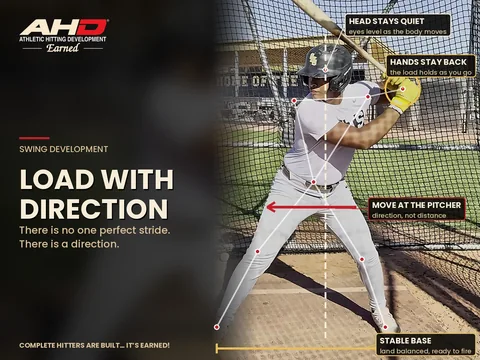
When a hitter gathers and begins moving toward the pitcher, their center of mass generally moves forward. Nothing wrong with that. That forward movement is part of how many good hitters organize their swings. (There’s no one perfect stride, either.)
The trouble comes when the hitter can’t control that movement. Maybe the upper body races ahead of the lower body. Maybe the front foot lands, but the torso keeps drifting. Maybe the hitter starts moving so early there’s no way to hold the position when the pitch is slower than expected.
Now the hitter has a timing problem and a body-control problem — and those two problems tend to feed each other. You can’t make good late adjustments consistently when your body is already falling somewhere you didn’t intend to go.
The better hitter can move forward, establish a usable position and keep organizing the swing without being a prisoner of that first move. That ability is huge.
4. Does shifting more weight forward create more power?
Forceful hitting requires interaction with the ground. The feet push against the ground, the ground pushes back, and the body uses those forces — along with coordinated muscular action — to accelerate and rotate its segments. Where your center of mass is, and how it moves, influences how you manage those forces.
Here’s where some hitting instruction gets a little sideways. We sometimes act as though transferring more weight forward automatically creates more power. It doesn’t. And we sometimes act as though keeping all the weight back creates more power. That isn’t true either.
What matters is the interaction of movement, timing, force, leverage and the sequencing of the body. A hitter needs to move into an athletic front leg, manage the forces involved and rotate explosively without losing control of the torso and the barrel. Simply locking the front knee or slamming into the front side doesn’t guarantee a productive swing. (More on that in The Kinetic Chain Trap.)
The goal isn’t to move the most body mass. It’s maximum USABLE force.
Use the body’s movement to deliver maximum effective force through the bat while keeping the ability to make solid contact. That’s where AHD hitters live — in Mechanically Advantaged Angles (MAA), positions that let the body produce force and still steer the barrel.
5. Adjustability: the benefit most hitters never think about
To me, this might be the biggest reason to teach center-of-mass control. A pitcher might throw a fastball at 92 followed by a breaking ball at 78. Those pitches demand different timing — and a hitter may already be moving forward before there’s enough information to know which pitch is coming.
The hitter who has lost control of their body is in trouble. They’re going to rush something, reach, collapse or make a dramatic barrel adjustment just to survive. The hitter who controls the forward move has options: delay rotation slightly, hold posture, adjust the hand path, keep the barrel available for a different contact point.
It’s not magic. There’s a limited amount of time to make those adjustments. But better body control gives the hitter a better chance to use that time — and in hitting, a little more room for error makes an enormous difference. That’s the swing and the Hitting Processor working together, two of the 4 Pillars of a Complete Hitter.
We talk about making the swing adjustable at AHD. Well, it’s awfully difficult to make an adjustable swing with an uncontrollable body.
6. Should your head stay completely still?
You hear coaches say, “Keep your head still.” I understand the intention — excessive head movement can make tracking the pitch and making consistent contact harder. But the head doesn’t have to stay completely stationary in an athletic swing, and head movement isn’t a direct measurement of center-of-mass movement.
You can have a quiet head while the rest of your body moves poorly. You can also see some natural head movement in a very effective swing. What interests me more is whether the athlete keeps functional posture and controls the trunk and pelvis:
- Can they rotate without falling off the baseball?
- Can they keep their spatial relationship to the pitch?
- Can they finish the swing without stumbling just to stay upright?
Those are clues about body control. They aren’t a precise scientific measurement of center of mass, but they give coaches useful things to investigate — and they’re exactly the kind of thing your phone can catch if you film the swing instead of trusting the feel.
7. 3 ways to train center-of-mass control
- Control the gather and forward move.Get athletic, gather, move forward — and pay attention to the whole body, not just getting the foot down. Can you hold posture, keep the torso from drifting and control when you land? Start slow and build to game speed.
- Land in a position you can actually hit from.Take your normal stride and pause at landing. Are you organized enough to launch a good swing from there without a big recovery move? It’s a drill, not something to do in an at-bat — then take the pause away and keep the same control at full speed.
- Challenge your control with different speeds and locations.Mix fastballs and off-speed, work inside and outside, change the contact point. A hitter who looks balanced on a tee can be a completely different athlete when the timing gets unpredictable. That’s where the real development happens.
The objective is enough control to deliver an effective swing even when the timing or location isn’t perfect. That’s much closer to what the game actually asks for.
8. The AHD connection: body control is a swing skill
At Athletic Hitting Development, losing balance or body control is one of the swing faults we specifically evaluate — it’s built right into SwingChecker™. You can spend hours on hand position, barrel angle, extension and rotation, but if the athlete keeps moving into positions they can’t control, those improvements may never show up when it matters.
It’s also why we don’t believe every hitter should have an identical stride length, stance width or amount of forward movement. Athletes have different builds, strength, mobility and movement strategies. The question isn’t whether every hitter looks the same. It’s whether the movement is effective and repeatable under game conditions. Our Swing Structure & Mechanics course trains exactly that, lesson by lesson.

THELESSON.
- Control the body, control the barrel
- Weight forward isn’t automatic power
- Body control buys adjustability
- Effective and repeatable beats identical
Complete Hitters Are Built…Earned.
A great swing isn’t just about moving fast. It’s about moving fast while staying in control of the movement. Enough forward movement to support an explosive swing. Enough control to avoid drifting into bad positions. Enough adjustability for the reality that pitchers won’t throw it exactly where or when you want. Because when you control your body, you give yourself a better chance to control your barrel.
Want to go deeper? Read There Is No Perfect Stride in Hitting and The Kinetic Chain Trap: Are We Sacrificing Barrel Control for Power?.
Quick answers
What is center of mass in hitting?
It is the point where the body’s mass can be treated as concentrated. In an athletic stance it sits around the pelvis and lower torso, and it moves as the hitter gathers, strides, lands and rotates. Good hitters control that movement rather than trying to stop it.
What causes a hitter to drift or lunge?
Usually a forward move the hitter can’t control: starting too early, the upper body racing ahead of the lower body, or the torso continuing forward after the front foot lands. It shows up most against off-speed pitches.
Does shifting more weight forward create more power?
Not automatically. Power comes from movement, timing, leverage and sequencing working together. Moving more mass forward without control can cost contact and adjustability.
Should a hitter’s head stay completely still?
No. Some natural head movement shows up in effective swings. Excessive head movement can hurt tracking, but posture and control of the trunk and pelvis tell a coach more about body control than the head alone.
Don’t collect drills. Build a complete hitter.
Complete Hitters Aren’t Born. They’re Built… and Earned.