By BK, Athletic Hitting Development
Complete Hitters Aren’t Born. They’re Built… and Earned.
Key takeaways
- A good bat path is a short, useful route from launch to contact: the barrel approaches above and inside the ball and works on the plane of the pitch.
- Most path problems fall into three buckets: casting, chopping down and uppercutting. Each needs a different drill.
- Pick the one drill that fixes your hitter’s problem. Don’t collect drills. Build a complete hitter.
- Check it on video from behind and from the side, same angles every time, or you’re just guessing.
The best bat path drills fix one specific problem: casting, chopping down or uppercutting. Pick the drill that matches your hitter’s miss, do short, focused rounds, and check the path on video so you know it’s actually changing.
The best bat path drills fix one specific miss. Use short-bat swings and a deep inside tee for casting, a two-tee line drill for chopping and uppercuts, and a high tee for getting under the ball, then check the path on video from behind and the side.
Train it: Swing Structure & Mechanics → Free tool: Match the Plane →I’ve watched a LOT of swings in 52 years of playing, coaching and scouting. Here’s what I see with bat path: hitters doing ten drills a day for ten different problems, and none of them sticking. That’s not a plan. That’s a pile.
So let’s do it the right way. First we figure out what a good path looks like. Then we figure out which miss your hitter has. Then we pick the drill that fixes THAT miss.
1. What does a good bat path look like?
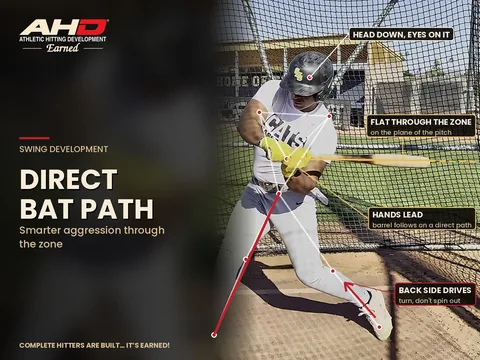
A good path is not a pretty picture you copy from a highlight. It’s a short, useful route for the barrel from launch position to contact. When the hitter lets go of the arrow, the barrel approaches the ball above and inside, gets on the plane of the pitch early and stays there through contact and extension.
That’s what Mechanically Advantaged Angles (MAA) give an AHD hitter: the body and barrel organized so the swing can be fast AND adjustable. Aggressive and athletic. Controlled violence, not a wild hack.
Direct doesn’t mean rushed. It means efficient.
One more thing before the drills. A path problem isn’t always a mechanics problem. A hitter fooled by the pitch will cast, chop or dump the barrel trying to save the swing. If the path only breaks down against live pitching, read Direct Bat Path: Position, Plan & Aggression first.
2. The 3 bat path problems I see most
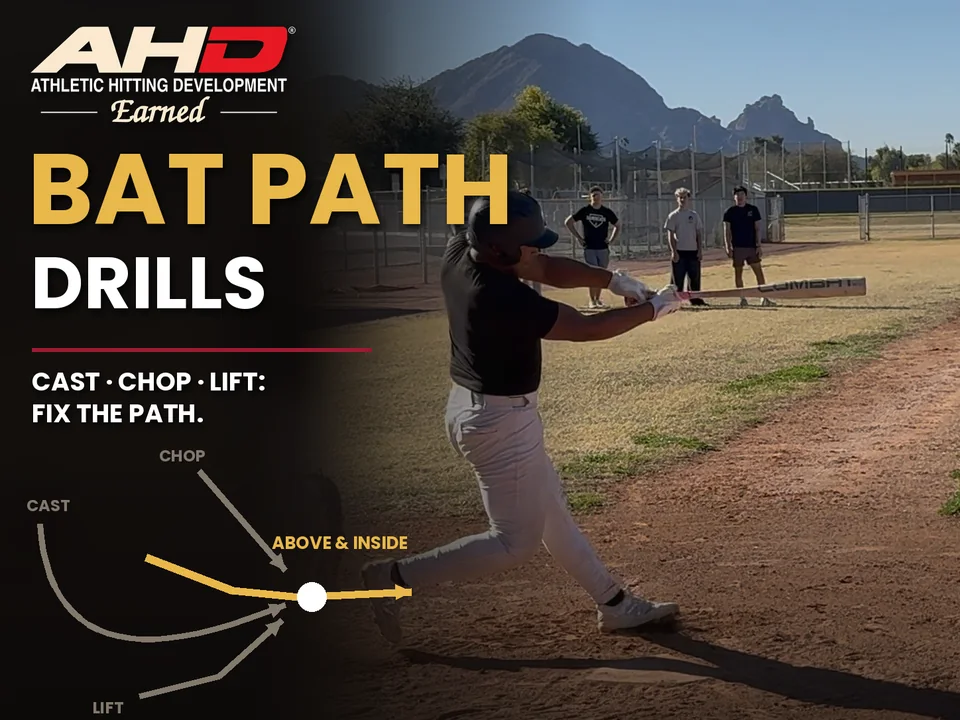
- Casting. The hands push away from the body early and the barrel swings long and around. Lots of weak oppo contact and rollovers on the inside pitch. (Bat drag is its cousin: the back elbow gets ahead and the barrel lags. See bat drag.)
- Chopping. The barrel comes steeply down and across the ball. Lots of ground balls and topped balls, very short time on the plane.
- Uppercutting. The back side drops, the barrel gets under the ball too early and the hitter lives on pop-ups and swing-and-miss up in the zone.
THE 3 PATH MISSES
CAST.CHOP. LIFT.
- Cast: long and around
- Chop: steep and across
- Lift: under it too early
- The miss picks the drill
ABOVE AND INSIDE, THEN THROUGH IT
Film a round before you pick a drill. Watch where the ball goes and what the barrel does. The miss tells you the drill.
3. 6 bat path drills (and what each one fixes)
- Bottom-hand and top-hand short-bat swings (fixes casting)Off a tee with a short bat or choked up, 2 rounds of 8 with each hand. Cue: “Barrel turns with the body, hands stay close.”
- Deep-and-inside tee (fixes casting)Set the tee on the inner third, slightly deeper than normal. 3 rounds of 6. Drive it to the pull-side gap without rolling over. A cast swing can’t get there.
- Two-tee line drill (fixes chopping and uppercuts)Ball on the front tee; an empty tee a few inches behind it on the line of the pitch, a touch lower. 3 rounds of 6. Cue: “Over the back tee, through the ball.” A chop hits nothing; an uppercut clips the back tee.
- High tee (fixes uppercuts)Tee at the top of the zone. 3 rounds of 6 hard line drives, no balls in the air. Cue: “Stay above it, then through it.”
- Contact-point freezes (fixes all three)Slow swings to the inside, middle and away contact points, then freeze. Check hand placement at contact and the barrel angle. 5 freezes per location.
- Front toss to a target (makes it stick)Firm front toss from behind a screen, line-drive target in the middle of the net. 3 rounds of 8. This is where the path has to show up at real speed.
Ten to fifteen minutes is plenty. Pick ONE drill for the hitter’s main problem, finish with front toss, and stop when the swings get sloppy. Tired reps teach the wrong path.
4. How do I check bat path on video?
If you don’t measure it, you don’t manage it. Film from two angles, the same way every time: chest high, landscape, slow motion, whole body and bat through the finish.
- From behind: does the barrel enter above and inside the ball, or does it swing out wide first (casting)?
- From the side: does the barrel match the plane of the pitch before contact, or come down steep (chopping) or get under early (uppercut)?
- Front side: is there an athletic front leg the hitter can rotate against, or is the body drifting?
- Results: more line drives in the middle of the field is the best video check there is.
Our swing analysis page has the full free filming checklist. Film 5 tee swings and 5 front toss swings before you start, then again after two weeks.
5. Why drills alone won’t fix the path
A drill is a tool. The path is built in order: ready position, gather, a directionally sound load, launch position, the bump, letting go of the arrow, then the barrel approach, contact, extension and finish. If the load or launch position is off, the path pays for it, and no drill fixes that by itself.
That’s why I always say it: don’t collect drills. Build a complete hitter. Find the real top priority, train it daily in short sessions, retest, then move to the next one.

THELESSON.
- Find the one miss
- Pick the one drill
- Short, sharp rounds
- Film, retest, adjust
Complete Hitters Are Built…Earned.
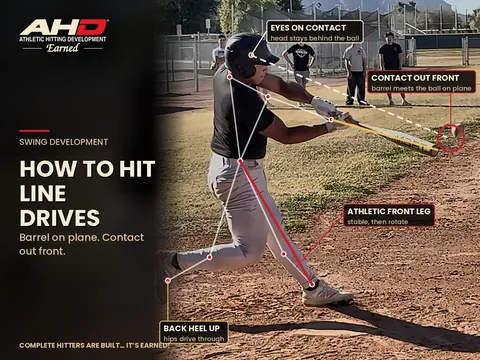
Not sure if the path is even the problem? Run the free SwingChecker™. If the path is the priority, Swing Structure & Mechanics walks your hitter through the whole swing in order, 16 lessons, Lessons 1–3 free. If the ball keeps popping up, How to Hit Line Drives is your next read.
Get your hitter a tee, a phone and 15 minutes. It’s a great day to hit!!
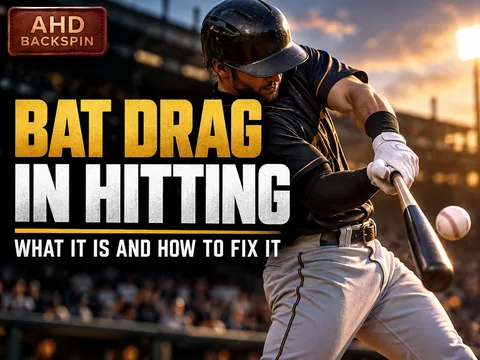
Want to go deeper? Read A Direct Bat Path Is Not Enough and Bat Drag in Hitting: What It Is, Why It Happens and How to Fix It.
Quick answers
What is the best drill for bat path?
The best drill is the one that fixes your hitter’s specific miss. Short-bat and deep-inside tee work fix casting, the two-tee line drill fixes chopping and uppercuts, and the high tee fixes getting under the ball.
How do I stop casting the bat?
Keep the hands close and let the barrel turn with the body. Short-bat one-hand swings and a deep, inside tee are the two drills I use most, and a casting swing usually rolls over on the inside pitch.
How often should a hitter do bat path drills?
A little every day beats a lot once a week. Ten to fifteen focused minutes, ending with front toss, and stop when the swings get sloppy.
Can bat path problems come from timing?
Yes. A hitter who is late or fooled will often cast, chop or drop the barrel to save the swing. If the path only breaks down against live pitching, train recognition and timing too.
Don’t collect drills. Build a complete hitter.
Complete Hitters Aren’t Born. They’re Built… and Earned.