By BK, Athletic Hitting Development
Complete Hitters Aren’t Born. They’re Built… and Earned.
Key takeaways
- There is no single contact point. Inside is out front, middle a little deeper, away deeper.
- A 2026 in-game study of Division I hitters found contact depth was strongly tied to attack angle and moderately tied to peak bat speed.
- Bat path numbers mean little until you know where contact happened. Read contact point, path and ball flight together.
- On the tee, move the tee for each location. One tee spot builds one contact point.
A hitter should meet the inside pitch out front, the middle pitch a little deeper and the away pitch deeper still. There is no single contact point, and a 2026 study of Division I hitters shows that where contact happens changes most of the swing numbers you read off a sensor.
A hitter should meet the inside pitch out front, the middle pitch a little deeper and the away pitch deeper. A 2026 Division I study found contact depth shapes attack angle and peak bat speed numbers, so read contact point, path and ball flight together.
Train it: Swing Structure & Mechanics → Free tool: Contact Point Trainer →Hitters love their numbers now. Attack angle, bat speed, exit velo. I like numbers too, as long as we read them right.
Here’s the deal. A bat path number without a contact point is half a sentence. Same hitter, same swing, meet the ball six inches deeper and the readout changes. If you don’t know where he hit it, you don’t know what the number is telling you.
1. What did the contact point study find?
In August 2026 the journal Sports published a study of NCAA Division I hitters in live games. Researchers used markerless motion capture and ball tracking on 2,779 batted balls from 239 hitters.
On average, contact happened about 20 inches in front of the hitter’s center of mass. That’s an average across a lot of pitches and locations, not a target for your kid.
- Attack angle: contact depth was strongly tied to the combination of vertical and horizontal attack angle.
- Peak bat speed: moderately tied.
- Exit velocity: only weakly tied.
- Bat speed at contact: no meaningful link.
The authors’ point is the one I care about. You can’t read attack angle or bat speed numbers without knowing where contact happened. This was observational, so it doesn’t prove every hitter should catch the ball farther out front. It tells us to stop reading the numbers alone.
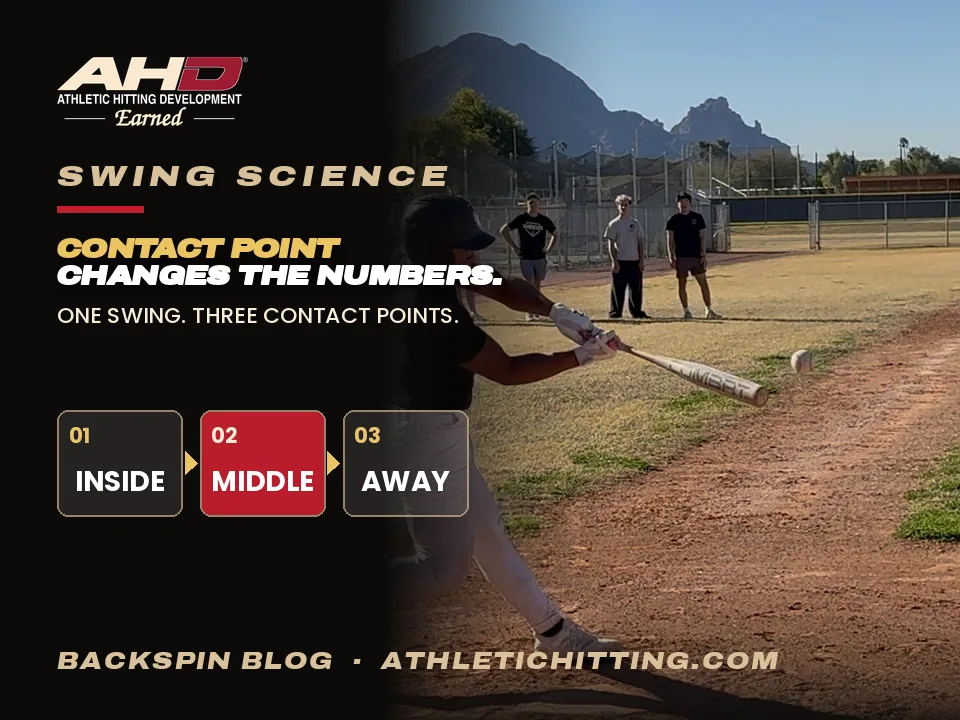
CONTACT POINT
ONE SWING.THREE SPOTS.
- Inside: out front
- Middle: a little deeper
- Away: deeper
- Same barrel approach every time
LET THE PITCH PICK THE SPOT
2. Why does contact point change bat path numbers?
Think about the barrel’s trip. It starts behind the hitter, works down and around, then up and out toward the pitcher. Where you stop the clock on that trip decides what the angle looks like.
Meet the ball deep and the barrel is still early in its arc, pointing more toward the opposite field. Meet it out front and the barrel has turned farther, pointing more toward the pull side and working up. Same swing, different snapshot.
Bat path numbers mean little without the contact point.
So when a parent tells me his son’s attack angle jumped, my first question is simple. Where did he hit it? If he just started catching everything farther out front, the swing may not have changed at all. The contact point did.
3. Where should a hitter make contact on inside, middle and away pitches?
Teach location-specific contact. One swing, three contact points, depending on where the pitch is.
| Pitch location | Contact point | Where the ball should go |
|---|---|---|
| Inside | Out front | Pull side, hard |
| Middle | A little deeper | Middle of the field |
| Away | Deeper | Opposite field, hard |
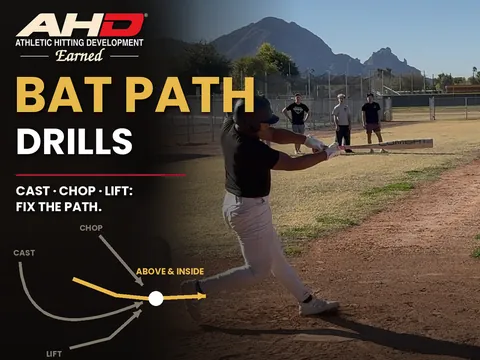
The barrel approach stays the same: above and inside the ball, hands in a strong position at contact, then extension through it. What changes is how far the ball travels before you meet it. Good hitters let the away pitch get deep and stay through it. “Hard, down the other way means we are on our way!” A hard ball to the opposite field on the away pitch tells me he let it travel and stayed on time.
That’s a big part of what we mean by Mechanically Advantageous Angles (MAA). AHD hitters get the body and barrel into strong positions at the contact point the pitch asks for, not one spot for every pitch. I go deeper on the inside pitch in how to hit an inside pitch and on the away pitch in barrel behind the hands.
4. How should you read sensor and HitTrax numbers?
Read three things together, every time. Never one alone.
- Contact pointWhere was the ball met: out front, even, or deep? Film from the side and behind so you can see it.
- Bat pathNow read the attack angle and bat speed, knowing where contact happened.
- Ball flightDid the ball go where that location says it should, and was it hit hard?
If all three agree, you have a swing. If the numbers look great and the inside pitch keeps getting jammed, the numbers are not the story. Exit velo is a result, which is why I call it a receipt, not a plan.
Not sure where your hitter’s swing breaks down first? Run the free SwingChecker™. In about three minutes it ranks his top priorities across the 4 Pillars, with cues, drills and matching free lessons.
5. How do you train contact points on the tee?
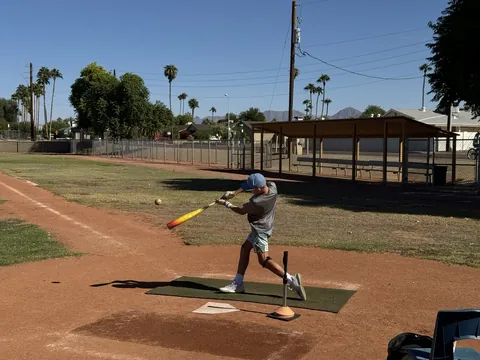
Move the tee. A tee that never moves builds one contact point, and the pitcher is not going to throw there all day.
- Inside. Tee on the inner part of the plate and set out front. Five swings, pull side, hard.
- Middle. Tee down the middle and a little deeper. Five swings, middle of the field.
- Away. Tee on the outer part and deeper. Five swings, opposite field, hard.
- Mix it. Have a partner move the tee between swings so the hitter has to find the new contact point every rep.
Fifteen good swings with a reason beat a hundred to one spot. Then take it to front toss with mixed locations, so the contact point comes from reading the pitch, not memorizing the tee. Want to see it first? The free Contact Point Trainer lets you pick a location and a contact depth and shows where the ball goes.
This is Lesson 13 of the course, One Swing, Five Locations. Start at Lesson 1, The Goal of the Swing, which is free. The full 16-lesson Swing Structure & Mechanics course builds the barrel route all the way to contact. It’s a great day to hit!!

THELESSON.
- No single contact point
- Read contact before the numbers
- Path, contact and ball flight together
- Move the tee for each location
Complete Hitters Are Built…Earned.
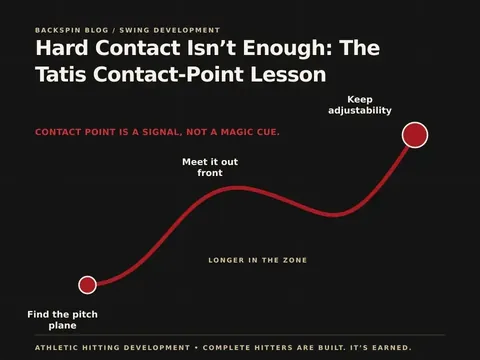
Want to go deeper? Read Hard Contact Isn’t Enough: The Tatis Contact-Point Lesson and How to Hit an Inside Pitch: Turn Inside Pitches Into Your Best Pitches.
Quick answers
Where should a hitter make contact with the ball?
It depends on the pitch location. Meet the inside pitch out front, the middle pitch a little deeper and the away pitch deeper, with the same barrel approach every time.
What is a good contact point in baseball?
A good contact point is the one that matches the pitch and lets the hitter drive the ball to the right part of the field. A 2026 study found Division I hitters averaged about 20 inches in front of their center of mass in games, but that is an average, not a target.
Does contact point affect attack angle?
Yes. A 2026 in-game study of Division I hitters found contact depth was strongly tied to vertical and horizontal attack angle, so you need to know where contact happened before you judge the number.
Should I hit the ball farther out front for more power?
Not as a rule. The study was observational and only found a weak link between contact depth and exit velocity, so match the contact point to the pitch location instead of pushing every ball out front.
Don’t collect drills. Build a complete hitter.
Complete Hitters Aren’t Born. They’re Built… and Earned.