By BK, Athletic Hitting Development
Complete Hitters Aren’t Born. They’re Built… and Earned.
Key takeaways
- Hitting zones split the strike zone into 9 zones (3 lanes inside, middle and away, by 3 heights) so a hitter can plan where to swing.
- Each zone has its own contact point: out front on the inner third, deeper on the outer third, with the body moving up or down, not just the hands.
- Your zone changes with the count. Early, hunt the zones you drive. With two strikes, the zone gets bigger.
- Zones are trained, not just known. Swing to a called zone on a clock until the adjustment is automatic.
Hitting zones split the strike zone into nine zones (inside, middle and away, each high, middle and low) so a hitter knows where to swing, where to take and where to meet the ball. Good hitters hunt the zones they drive early in the count and widen their zone with two strikes.
Hitting zones split the strike zone into nine zones (inside, middle and away at three heights) so a hitter can plan where to swing and where to meet the ball. Hunt the zones you drive early in the count, and widen your zone with two strikes.
Train it: Hitting Processor → Free tool: Strike Zone Swings →When a kid tells me “I swing at strikes,” I ask him which ones. Because a strike on the black at the knees and a strike thigh-high over the middle are two very different pitches. One is a ball you hit 100. The other is a ball you roll over.
Thinking in zones turns “see ball, hit ball” into a plan. Here’s how it works.
1. What are hitting zones?
Officially, MLB defines the strike zone as the area over home plate from the midpoint between the batter’s shoulders and the top of the uniform pants down to a point just below the kneecap. That’s the rule. Hitting zones are how a hitter breaks that box into parts he can actually plan for.
The common setup is a 3×3 grid: three lanes across (inside, middle, away) and three heights (up, middle, down). Younger or newer hitters often start with just the three lanes to learn contact depth, then move to all nine.
Every hitter has zones where they do damage and zones where they don’t. Knowing yours is the start of a real approach.
HITTING ZONES
NINE ZONES.ONE PLAN.
- Inside, middle, away
- Up, middle, down
- Inside out front, away deeper
- Adjust height with the body
KNOW YOUR DAMAGE ZONES
2. Where do you hit the ball in each zone?
Pitches don’t come down the middle. A good swing moves the contact point to where the ball is. That’s the whole point of thinking in zones.
| Zone | Where contact happens | What the body does |
|---|---|---|
| Inside | Out front | Turn and let the barrel get there early |
| Middle | Even with the front hip area | Stay through the middle of the field |
| Away | Deeper, closer to the body | Let it travel; drive it the other way |
| Up | Barrel stays above the ball | Body stays taller; don’t drop under it |
| Down | Barrel matches the low plane | Body works down; hands don’t just dip |
The height adjustment is where most hitters break down. They reach for the low pitch with their hands. Good hitters adjust with their body, so the swing keeps its angles. AHD hitters build Mechanically Advantageous Angles (MAA) so they can hold those angles at every height.
Want more on depth? See how to hit an inside pitch and how contact point changes your swing numbers.
3. How does the count change your hitting zone?
Your zone isn’t the same on every pitch. It changes with the count.
- Ahead (0-0, 1-0, 2-0, 2-1, 3-1). Hunt your best zones. If it isn’t in a zone you drive, you can let it go.
- Even (1-1). Still aggressive, but the zone opens a little.
- Two strikes. The zone gets bigger. Protect the plate, shorten up and compete. See our two-strike approach.
Here’s the line I want every hitter to own: "Swing at a bad pitch? No biggie. Take a good pitch to hit? Not happening." When the ball is in your zone, you swing it. A chase is a fixable mistake. Watching your pitch go by is the one that hurts.
Heater or hanger in your zone? Gotta swing it to hit it.
4. Should hitters look for a zone or a pitch?
Both, but the zone usually comes first. Looking for a zone is simpler than guessing a pitch, and it holds up against pitchers you’ve never seen. If you sit middle-away and the ball shows up there, you’re ready no matter what spin is on it.
As hitters get older and the scouting gets better, they combine the two: “fastball, middle-in” or “anything soft, away.” That’s a plan built for one pitcher on one night.
Either way, the plan has to be set before the pitch. Late decisions turn into check swings and chases. Decide early, commit to it, and let the ball tell you yes or no.
5. How do you find your best hitting zones?
Your best zones are the ones you drive hard and on a line, not just the ones you make contact in. Here’s a simple way to find them:
- Set the tee in all nine zones.Five full-intent swings in each, filmed from the side.
- Grade every ball.Hard line drive, weak contact, or miss. Keep it simple.
- Mark your damage zones.Usually two to four zones stand out.
- Retest in front toss.A zone that holds up off a moving ball is a real strength.
- Write your plan.Early in the count, hunt those zones. Work on the rest in practice.
Do this every few weeks. Zones change as a hitter gets stronger and the swing improves.
6. How do you train hitting zones?
Knowing your zones isn’t enough. The adjustment has to be automatic, because there’s no time to think at game speed. That’s why we built the free Strike Zone Swings drill.
A strike zone split into 9 zones (or 3 lanes) shows on your phone, tablet or TV. A countdown runs, one zone lights up and a voice calls it out, and the hitter swings to that location. A new zone lights every 5, 7 or 10 seconds. It works for baseball and fastpitch, right- or left-handed.
- Dry swings. Full intent, no ball. Finish to the called zone. Great at home.
- Tee. When the zone lights, move the tee to it and hit. Use the 10-second clock.
- Front toss. The coach watches the screen and tosses to the called zone.
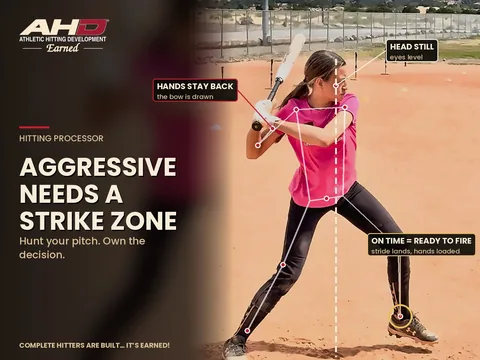
This is the Hitting Processor at work: see it, time it, decide, attack it. It’s trained DAILY, like any other skill. For the full plan, see swing decisions are a skill, then train it start to finish in the Hitting Processor course. Lesson 1 is free here.

THELESSON.
- Find your damage zones
- Hunt them early
- Widen with two strikes
- Train it daily
Complete Hitters Are Built…Earned.
Want to go deeper? Read Swing Decisions Are a Skill and Hit Strikes Hard: The Simplest Hitting Approach There Is.
Quick answers
How many hitting zones are there?
Most hitters use a 3 by 3 grid: inside, middle and away at three heights, for nine zones. Newer hitters can start with three lanes: inside, middle and away.
Where should you hit an inside pitch?
Out front. The inside pitch has to be met earlier in the swing, while the outside pitch is met deeper, closer to the body.
Should my hitter swing at everything in the strike zone?
Not early in the count. Ahead in the count, hunt the zones you drive. With two strikes, the zone gets bigger and you protect the plate.
How do you practice hitting different zones?
Move the tee to all nine zones, use front toss to called locations, or use a free zone-callout drill like Strike Zone Swings for dry swings, tee work or front toss.
Sources: MLB Glossary: Strike zone (official definition)
Don’t collect drills. Build a complete hitter.
Complete Hitters Aren’t Born. They’re Built… and Earned.