By BK, Athletic Hitting Development
Complete Hitters Are Built… Not Given. Earned!
Baseball has a strange relationship with time.
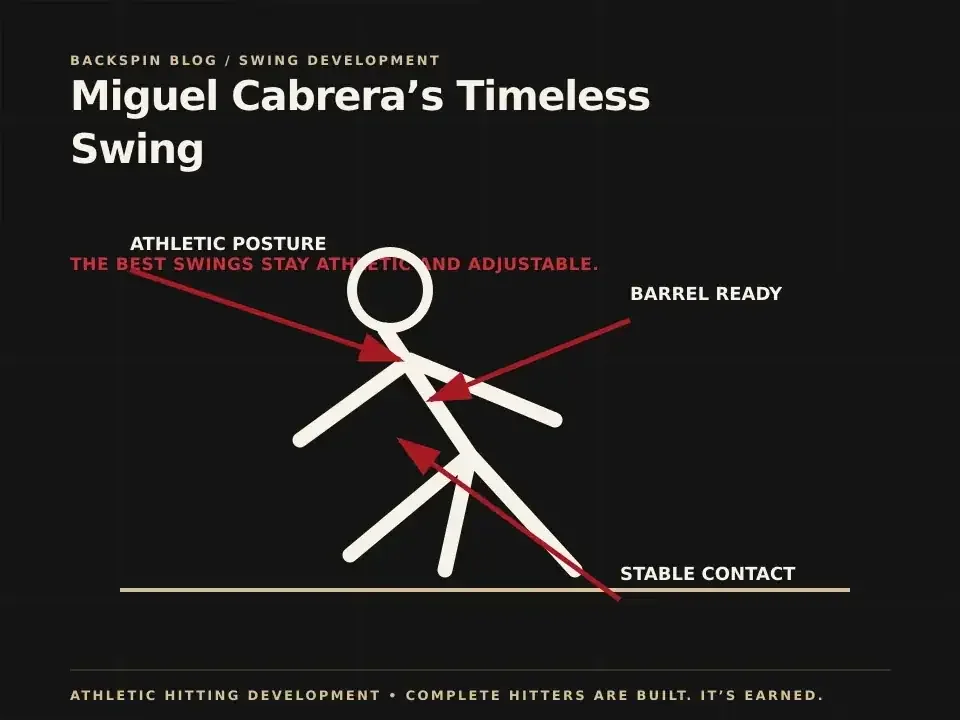
Miguel Cabrera’s swing lasted because it gave him margin for error, adjustability and decision time, not because it never changed. Don’t copy his shape; learn from it by staying athletic enough to adjust, using the whole field and understanding why your swing works so you can find it again.
Train it: Swing Structure & Mechanics Masterclass →The game does not look like it is ruled by a clock, but time is everywhere. A fast runner gets older. Recovery takes longer. Bat speed changes. Pitchers learn you. The league adjusts. The body changes. The window for making decisions gets smaller as the competition gets better.
Eventually, almost everything in the game has to answer to Father Time.
And then there are swings that seem to fight back.
Miguel Cabrera built one of those swings.
A Sports Illustrated story published on August 22, 2021—the day Cabrera hit career home run No. 500—used that idea beautifully. The remarkable thing was not simply that Cabrera had reached another enormous number. It was that after nearly two decades in the major leagues, the best version of his swing could still look unmistakably like Miguel Cabrera.
The 500th home run was the perfect example
Cabrera’s 500th homer came in Toronto against left-hander Steven Matz. The pitch was a changeup away. Cabrera drove it to right-center field, tying the game in the sixth inning.
That matters to hitters.
It was not a cartoon version of power where a hitter sells out, yanks the ball and tries to create a milestone. It was a veteran hitter staying inside the baseball, using the field and producing damage on a pitch that was not sitting in the middle of the plate.
The home run made Cabrera the 28th player in major-league history to reach 500 and the first Venezuelan-born player to do it.
The AHD lesson
A swing that lasts is not one that looks identical forever. It is one that gives the hitter enough margin for error, adjustability and decision time to keep solving new problems.

CAREER HOME RUN NO. 500
STAYINSIDE IT.
- Changeup away.
- Driven to right-center.
- No selling out for the pull.
MARGIN. ADJUSTABILITY. DECISION TIME.
Do not confuse “timeless” with “unchanging”
This is where young hitters can misunderstand great players.
They see one famous swing and think the goal is to copy the shape.
That is not the lesson.
No hitter stays exactly the same for twenty years. Bodies change. Strength changes. mobility changes. Pitching changes. The league finds new ways to attack you. Your own strengths and weaknesses evolve.
The skill is not freezing your swing in time.
The skill is building a movement solution that can keep adjusting while preserving what makes you dangerous.
What actually survives?
When we look at a hitter like Cabrera through the AHD lens, the most useful question is not, “How do I swing exactly like him?”
It is:
What qualities can survive as the game gets harder?
Stay organized long enough to adjust.
A hitter who loses balance or body control early has fewer solutions when the pitch is not perfect.
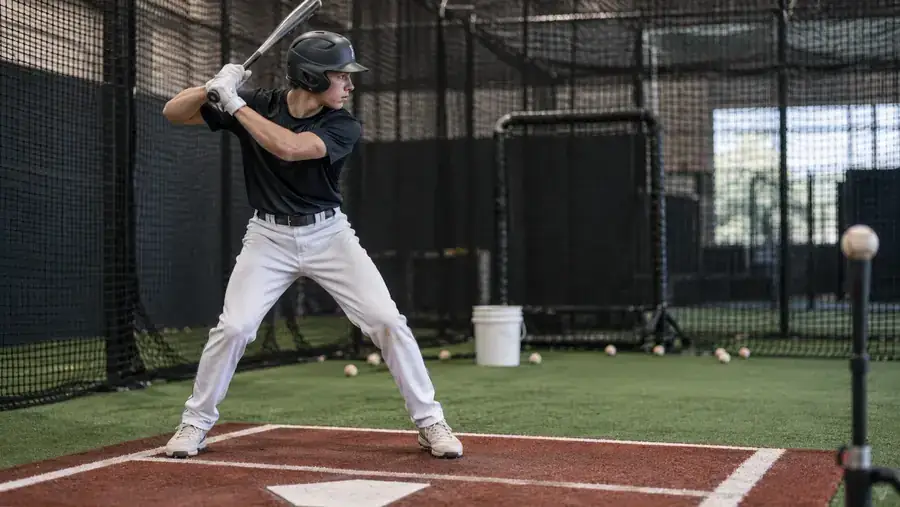
THELESSON.
- Don't copy the shape.
- Learn from Cabrera.
- Stay organized to adjust.
- Use the whole field.
- Keep solving new problems.
Complete Hitters Are Built…Earned.
Quick answers
What made Miguel Cabrera’s swing so good for so long?
It gave him margin for error, adjustability and decision time. He could do damage to more than one part of the field, adjust contact depth and still hit the ball hard, and handle different pitch types and locations. He kept learning and competing long after pitchers had years of information on him.
Should young hitters copy Miguel Cabrera’s swing?
No. Do not copy Cabrera. Learn from Cabrera. Trying to manufacture his hand position, stride length or finish misses the point. Study the larger qualities: athletic control, a barrel that handles different contact points, using the whole field and strong pitch processing. Those lessons transfer to any hitter.
How do you build a swing that lasts?
A swing that lasts is not one that looks identical forever. Bodies, strength and pitching all change. Build athletic control, adjustability, pitch recognition, strength, confidence and understanding of why your swing works. If your whole identity is one cue from one coach, you are vulnerable when something changes.
Why do some hitters stay good as they get older?
Their swing doesn’t depend on everything being perfect. An efficient, adjustable move buys decision time, and a sharp hitting processor lets them keep solving pitches even as some physical tools change. They understand their swing well enough to keep finding it again.
This article is part of the AHD guide Baseball Swing Mechanics. Start there for the full picture and every related article.
Give the barrel room to work.
The best hitters create paths that can handle different contact depths, heights and pitch shapes instead of requiring one perfect point.
Let pitch location help determine contact.
Cabrera’s 500th going to right-center is a useful reminder that damage does not have to mean pulling every ball.
The swing only matters after the decision.
Recognition, timing and decision quality become more important as velocity and spin improve.
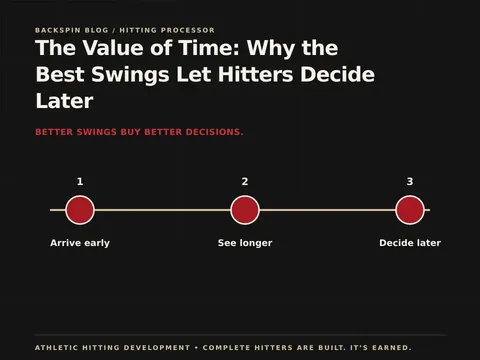
The swing has to give you time
This connects directly to one of the most important AHD ideas.
Great movement should not force the hitter to make every decision too early.
If the body leaks, the hands commit, the barrel dumps or the hitter has only one route to the ball, the decision window shrinks. Now the athlete has to guess earlier just to get the barrel there.
An efficient, adjustable swing buys usable time.
And usable time matters because the Hitting Processor still has work to do:
This is one reason veteran hitters can remain dangerous even as some physical tools change. If the movement is efficient and the hitter’s processor is elite, the athlete can continue solving pitches without needing to win every battle with raw physical advantage.
500 home runs is really a consistency statistic
Five hundred home runs sounds like a power statistic.
Of course it is.
But it is also a durability statistic. A learning statistic. An adjustment statistic. A consistency statistic.
You do not reach numbers like that with one hot summer.
You have to produce through different pitchers, different eras, injuries, mechanical adjustments, changing bodies, changing teams, changing expectations and thousands of failed at-bats.
The achievement tells us something larger:
Greatness is not one great swing. It is the ability to keep finding a good swing again.
This is why hitters have to understand why they are good
One of the biggest goals of Athletic Hitting Development is not simply giving a player a good swing.
It is helping the hitter understand what makes the swing work.
Because eventually something changes.
Your timing changes. You grow. You get stronger. Pitchers throw harder. The breaking ball improves. Your body feels different in July than it did in February.
If your entire hitting identity is built around one cue from one coach, you are vulnerable.
If you understand your movement, your sequence, your bat path, your adjustability and your processor, you have tools for finding yourself again.
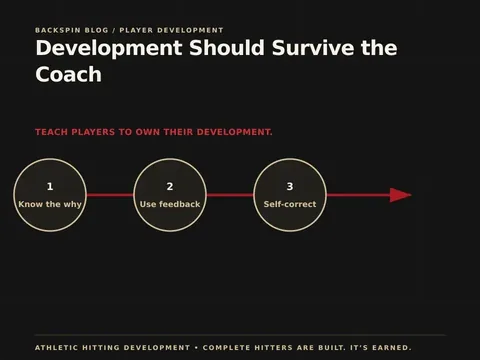
Read next: Development Should Survive the Coach →
Do not copy Cabrera. Learn from Cabrera.
Young hitters should not watch Miguel Cabrera and try to manufacture his exact hand position, stride length or finish.
That misses the point.
Instead, study the larger qualities:
- He could do damage to more than one part of the field.
- He could adjust contact depth without losing his ability to hit the ball hard.
- He could handle different pitch types and different locations.
- His offensive identity was bigger than one swing cue.
- He continued learning and competing long after pitchers had years of information on how to attack him.
Those are transferable lessons.
Father Time changes the athlete. Development gives the athlete options.
No swing truly beats time forever.
Cabrera eventually retired. Every athlete does.
But there is a huge difference between a swing that depends on everything being perfect and a hitter who owns enough tools to keep adjusting as circumstances change.
That is why AHD does not build hitting around one mechanical idea.
We build the complete hitter.
The swing gives you movement solutions. Strength and explosiveness give you physical capacity. The processor gives you information and time. Mental training allows you to keep competing through the inevitable failures and changes.
The longer you play, the more those pieces have to cooperate.
What should a young hitter take from this?
Not that you need 500 home runs.
Not that your swing should look like Miguel Cabrera’s.
And definitely not that talent makes the work unnecessary.
The lesson is that the best hitters build skills that remain useful when the game changes.
Build for the hitter you will become.
Do not only build a swing that works against today’s pitching. Build athletic control, adjustability, pitch recognition, strength, confidence and understanding that can travel with you to the next level.
The 12-year-old game changes.
The high-school game changes.
The college game changes.
The professional game changes.
Your body changes.
Your competition changes.
Your swing needs enough truth in it to change with you.
No subscription. No login. Learn one thing, train it, and own it.
Baseball example: Inspired by Emma Baccellieri’s Sports Illustrated feature “Miguel Cabrera’s Swing Stands Up to Father Time,” published August 22, 2021, and checked against MLB’s reporting on Cabrera’s 500th career home run. Read the SI feature · MLB: Cabrera hits No. 500