By BK, Athletic Hitting Development
Complete Hitters Are Built… It’s Earned!
Key takeaways
- Split the offseason into four phases: assess and build the base (weeks 1–3), build strength and swing priorities (4–7), add pitch speed and decisions (8–10), compete and peak (11–12).
- Train all 4 pillars every week, but change the emphasis by phase; the Hitting Processor gets a few minutes DAILY.
- Test in week 1 and week 12 with the same tests and same video angles, so progress is measured, not guessed.
- Plan rest days and a deload week, keep strength work age-scaled, and protect the throwing arm.
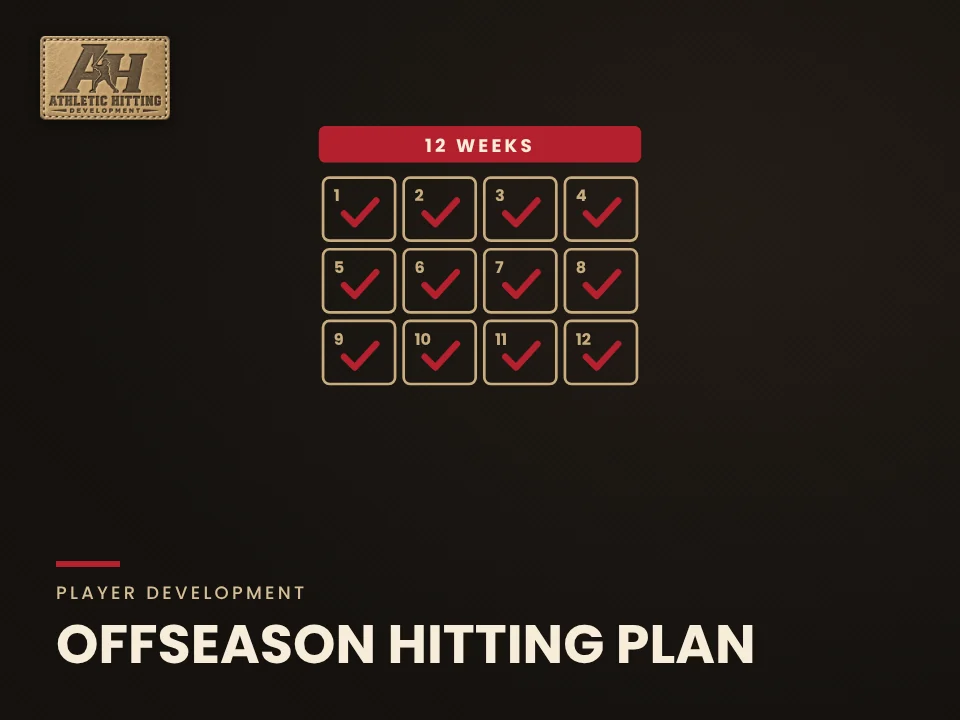
A good offseason hitting program runs 12 weeks in four phases: weeks 1–3 assess and build the base, weeks 4–7 build strength and swing priorities, weeks 8–10 add pitch speed and decisions, and weeks 11–12 compete and peak for tryouts. Test at the start and the end so you know it worked.
Most offseasons go one of two ways. The hitter shuts it down until January, or swings 300 times a day in November and is burned out by tryouts. Neither builds a hitter.
Here is the plan I would hand a family in the fall. It is built on the 4 Pillars of a Complete Hitter, and it peaks when it counts.
1. How should my hitter test at the start of the offseason?
Week 1 starts with a test, not a drill. You cannot build a plan without knowing where you are.
- Swing video. Open side and directly behind, chest high, slow motion, 5 tee and 5 front toss swings. Use the filming checklist on our swing analysis page.
- A simple power number. A seated or standing med ball throw for distance, or bat speed if you have a sensor. See the med ball test.
- A decision check. Ten mixed front-toss pitches, some strikes, some not. Count good swings and good takes.
- The free SwingChecker. About 3 minutes. It ranks the top priority across all 4 pillars.
Write the numbers down. You will run the exact same tests in week 12.
2. What does the 12-week offseason plan look like?
| Weeks | Phase | Main focus | Hitting volume |
|---|---|---|---|
| 1–3 | Assess and build the base | Test, movement quality, posture, tee work on the #1 priority | Low: 50–75 quality swings a session |
| 4–7 | Strength, speed and swing priorities | Age-scaled strength, med ball and sprint work; own the swing fix | Moderate: 75–100 swings, mostly tee and front toss |
| 8–10 | Speed of pitch and decisions | Faster front toss, machine or live; mix speeds; take and swing calls | Moderate, more live, fewer tee swings |
| 11–12 | Compete and peak | Live at-bats, scored games, tryout simulation, re-test | Lower volume, game intensity, extra rest |
Notice the volume never goes crazy. Quality reps on the right priority beat buckets of random swings. Don't collect drills. Build a complete hitter.
Phases only work if you earn your way through them. If the swing fix is not holding off front toss by week 7, stay in phase two another week. Adding speed to a move the hitter does not own just buries the problem. The calendar serves the hitter, not the other way around.
Count backward from your tryout date to set week 1. If tryouts are in late January, start in early November.
12 WEEKS TO TRYOUTS
BUILD ITIN ORDER.
- Wk 1–3: Assess + base
- Wk 4–7: Strength + swing
- Wk 8–10: Speed + decisions
- Wk 11–12: Compete + peak
TEST IN WEEK 1. RE-TEST IN WEEK 12.
3. What should my hitter do in each phase?
- Weeks 1–3: Build the baseFix how the body moves before adding speed; work slowly on the top swing priority and get strong positions like the Mechanically Advantaged Angles (MAA) every AHD hitter learns to own.
- Weeks 4–7: Get stronger and own the swingTwo or three strength and explosiveness sessions a week, plus daily swing work until the fix holds at game speed off front toss.
- Weeks 8–10: Add speed and decisionsSpeed up the ball, mix pitch speeds and make every rep a decision: see it, time it, decide, attack it.
- Weeks 11–12: Compete and peakCut the volume, raise the intensity, play scored games and simulate tryout day, then re-test.
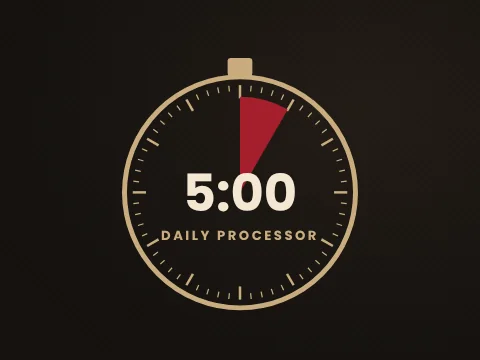
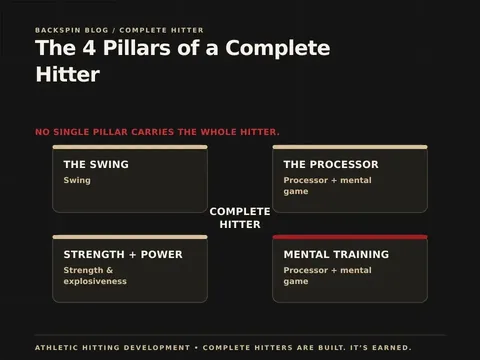
Every week touches all 4 pillars: The Swing, Strength & Explosiveness, the Hitting Processor and the Mental Approach. Only the emphasis moves. The Processor gets a few minutes every day, even in week 1. Try the 5-minute daily Processor plan.
Mental work belongs in here too. Build a simple at-bat routine in phase two, then use it on every live rep in phases three and four. By tryouts it should be automatic.
4. How much time per week, and how much strength work?
A realistic weekly budget for a committed high school hitter is 4 to 6 hours total. For 12U and younger, 2 to 3 hours is plenty.
- Swing work: 15 to 20 minutes, 4 to 5 days a week.
- Hitting Processor: 5 minutes a day.
- Strength & explosiveness: 2 to 3 sessions of 30 to 45 minutes.
- Live or game-speed hitting: 1 to 2 sessions, growing in phases three and four.
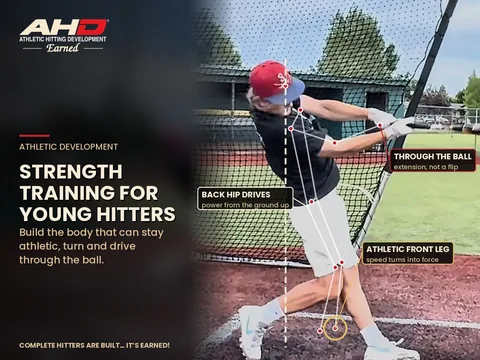
Keep strength general and scaled to age. Younger hitters do bodyweight, jumps, sprints, throws and play. Older hitters add supervised lifting with good form before load. Read strength training for young hitters by age, and get a qualified trainer for barbell work.
5. How do we avoid burnout and protect the arm?
Rest is part of the plan, not a break from it.
- One or two full days off a week. No swings, no lifting.
- A lighter week around week 7. Cut volume by about half, then build back up.
- Arm care. Most hitters also throw. Follow a sensible throwing build-up and do not stack heavy throwing, lifting and hitting on the same day.
- Pain stops the session. Soreness is normal; sharp or lingering pain is a reason to see a medical professional.
- Let the hitter own it. Give them the plan and a checklist. Kids who own the work burn out far less than kids who are pushed through it.
If you want the 12 weeks built out lesson by lesson, the Complete Hitter Masterclass covers all 4 pillars in 24 lessons. Families who want me to write and check the plan personally can look at 90-Day Private Hitter Development.

THELESSON.
- Test before you train
- All 4 pillars, every week
- Quality swings over buckets
- Rest so you peak on time
Complete Hitters Are Built…Earned.
Want to go deeper? Read Strength Training for Young Hitters: What’s Right at Every Age and The 5-Minute Daily Hitting Processor Plan.
Quick answers
How long should an offseason hitting program be?
About 12 weeks works well for most hitters. It gives time to assess, build strength and the swing, add pitch speed and decisions, and peak for tryouts.
How many swings a day should my hitter take in the offseason?
Quality matters more than count. Around 50 to 100 focused swings per session, 4 to 5 days a week, is plenty for most youth and high school hitters.
Should my kid take time off from baseball in the fall?
A short break after the season is healthy. Then build back gradually, with one or two full rest days every week throughout the offseason.
When should my hitter start live pitching before tryouts?
Start mixing in faster front toss, machine or live pitching around week 8 of a 12-week plan, then shift to game-like at-bats in the final two weeks.
Don’t collect drills. Build a complete hitter.
Complete Hitters Are Built… It’s Earned!
This article is part of the AHD guide Bat Speed & Power Training. Start there for the full picture and every related article.