By BK, Athletic Hitting Development
Complete Hitters Aren’t Born. They’re Built… and Earned.
Key takeaways
- The White Sox didn’t teach one swing. Per MLB.com, everyone gets their own plan.
- The standard is the same for every hitter: on time, barrel in the zone early, good decisions, repeatable under pressure.
- Compare a hitter to his own video, not to a poster swing, and pick one trainable priority at a time.
- A hitter who knows what he’s training and why owns his development instead of riding along in somebody else’s.
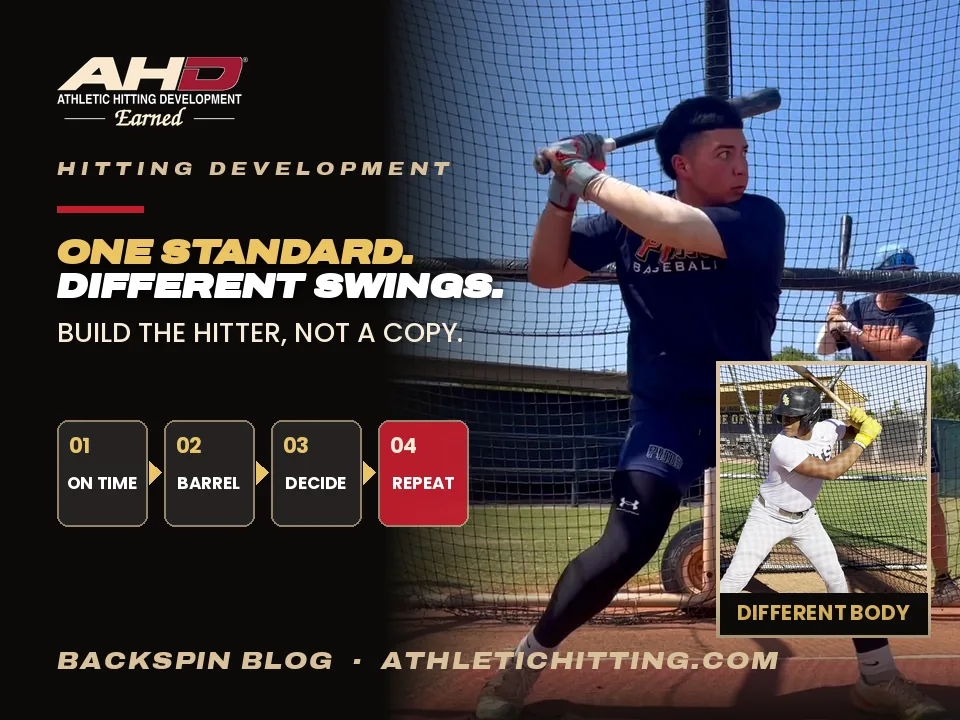
No, every hitter should not have the same swing. Every hitter needs the same standard, and then his own plan to meet it.
Every hitter should meet the same standard, not copy the same swing. Build an individual plan around what his body already does, train one top priority at a time, and compare him to his own video instead of a model swing.
Train it: Complete Hitter Masterclass → Free tool: SwingChecker™ →That was the big idea in a July MLB.com story on the White Sox, a club that lost 121 games in 2024 and 102 in 2025 and was tied for first in the AL Central when the piece ran. Their hitting staff didn’t hand out one swing. As the article put it: “The common denominator is not that everyone is learning the same swing with the White Sox – it’s that everyone gets their own plan.”
That’s how I’ve coached hitters for 25+ years. It’s the difference between a hitter with a map and a hitter carrying around a random pile of drills.
1. What Did the White Sox Do Differently With Their Hitters?
The story, by Travis Sawchik, describes a staff that looks at what each hitter already does well, builds a plan around those traits and lets the player own it. Infielder Jacob Gonzalez said it didn’t feel like he was being told what to do. His line: “The ingredients were mostly already there.”
They used real information, too: swing data comparisons, bat-speed training and pitching-machine reps. Team average bat speed went from 70.9 mph to 71.8 mph, and team wRC+ jumped from 88 to 104.
I’m not going to tell you one article proves a system. A lot goes into a turnaround. But the principle is one I’d bet on every time: find what the hitter already has, then build it.
Everyone gets the same standard. Everyone gets their own plan.
WHITE SOX HITTING
ONE STANDARD.THEIR OWN PLAN.
- Find the traits he already has
- Build the plan around them
- Use real swing data
- Let the hitter own it
EVERYONE GETS THEIR OWN PLAN
2. Why Doesn’t Copying One Swing Work?
A lot of hitters get handed a picture to copy. Stand here. Load like this. Get your foot down at this exact moment. Mechanics matter. They do. The problem is treating one good swing as the answer for every body.
A 6-foot-3 sophomore with long levers and a 5-foot-8 middle infielder who’s all fast-twitch are not going to move the same way. One may use a quiet toe tap. Another may need a bigger gather to get going. One wins with a long, athletic move. The other wins with a compact launch and an early decision.
If both are on time, control the barrel, make good decisions and repeat it under pressure, my job is not to make them match. What good hitters DO share are Mechanically Advantaged Angles (MAA), the body and barrel positions that let them deliver force efficiently. The angles are the standard. The style around them belongs to the hitter. More in MAA: Mechanically Advantaged Angles.
I made the same point about the Brewers in There Is No Team Swing. Different club, same lesson.
3. What Standard Should Every Hitter Meet?
At AHD the standard isn’t a look. It’s four questions every hitter from 13 to 21 should be able to answer about himself:
- What is my barrel doing? Does it get on plane early and stay through the zone?
- Am I on time often enough? A late hitter can’t make good decisions. He’s just guessing.
- What does my body let me repeat? Mobility, strength and explosiveness set the ceiling on the move.
- What am I training this week, and why? If he can’t say it in one sentence, he doesn’t have a plan.
Those line up with the 4 Pillars of a Complete Hitter: The Swing, Strength & Explosiveness, The Hitting Processor and the Mental Approach. The standard covers all four. The plan decides which one gets the work right now.
"Two choices: A. Do everything in your control. B. Anything but A." Effort, preparation and attitude are the same standard for every hitter. Nobody gets an individualized plan for effort.
4. What Should Coaches and Parents Look For Instead?
Stop asking, “Does this swing look like mine?” or “Does it look like the big leaguer on YouTube?” Ask better questions:
- Stable launch, on timeDoes he get to a stable launch position before the ball is on him, or is he still loading at release?
- Barrel in the zone earlyDoes the barrel enter the zone behind the ball with a chance to stay there, or does it cut across it?
- Decision before the swingCan he recognize the pitch and decide yes or no before the swing starts?
- Holds up under speedDoes the move survive when the drill gets faster, less predictable or competitive?
Score each one 1 to 5 after a session and write it down. The weakest one shows up fast, and that’s what gets the next two weeks. The free 4 Pillars Hitter Scorecard does the same thing across 12 skills.
These questions take the emotion out of coaching. They also keep a 15-year-old from changing three things every time the ball doesn’t jump.
5. How Do You Use Video Without Chasing a Perfect Swing?
Film the hitter and compare him to himself, not to a poster. Same angles every time: open side and directly behind, phone chest high, slow motion. The full checklist is in How to Film Your Swing for Analysis.
- Good swing vs. bad swing. Pull a barreled ball and a rollover from the same day. What changed?
- Early work vs. late work. Does the move hold up at the end of the session, or fall apart when he’s tired?
- Tee vs. live arm. The tee shows the move. Live pitching shows whether his timing lets him use it.
Find what changed, then connect it to timing, contact and ball flight. Not a dozen flaws. ONE trainable priority.
Want trained eyes on it? AHD Swing Lab is a $79 coach-reviewed video analysis (opening Nov. 15). Want to start free? SwingChecker™ takes about 3 minutes and ranks his top priorities across the 4 pillars, with cues, drills and matching free lessons.
6. How Does a Hitter Own His Plan?
Ownership is the part most programs skip. A hitter who knows why he’s doing a drill does it better than one who’s just following orders. Here’s how we run it at AHD:
- One priority for two weeks. One. He writes it on the first page of his notes.
- Daily work, 15 to 20 minutes. Short, daily and focused beats one long Saturday.
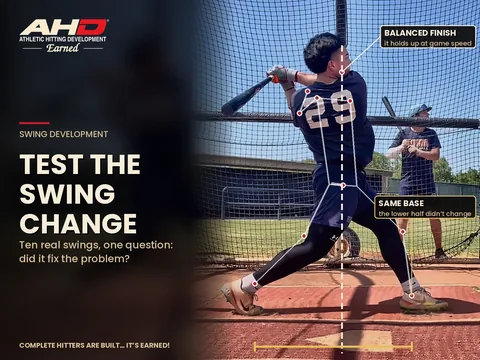
- Re-film every two weeks. Same angles. Better? Move to the next priority. Not better? Ask why before adding anything.
- Start with what’s working. The White Sox open their hitter meetings with positives from the day before. Steal that.
"Belief is the most powerful human force." A hitter who built his plan with real work believes in it, and that’s when he swings free.
If you want the whole plan laid out across all four pillars, the Complete Hitter Masterclass gives you 24 lessons in order, and Lessons 1–3 are free. Want the swing piece first? Start with Swing Structure Lesson 1.
THELESSON.
- Same standard for every hitter
- Different swings are allowed
- Compare him to himself
- One priority at a time
Complete Hitters Are Built…Earned.
Want to go deeper? Read There Is No Team Swing and MAA: Mechanically Advantaged Angles.
Quick answers
Should every hitter on a team have the same swing?
No. Every hitter should meet the same standard: on time, barrel in the zone early, good decisions and a move that repeats under pressure. How each body gets there can look different.
What is an individual hitting plan?
It’s a short written plan that names the hitter’s top priority across the 4 pillars, the daily work that trains it and how you’ll measure it. At AHD a hitter usually works one priority for about two weeks, then re-films.
How do I know what my hitter should work on first?
Film him from the open side and from behind, score the four standard questions 1 to 5 and start with the lowest. SwingChecker does a free version in about 3 minutes and ranks his top priorities.
How did the White Sox improve their hitting in 2026?
According to MLB.com, their staff built an individual plan around each hitter’s existing traits, used swing data and bat-speed training, and let players own the process. Team wRC+ rose from 88 to 104.
Don’t collect drills. Build a complete hitter.
Complete Hitters Aren’t Born. They’re Built… and Earned.