By BK, Athletic Hitting Development
Complete Hitters Aren’t Born. They’re Built… and Earned.
Key takeaways
- VR batting with a real swing helped trained hitters swing at more strikes, but it didn’t clearly cut chases.
- Under time pressure, hitters start the swing earlier and still adjust the bat path to location mid-swing.
- Early ball flight tells a hitter WHERE to swing. “See it late” is not the answer.
- Timing, zone decisions and location adjustment are three different problems. Fix one at a time.
You can have the prettiest swing in the state. If you can’t see the ball, read it and decide in time... good luck.
New 2025–26 studies say early ball flight drives where the swing goes, hitters start earlier under time pressure but still adjust mid-swing, and timing, zone decisions and location are separate skills. Train early pickup, real take-or-commit decisions and one problem at a time.
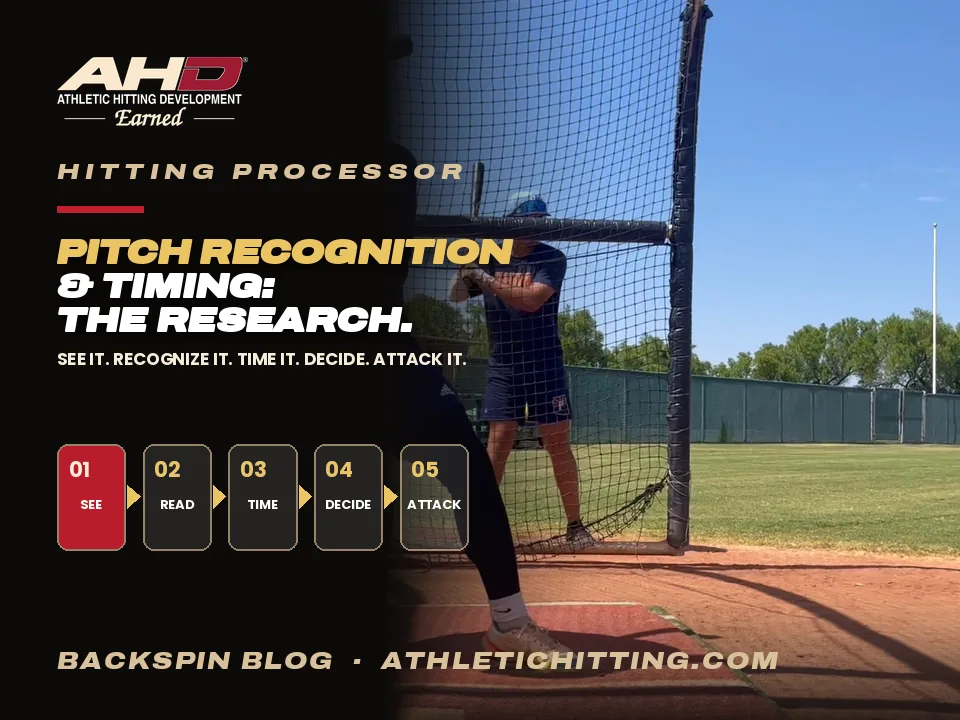
Train it: Complete Hitter Academy → Free tool: Spin Read Test →That’s the truth about hitting, and it’s why the Hitting Processor, the pitch recognition, timing and decision side of hitting, is its own level in the AHD Complete Hitter Academy. The swing is the engine. The Processor is the driver. It runs five steps, in order: See It → Recognize It → Time It → Decide → Attack It.
I read hitting research the way most people read box scores. This fall a batch of new studies landed (2025–26) on exactly how hitters see, time and decide. Some of it backs up what good coaches have taught in the cage for years. Some of it should make us drop a cue or two. Here’s what the science says, what it doesn’t say, and what I’d do with it on Monday.
One honest note before we start: these are small studies, mostly in labs and VR headsets. They point the way. They don’t prove anything for every hitter. I’ll tell you which part is the study and which part is me coaching.
1. VR batting helped hitters swing at more strikes
Researchers led by Fabian Romero Clavijo split 20 highly trained male players (ages 15–20) into two groups. Both did their normal training. One group added twelve 20-minute VR batting sessions over six weeks, swinging a real bat at a virtual pitcher. So far this work is out as a conference abstract, not a full paper.
The VR group got better at a pitch recognition test and swung at more strikes in live batting. They did NOT clearly chase fewer balls.
The limits: only 14 players finished the live test, all male, one VR system, short-term results.
What I’d do with it: a hitter has to take, commit and tell you WHY. Not “I saw it”. Exactly what did you see? Spin? Release? Where it started? A button-press app can’t make you do that. A real swing can. That’s See It → Recognize It → Decide.
2. The swing is part planned, part adjustable
Hiroki Hayashi and his team tested 18 skilled college hitters in high-end VR, squeezing the time they had and changing where the pitch would end up. Contact dropped off once they had less than roughly 400–425 milliseconds. Under pressure, hitters started their swings earlier, but the bat path still adjusted to location mid-swing (study summary).
The limits: VR, a modest group of hitters, lab timing instead of a live at-bat.
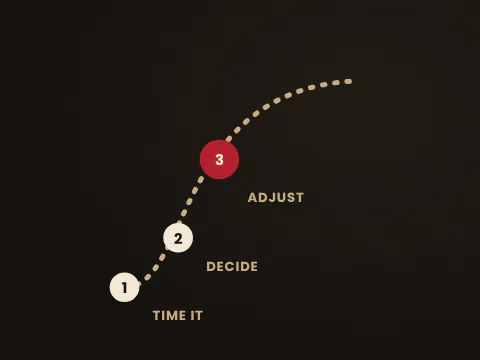
What I’d do with it: “Just wait longer” is not a timing plan, and good timing drills don’t teach it. Get the load started early and on time, so you have room to adjust and attack the pitch that actually shows up. Quiet, smooth and early gather and load. That’s Time It → Decide → Attack It. For more on this, read Time It, Decide, Adjust.
THE HITTING PROCESSOR
FIVE STEPS.IN ORDER.
- See It
- Recognize It
- Time It
- Decide
- Attack It
THE SWING IS THE ENGINE
3. Early ball flight tells you WHERE
Dukchan Jang’s group had 15 skilled college hitters intercept a moving target on a touchscreen, sometimes hiding the early flight, sometimes the late flight. Hiding the early part hurt their spatial accuracy badly. Their timing held up either way, which suggests timing runs on an internal model the brain builds (Jang et al., 2026).
The limits: a touchscreen is not a bat, and a dot on a screen is not a pitcher.
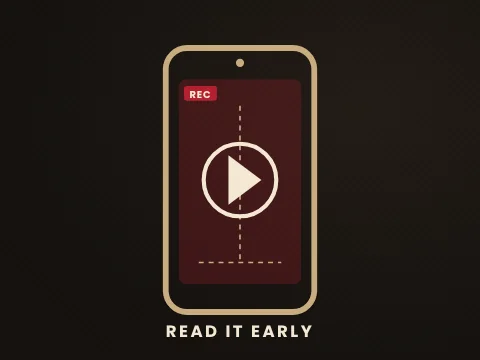
What I’d do with it: stop selling “see it late” as the answer. Train the early pickup: the release window, the first few feet of flight, the direction it comes out. Drills where the hitter calls the pitch from the first third of flight, like the ones in Cut the Video Short. That’s See It → Recognize It → Attack It.
4. Pros lost decision quality when the ball disappeared
Naoki Saijo, Takehiro Fukuda and Makio Kashino put 23 Japanese professional hitters in VR built from real game pitches. When the ball vanished midway, their strike/ball calls slipped (hit rate .78 to .67), and their bat-path adjustment to location dropped the most. Timing adjustment to speed held up (Saijo, Fukuda & Kashino, 2025).
The limits: artificial occlusion in VR. It doesn’t prove one fixed order for every hitter.
What I’d do with it: timing, zone decisions and location adjustment are three different problems. A hitter can be right on time and still swing at a bad pitch, or square up the wrong spot. Diagnose which one it is. Less is more: fix one at a time.
5. Can you train pitch recognition at home without VR?
Yes, with a caveat. The VR study worked because hitters swung a real bat and made real decisions. The headset wasn’t the magic. The decisions were.
You can get most of that without buying anything:
- Cut the video short. Watch pitcher video and pause it just after release. Call the pitch and the location before you see the rest. More in Cut the Video Short.
- Train spin reads. The free Spin Read Test takes two minutes a day.
- Take it to live reps. Screen work has to show up against a real ball. Mixed front toss or machine: take or commit, and say why.
- Rehearse the nasty ones. That’s the Galvan Method below.
The limit: none of this has been proven to beat VR or live at-bats. Treat screen work as extra reps for the eyes and brain, not a replacement for seeing real pitching.
6. For softball hitters: what elite fastpitch hitters read
Jan Carboch, Petra Praveckova and Marek Joska interviewed eight elite fastpitch hitters about how they anticipate pitches. The hitters described a mix: game context, the pitcher’s body and release, tactical awareness, confidence and their batting plan (Carboch, Praveckova & Joska, 2026).
That’s self-report, not proof that any single cue makes you a better hitter. It IS a great starting point for conversations with your softball hitters: ask them what they read, then build drills around their answers. Start with our Softball Hitting Timing Drills and Train the Eyes Without Swinging.
7. What this means for your Processor
Here’s how I’d put it all together in the cage:
- Pick up information early.Release and first flight, not a last-second rescue.
- Train the zone separately from timing.Different problems, different drills.
- Make real take-or-commit decisions under real time pressure.I’ve never seen a really good passive hitter.
- Use the situation to build a plan,not to stop watching the ball.
- Don’t oversell any one cue.No single gaze pattern or “late adjustment” trick works for everybody.
As I tell every hitter: “Swing at a bad pitch? No biggie. Take a good pitch to hit? Not happening.” Decide early, then be aggressive on the pitch you can drive.
8. The Galvan Method: the research, in a real hitter
I’ve seen all of this in one hitter: Justin Galvan. Justin hit in the 3-hole for one of the best teams in the country and hit over .400 across four seasons of high-level college baseball. Average body, below-average speed. What made him elite was his Processor.
Justin’s habit is what I call the Galvan Method. Every time he saw a pitch with nasty or unusual movement (swing, take or miss), he stepped out, took a breath and replayed it 5–10 times: the release, the spin, the shape, where it finished, and his barrel getting there on time. Then he kept replaying it on deck, in the dugout and between innings.
By the end of a game, he’d “seen” that first-inning curveball 50 times. The pitcher had thrown it maybe three.
Look at what he was feeding his brain: release and early flight, the exact information the studies say drives WHERE the swing goes. And he was building the internal timing model that held up even when the ball disappeared. The studies didn’t test visualization, so I won’t claim they prove it. But it’s See It → Recognize It → Time It, rehearsed until the real pitch looked familiar.
Feed the information to your brain over and over. When you get up next, you’re more prepared.
THELESSON.
- Replay the nasty pitch 5–10 times
- Release, spin, shape, finish
- On deck, dugout, between innings
- 50 looks at a pitch thrown 3 times
Complete Hitters Are Built…Earned.
9. Train your Processor with AHD
Start with the free Spin Read Test to see how well you pick up spin right now. Then join the Academy waitlist. The Hitting Processor is Level 3 of the Complete Hitter Academy, built the AHD way: one step at a time, all four pillars working together.
Want a coach’s eyes on your swing decisions? Send video to AHD Hit Lab.
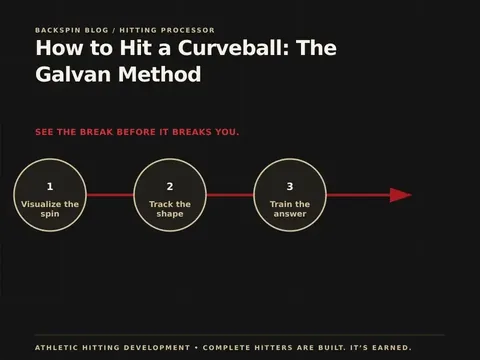
Want to go deeper? Read How to Hit a Curveball: The Galvan Method and Time It, Decide, Adjust: The Order Your Brain Hits In.
Quick answers
What is pitch recognition in baseball and softball?
It’s a hitter’s ability to read what a pitch is and where it’s going early enough to decide whether to swing. At AHD it’s the See It and Recognize It steps of the Hitting Processor.
Does VR batting training actually work?
Early research is promising. One 2026 study found VR batting with a real swing helped trained players swing at more strikes, but it was small and short-term.
Should hitters “see the ball late” or early?
New research says early ball flight matters most for where you aim the swing. Hitters still adjust during the swing, but early pickup is the foundation.
How do you train hitting timing?
Start your load early and on time so you can adjust to the pitch you get. Waiting longer by itself isn’t a timing plan.
Sources: Saijo, Fukuda & Kashino (2025), Frontiers in Psychology: The temporal structure of multiple visuomotor processes in baseball batting · Jang et al. (2026), Frontiers in Psychology: Predictive and prospective control strategies of elite batters during interception tasks · Hayashi, Ikudome, Takamido, Cañal-Bruland & Nakamoto (2026, accepted), Journal of Experimental Psychology: Human Perception and Performance: Pre-planned vs. online control in baseball batting · Carboch, Praveckova & Joska (2026), Journal of Human Sport and Exercise: Anticipatory information sources in elite softball batting · Romero Clavijo et al. (2026), conference abstract: VR batting practice and swing decisions
Don’t collect drills. Build a complete hitter.
Complete Hitters Aren’t Born. They’re Built… and Earned.