By Tyson Heskett, AHD parent
Complete Hitters Aren’t Born. They’re Built… and Earned.
Key takeaways
- Loving fastpitch and knowing how to develop fastpitch hitters are not the same thing.
- AHD starts with assess → diagnose → prioritize → train → reassess: one correction that matters beats six cues that don’t.
- The 4 Pillars cover the whole fastpitch hitter, including the Hitting Processor for a 43-foot reaction-and-decision game.
- The credential is earned: 8 course finals, a 50-question Certification Final and a filmed coaching exam graded by BK.
For a softball hitting coach who wants to get better, AHD’s certification is a no-brainer: invest in a complete system, learn to diagnose instead of guess, and prove you can actually coach.
For a fastpitch coach who wants to get better, AHD’s certification covers the whole hitter across 4 pillars, with Softball notes where the sports differ. It has to be earned: 8 course finals, a 50-question final and a filmed coaching exam graded by BK.
Train it: AHD Softball Hitting Coach Certification →Tyson Heskett is the parent of two kids who train with BK. This is his view of what a great hitting coach does, and why the AHD certification makes sense for softball coaches. Tyson reviewed and approved this post.
As a parent, I’ve seen what it looks like when a coach really knows how to develop hitters: the moment a hitter finally figures out something they’ve struggled with for weeks. Loving the game and knowing how to develop hitters are not the same thing.
A coach can have great intentions and spend hours throwing front toss, running drills and studying swings. But if that coach can’t explain why a hitter is struggling, identify her most important limitation or help an adjustment transfer into games, is she really getting everything she deserves? That’s why the AHD Softball Hitting Coach Certification deserves a serious look.
1. Coaches Don’t Need 100 More Drills. They Need a Better Way to Teach.
There isn’t a shortage of hitting information. There’s a shortage of clarity. Scroll through social media for five minutes and you’ll find somebody telling hitters to stay back, another saying get forward, one telling them to swing up and somebody else promising one drill will fix everything.
What happens when a player’s swing looks great off the tee but she can’t hit a good rise ball? When she crushes predictable front toss but struggles to recognize a changeup? Or when she has all the physical tools and loses confidence after a rough weekend? Those aren’t necessarily the same problem, and they shouldn’t get the same correction.
- AssessLook at the evidence before you coach.
- DiagnoseFind the root cause, not just the visible result.
- PrioritizeAnswer the big question: what actually needs to improve first?
- TrainGive one correction that matters.
- ReassessCheck that it changed — and that it shows up in games.
One correction that matters beats six cues that don’t.
2. The Four Pillars Address the Whole Fastpitch Hitter
AHD’s philosophy is built around four pillars, and none of them is treated as optional.
FASTPITCH COACHES
THE 4PILLARS.
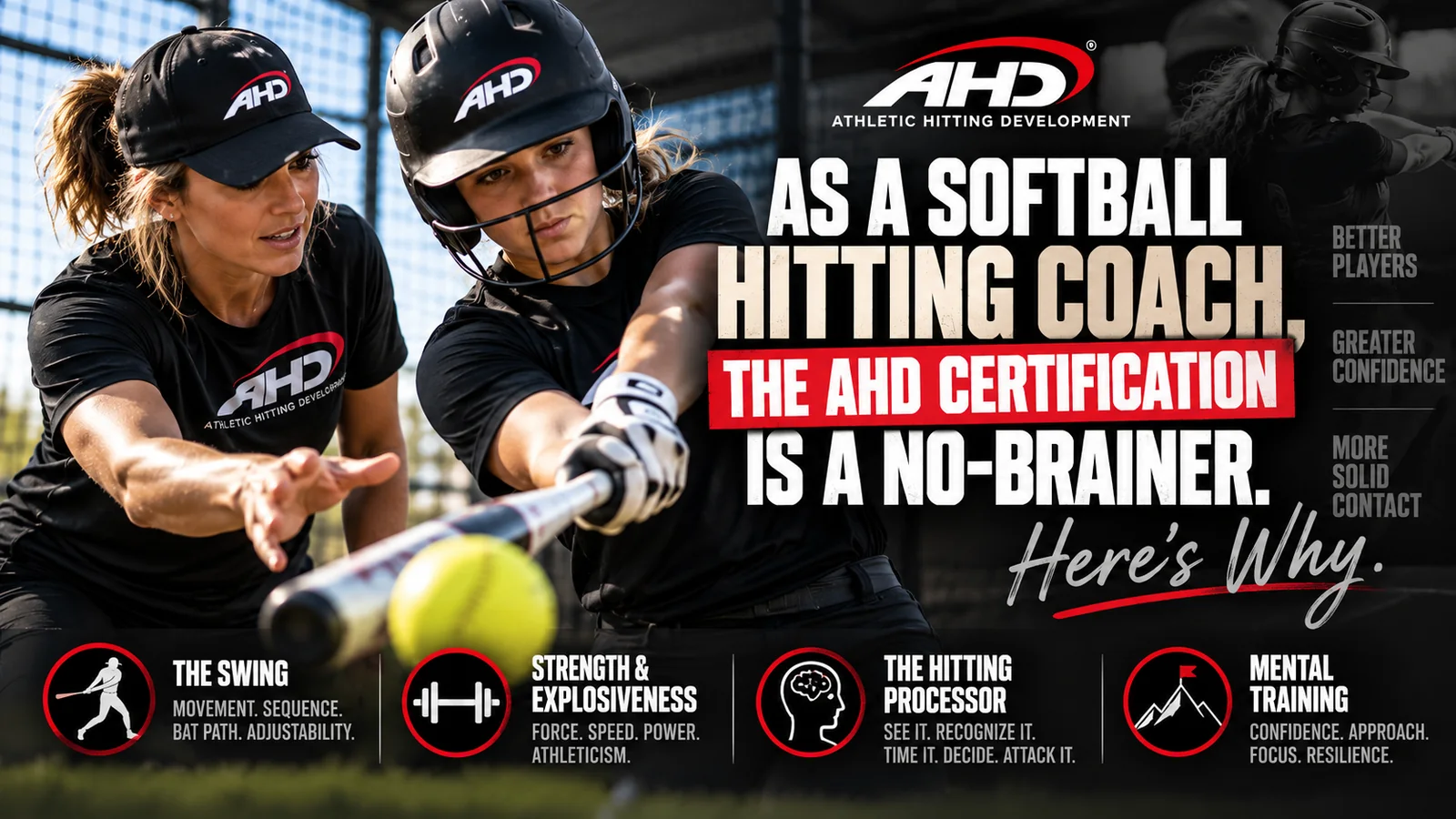
- The Swing
- Strength & Explosiveness
- The Hitting Processor
- Mental Training
BUILD THE WHOLE HITTER.
The Swing — Movement, Sequence, Bat Path, Adjustability. Understand more than how a swing looks in slow motion: why one hitter gets jammed, another rolls over and another can adjust the barrel late without losing power. Know which movements are useful and which visual differences are simply a player’s individual style. A good hitting coach shouldn’t turn every athlete into the same picture.
Strength & Explosiveness — Force, Speed, Power, Athleticism. Softball players are athletes first. Balance, strength, body control, mobility and explosiveness affect how effectively they swing. The goal is to connect physical development and hitting development, not send players to the weight room and hope it transfers.
The Hitting Processor — See It → Recognize It → Time It → Decide → Attack It. This might be the most important reason to explore AHD. Fastpitch is a reaction and decision-making game: a hard pitch one at-bat, an off-speed pitch the next, and movement that makes two pitches look similar out of the hand. If you only coach what happens after the hitter decides to swing, you’re leaving out an enormous part of offensive development.
Mental Training — Confidence, Approach, Focus, Resilience. Every softball coach has seen confidence disappear after a few strikeouts or a bad tournament. Good mechanics don’t automatically solve a hitter’s fear, frustration or confusion. Helping players compete with a clear approach, recover after failure and trust their preparation is part of coaching hitting, too.
The goal isn’t a prettier swing. It’s a better hitter.
3. Fastpitch Has Its Own Demands. A Coach’s Education Should Recognize Them.
Fastpitch isn’t just baseball with a bigger ball. At the high school and college levels, pitchers work from 43 feet. Hitters must read an underhand release, different pitch shapes, changing speeds and demanding game situations. Slapping and the short game add further tactical requirements for certain players and teams.
You shouldn’t pay for an education that assumes every baseball example translates perfectly to softball. AHD is one certification for baseball and fastpitch softball coaches, with a Softball note in the lessons wherever the sports differ.
That doesn’t mean blindly assuming every lesson is the right fit. Watch the free sample lessons, review the syllabus and ask questions about your players’ ages and needs. But the program starts from the right place: shared hitting principles, with attention to the sport being coached.
4. A Credential Should Be Earned, Not Just Bought
This is where the program separates itself from the idea of a weekend certificate. The coach pathway includes:
- 8 coaching courses and 144 coach lessons across complete-hitter development, swing structure, athletic development, the Hitting Processor, mental approach, off-speed hitting, bunting and coaching methodology.
- A final test in each course to check what the coach understands.
- A 50-question Certification Final covering the broader system.
- Practical coaching work and a filmed video exam graded by BK.
Those requirements matter because a piece of paper shouldn’t be the only outcome. The point is to become the coach who can look at a hitter, identify the root issue, explain it clearly, organize meaningful training and demonstrate what changed.
To be clear: AHD Certified Coach is an AHD-issued credential, not an externally accredited CEU or a substitute for required league, school or safety credentials. That distinction is worth understanding before anyone enrolls.
5. Better Coaching Is Worth More Than a Line on a Résumé
Whether you coach youth, travel ball, high school or private lessons, families trust you with something important: their athlete’s development. You should be able to explain what you’re doing and why, show a plan instead of stringing together random cage sessions, and track improvement without promising a certain batting average or scholarship.
That kind of professionalism builds trust. And if you teach lessons privately, being a clearer, more organized coach can strengthen your business over time. But a certification doesn’t automatically create clients or guarantee results.
The value is in the skills you use, not the letters beside your name.
6. The Price Makes the Decision Easier — but the Education Has to Deliver
AHD lists a $599 founding price (regular $799) for the full coaching certification: the eight-course curriculum, assessments and the practical certification process, with one year of course access. At $150 an hour, a common rate for private fastpitch hitting lessons, that’s about 4 hours of lessons. (Simple math at that rate, not an income guarantee.)
Still, don’t buy on a sales pitch alone. The right questions are whether you can apply the material, how much feedback and practical evaluation you receive, and whether the lessons fit the level of hitters you work with.
The first three lessons of every coach course are free. That’s where to start. If the teaching is clear and the material challenges you in useful ways, the rest of the program becomes a much easier decision. Enrollment opens November 15, 2026.
7. What I Want From My Kids’ Hitting Coach
When my kids step into the cage, I want their coach to have a reliable process rather than a quick opinion: identify the priority instead of chasing every imperfection, and see whether a problem comes from movement, timing, pitch recognition, approach or some combination.
Give a simple cue, choose an appropriate drill, challenge the hitter with more game-like practice and reassess. Know when not to make a change. And explain all of this to the athlete and her parents without hiding behind complicated language. That’s what better coaching looks like from the parent’s side of the fence.
THELESSON.
- Find the priority
- Coach the cause
- One cue, one drill
- Reassess every time
Complete Hitters Are Built…Earned.
8. If Coaches Expect Players to Improve, They Have to Keep Improving Too
We ask softball players to work at their craft every week: practice when it isn’t easy, study their mistakes, challenge themselves and keep learning. Coaches should be willing to do the same.
You don’t have to pretend you know everything, and you don’t need to have played professionally to care deeply about the details of teaching. But you do have a responsibility to keep learning, question your habits and invest in the athletes who trust you.
That’s why AHD’s certification is a no-brainer for a serious softball hitting coach. Not because a certificate magically makes anybody great, but because a complete curriculum, a clear coaching framework and a practical assessment give you a meaningful way to become better.
9. The Bottom Line: Better Coaches Build Better Softball Hitters
The goal isn’t to collect coaching certificates. It’s to help players understand their swings, recognize pitches, become stronger and more explosive, compete confidently and make adjustments when a game demands it. If a program helps you do those things more effectively, it improves far more than your coaching résumé. It improves what you bring to every hitter you work with.
Great hitting is built, not found. Great coaching should be built, too.
EXPLORE AHD’S SOFTBALL HITTING COACH CERTIFICATION →
START THE FIRST FREE COACH LESSON →
JOIN THE NOVEMBER 15 LAUNCH LIST →
Want to go deeper? Read Online Softball Hitting Coach Certification: A Fastpitch Coach’s Guide and Baseball Hitting Coach Certification: Why I Believe AHD Is the Best Investment a Hitting Coach Can Make.
Quick answers
Is AHD’s hitting coach certification designed for softball coaches?
Yes. It is one certification for baseball and fastpitch softball coaches, with a Softball note wherever the sports differ. Review the free lessons to decide whether it fits your level and your hitters.
Do I need professional playing experience to enroll?
No. It is built for youth coaches, travel and high school coaches, private instructors and parents who coach. Playing experience helps, but the program focuses on teaching and assessment skills.
Does completing the videos automatically make me certified?
No. You must pass a final test in each of the 8 courses, the 50-question Certification Final and a practical filmed coaching exam graded by BK.
Is AHD an accredited CEU?
Not at present. AHD Certified Coach is an AHD-issued credential, not an externally accredited CEU.
What does the softball hitting coach certification cost?
The founding price is $599 (regular $799), with one year of course access. Lessons 1–3 of every coach course are free, and enrollment opens November 15, 2026.
Don’t collect drills. Build a complete hitter.
Complete Hitters Aren’t Born. They’re Built… and Earned.