By BK, Athletic Hitting Development
Complete Hitters Aren’t Born. They’re Built… and Earned.
Key takeaways
- Being able to hit doesn’t mean you can teach hitting — and 20 years of coaching isn’t automatically 20 years of getting better at it.
- AHD coaches learn the 4 Pillars: The Swing, Strength & Explosiveness, The Hitting Processor and Mental Training — and how they work together.
- The coaching process is Assess → Diagnose → Prioritize → Train → Reassess. Coach causes, not symptoms.
- The credential is earned: 8 courses, 8 final exams, a 50-question Certification Final and a Practical Video Exam graded by BK.
GREAT HITTING IS BUILT, NOT FOUND. GREAT HITTING COACHES ARE TOO. AHD’s certification is built to make you a better coach of the complete hitter — and the credential has to be earned, not bought.
AHD’s hitting coach certification teaches the complete hitter across all 4 pillars, not just the swing, plus a repeatable assess-diagnose-train-reassess process. It has to be earned: 8 course exams, a 50-question final and a filmed coaching session graded by BK.
Train it: AHD Complete Hitter Development Coach Certification →There are thousands of baseball and softball hitting coaches across America. Some are former professional players. Some played college baseball. Some have coached for 30 years. Others are parents, young coaches or former players who simply love teaching the game.
But here’s something I’ve learned after more than 25 years developing hitters privately — on top of 30 years coaching high school and college ball: being able to hit doesn’t automatically mean you can teach hitting. And having coached for 20 years doesn’t automatically mean you’ve spent 20 years getting better at coaching.
Great coaching requires more than experience. It requires understanding, curiosity, a repeatable process and the ability to communicate complicated information in a way an athlete can actually use. That’s why I built the AHD Complete Hitter Development Coach Certification. Not to sell another certificate. To help build better hitting coaches — and ultimately, better hitters.
1. The Biggest Problem in Hitting Instruction Today
We have more baseball information available than at any point in history: more videos, more data, more technology, more swing-analysis software, more drills and more opinions.
Yet too many hitters are still confused.
One instructor tells a hitter to stay back. Another tells him to get forward. One says swing down. Another says swing up. A hitter can receive five different corrections from five different coaches in one week — and the athlete is left trying to figure out whom to believe.
The problem isn’t a lack of hitting information. It’s coaches who never learned to organize it, evaluate it and teach it.
That is where AHD starts. We don’t want coaches memorizing 100 drills. We want coaches who understand why a drill works, when it should be used, who needs it and how to determine whether it actually helped. That’s a completely different level of coaching.
2. Why AHD Is Different From a Typical Hitting Certification
There are valuable coaching education programs available, and different certifications serve different purposes. Some concentrate on coaching fundamentals and safety. Others emphasize biomechanics, strength training, movement screening or technology. Those are worthwhile subjects. (If you want them side by side, I compared the types in Hitting Coach Certification Programs Compared.)
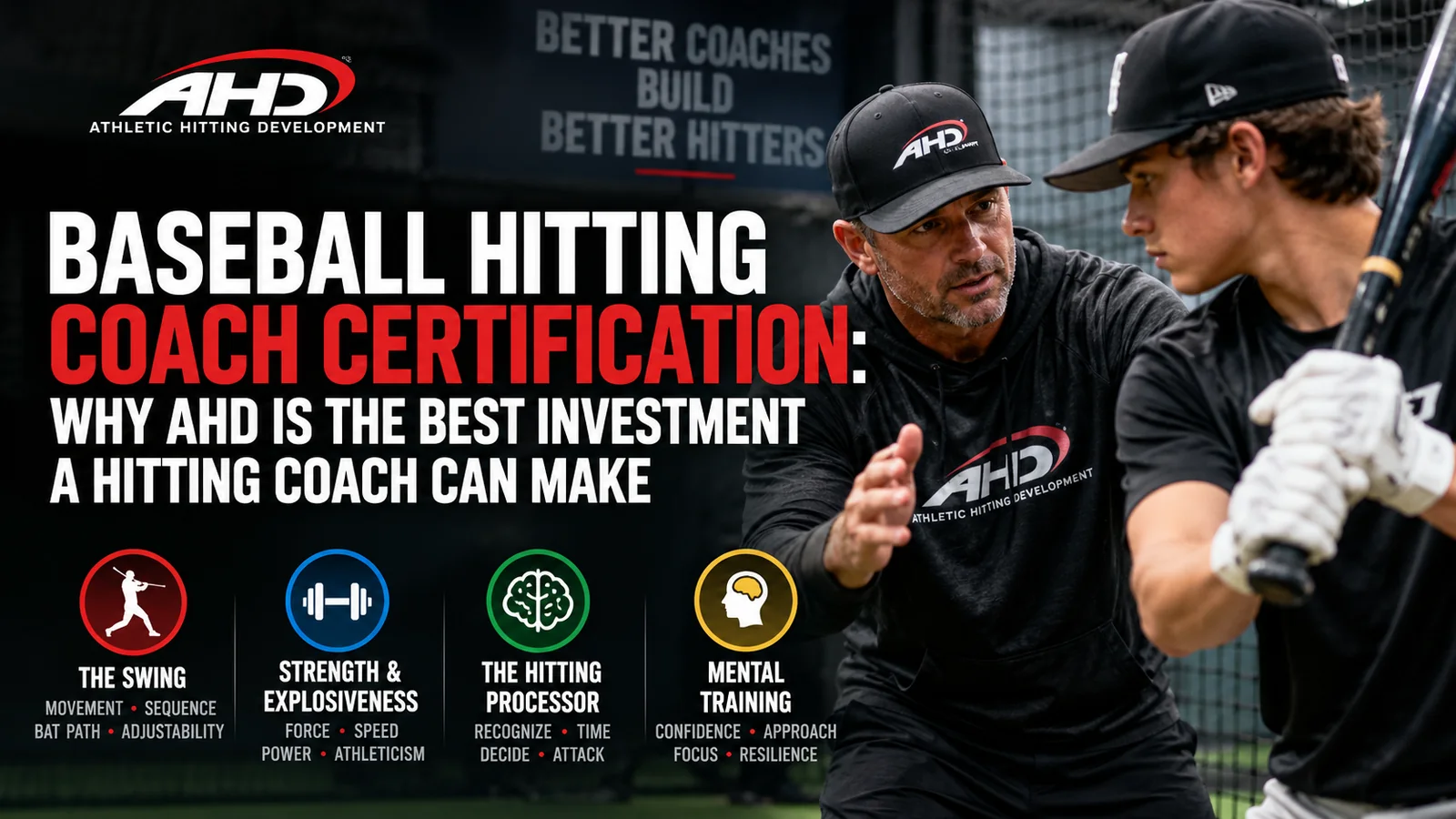
But I believe the best hitting coaches must understand something bigger: the complete hitter. A hitter isn’t just a swing. They’re an athlete who must move, generate force, recognize pitches, control timing, make decisions and compete under pressure. That’s why every AHD coach learns our Four Pillars of Complete Hitter Development.
FOR COACHES
THE 4PILLARS.
- The Swing
- Strength & Explosiveness
- The Hitting Processor
- Mental Training
ALL 4. TOGETHER.
Pillar 1: The Swing — Movement • Sequence • Bat Path • Adjustability. Understand what creates a powerful, efficient, adjustable swing. Learn to evaluate athletic setup, gather, forward movement, launch, contact, extension and finish. Understand why Mechanically Advantaged Angles (MAA) matter, how force reaches the barrel and how hitters keep a large margin for error. Most importantly, learn to separate a hitter’s personal style from the underlying movements that make the swing effective. We’re not teaching every hitter to look identical. We’re teaching coaches to recognize what great swings have in common.
Pillar 2: Strength & Explosiveness — Force • Speed • Power • Athleticism. A mechanically efficient swing can only produce the force the athlete is capable of generating and controlling. Coaches need to understand athletic development: balance, body control, strength, rotational explosiveness, speed and mobility — and how these qualities influence hitting performance. AHD teaches coaches to connect athletic development to what happens in the batter’s box rather than treating the weight room and the hitting cage as two separate worlds.
Pillar 3: The Hitting Processor — See It → Recognize It → Time It → Decide → Attack It. This is one of the most overlooked areas of hitting instruction. I’ve seen plenty of beautiful batting-practice hitters who couldn’t consistently hit quality pitching. Why? Because hitting isn’t simply executing a swing. It’s processing information quickly enough to make a good decision and deliver the barrel on time. You can build a beautiful swing, but if the hitter doesn’t recognize the pitch, time it correctly or make a good decision, what have you really accomplished?
Pillar 4: Mental Training — Confidence • Approach • Focus • Resilience. Hitting is difficult. Failure is built into the game. A good coach must know how to help a hitter respond to adversity, handle pressure, maintain confidence and compete with a clear approach. We teach coaches how to develop routines, build confidence through preparation and help athletes stay aggressive without becoming reckless. Because mechanics alone won’t save a hitter who is afraid to fail.
The best hitting coaches develop all four pillars — and understand how they work together.
3. Stop Coaching Symptoms. Start Identifying Causes.
This may be the most valuable thing an AHD coach learns. A hitter rolls over three consecutive ground balls. What does the average coach do? Change the hands. Move the tee. Give a cue. Try a drill. Maybe that works. Maybe it doesn’t.
An educated coach asks a better question: WHY is the hitter rolling over? Was it poor posture? Bad timing? Early rotation? An inefficient barrel path? Loss of body control? Poor pitch selection? The visible result doesn’t automatically tell you the cause.
AHD teaches a systematic coaching process:
- AssessIdentify the symptom and evaluate the swing checkpoint.
- DiagnoseLook for the root cause, not the visible result.
- PrioritizeFind the hitter’s biggest limitation — one thing, not fifteen.
- TrainSelect the correction that addresses the actual issue.
- ReassessMeasure the result, and check that it transfers into game hitting.
No guessing. No throwing 15 corrections at one athlete. No changing something simply because it looks different. Find the biggest limitation. Fix it. Measure it. Move forward. That’s how coaching becomes a repeatable process rather than a collection of opinions.
4. Why This Certification Has to Be Earned
There is something I strongly believe: a certificate should represent an accomplishment — not merely a payment. That’s why the AHD Hitting Coach Certification goes beyond watching instructional videos. The program includes:
- Eight complete coaching courses. 144 coach lessons covering swing development, athletic development, the Hitting Processor, mental training, off-speed hitting, bunting and complete-hitter coaching.
- Eight course final exams. Each course has an assessment that must be passed.
- A 50-question Certification Final. A cumulative test of the coaching system.
- Practical assignments. Including hitter evaluation and individual training plans.
- A Practical Video Exam. A filmed coaching session evaluated by BK against a scoring rubric.
- An AHD Certified Coach credential. Awarded after the requirements are successfully completed, with a registry listing.
I want to see whether you understand the information. But more importantly, I want to see whether you can actually teach it. Can you identify a hitter’s most important limitation? Explain the cause? Make the correction understandable? Organize a practice? Build a development plan? Demonstrate effective coaching with a real athlete? Those are the questions that matter.
To be clear: AHD certification is an AHD-issued credential. It is not currently an externally accredited CEU or a replacement for other required coaching licenses or safety training. (More on that in NFHS vs. Hitting Coach Certification.) The credential should stand for demonstrated knowledge and practical coaching ability.
5. Why Every Serious Hitting Coach Should Consider It
Think about what improving your coaching education can do.
| Coach | What it helps you do |
|---|---|
| Youth coaches | Stop overwhelming developing hitters with conflicting instructions. Teach movements, athletic skills and competitive habits in a logical progression. |
| High school coaches | Build a more consistent offensive development program, identify individual needs and give your staff a common instructional language. |
| College coaches | Strengthen player assessments and development plans, and connect physical development, swing mechanics and pitch processing with game performance. |
| Private instructors | Offer a more organized coaching experience and explain to parents exactly what an athlete is working on and why. |
| Former players | Turn playing experience into teaching ability. What worked for you might not be what works for the next athlete. |
| Softball coaches | Apply the complete-hitter philosophy to fastpitch while respecting differences in pitching, timing and player development. |
The benefit isn’t simply putting three more letters behind your name. It’s becoming more valuable because you understand more, diagnose better and teach more effectively. (Fastpitch coaches: see Online Softball Hitting Coach Certification.)
6. The Business Side: Better Education Creates Greater Coaching Value
You can love coaching and still want to make a good living doing it. If you’re a private instructor, your long-term value comes from helping athletes improve, building trust and creating an experience families believe in.
Parents aren’t just buying 45 minutes in a batting cage. They’re investing in the hope that their child becomes a better, more confident player. Your ability to give a clear assessment, communicate a development plan and show meaningful progress is what separates professional instruction from supervised batting practice.
An AHD certification doesn’t guarantee clients, income or better player results — but a stronger coaching process gives you something important to build your reputation around.
Don’t compete by claiming you know more drills. Compete by showing you know how to develop hitters.
7. Why I Believe AHD Is One of the Best Choices for Serious Hitting Coaches
Here’s what I bring to this program: more than 25 years of private hitter development, 30 years coaching high school and college baseball and softball, work with more than 200 professional players, 2,000 college players and 100,000 high school and youth athletes, and camps and clinics across 39 states. (The longer version is in BK on BK.)
Decades of studying swings, evaluating hitters, questioning conventional instruction and learning what translates into better performance. That experience doesn’t mean I know everything. It means I’ve had the opportunity to study an enormous number of hitters, learn from their successes and failures, and refine the way I teach. And I’m still learning. A great coach should never be finished learning.
I built AHD around that philosophy. I believe its combination of complete-hitter education, practical instruction, systematic diagnosis and evaluated coaching makes it an outstanding choice for coaches who want more than a quick certificate. You won’t be asked to memorize my favorite swing. You’ll be challenged to understand hitting deeply enough to coach different kinds of athletes. That’s the difference.
8. What Will You Be Able to Do After AHD Certification?
My goal is that a coach who completes the program can walk into a cage, observe a hitter and approach the session with clarity. Instead of immediately changing five things, you’ll have a process for evaluating what matters most.
You’ll be better equipped to build a lesson around one priority, explain why you’re teaching it and select training that addresses the actual issue. You’ll understand how that hitter’s strength, athleticism, timing, pitch recognition and mental approach influence performance. And you’ll know how to reassess the athlete rather than assuming a drill worked because the last five batting-practice swings looked good.
The certificate is evidence of completing and passing the program’s standards. The real reward is what you can take into the cage and onto the field.
9. The Best Coaches Invest in Themselves
Coaches ask athletes to make sacrifices every day: get stronger, study your swing, watch video, learn from mistakes, stay disciplined and put in the work. But how often do we demand the same things from ourselves?
If you’re going to ask an athlete to invest hundreds of hours in becoming a better hitter, why wouldn’t you invest in becoming a better coach? You cannot guarantee every athlete will become a great hitter. But you can control the preparation, knowledge and effort you bring to teaching that athlete.

THELESSON.
- Assess before you instruct
- Fix causes, not symptoms
- One priority at a time
- Reassess every time
Complete Hitters Are Built…Earned.
Every hitter who trusts you with their development deserves a coach who is still working to get better. Continued coaching education should be a responsibility, not an afterthought.
10. How Much Does AHD Hitting Coach Certification Cost?
The current founding price for the complete AHD certification is $599 (regular $799). That includes the eight-course coaching curriculum, assessments, certification examinations and practical evaluation requirements, with one year of course access. A $995 tier adds my personal review of your athlete assessment and development plan.
Lessons 1–3 of every course are free, so you can evaluate the teaching approach before committing. Enrollment opens November 15, 2026.
EXPLORE AHD HITTING COACH CERTIFICATION →
JOIN THE COACH CERTIFICATION LAUNCH LIST →
11. The Bottom Line: Better Coaches Build Better Hitters
I don’t believe the baseball and softball world needs another generation of coaches repeating things they don’t fully understand. We need educated coaches. Curious coaches. Coaches who study the game, challenge their assumptions, communicate clearly and care enough to keep getting better. Coaches who can explain not only WHAT they’re teaching, but WHY.
The AHD Hitting Coach Certification exists to help develop those coaches. And if you’re serious about teaching hitting, I believe it’s an investment worth making. Not because a certificate makes you great, but because the work required to earn it can help make you better.
STOP GUESSING. START DEVELOPING COMPLETE HITTERS.
GREAT HITTING IS BUILT, NOT FOUND. GREAT COACHES ARE BUILT, TOO.
— BK, Founder, Athletic Hitting Development
BECOME AN AHD CERTIFIED HITTING COACH →
Want to go deeper? Read How to Become a Certified Hitting Coach (2026 Guide) and Hitting Coach Certification Programs Compared (2026 Guide).
Quick answers
Do I need to have played professional baseball to become a certified hitting coach?
No. Playing experience can be valuable, but teaching requires its own knowledge and skills. AHD is designed for coaches, instructors and committed parents at various levels of experience.
Is the AHD certification for baseball and softball?
Yes. AHD covers both baseball and fastpitch softball hitting development, recognizing differences between the sports while teaching common principles of athletic movement, bat delivery and competitive hitting.
Can a hitting coach certification help me attract clients?
A certification can support credibility and show a commitment to coaching education. Families should also consider communication, professionalism, player development process and results. Certification by itself doesn’t guarantee business success.
What makes AHD different from a basic online coaching course?
AHD combines eight coaching courses with knowledge assessments, a cumulative certification exam and a practical filmed coaching evaluation. The program addresses the complete hitter rather than swing mechanics alone.
Is AHD certification an official coaching license or accredited CEU?
No. It is an AHD-issued coaching credential earned by meeting the program’s requirements. External CEU accreditation has not yet been approved.
Don’t collect drills. Build a complete hitter.
Complete Hitters Aren’t Born. They’re Built… and Earned.