By BK, Athletic Hitting Development
Complete Hitters Aren’t Born. They’re Built… and Earned.
Key takeaways
- The offseason isn’t time away from development. It’s the development window, the one stretch with no game demanding the next at-bat.
- Recover first, then train with direction. Rest and training belong in the same plan.
- Start with an honest assessment, not a drill. Pick two or three priorities across the 4 Pillars and train them every week.
- Finish with evidence: what you worked on, why, proof on video and in live at-bats, and a plan for opening day.
The offseason builds complete hitters because it’s the only stretch of the year with time to fix what the season exposed. Recover first, then train a few honest priorities across all 4 Pillars, and prove the change before spring.
The offseason builds complete hitters because it’s the one time of year with room to fix what the season exposed. Recover first, assess honestly, train two or three priorities across all 4 Pillars, and finish with video and live at-bat proof.
Train it: Complete Hitter Masterclass → Free tool: SwingChecker™ →Every fall I hear two versions of the same mistake. One family shuts it all down until February. Another books the cage five nights a week and calls it work. Neither one builds a hitter.
The offseason isn’t time away from development. It IS the development window. Games are where you find out what you have. The offseason is where you build what you’re missing.
1. What does the Arizona Fall League teach young hitters?
The Arizona Fall League plays right here in the Valley, close to where I coach in Scottsdale. MLB.com calls it top prospect finishing school. These are some of the best young players in pro baseball, and they’re still building in October.
One example from this fall: MLB.com reported that Pirates prospect Wyatt Sanford, held to 77 games in 2026 after a broken hand, is using the Fall League to make up lost reps and refine his approach. In his words, he’s working on “just making sure I’m a complete hitter.”
That’s a pro, with pro coaching, still treating the fall as a building season. Not a quick swing fix. A plan. Your high school, travel or college hitter deserves the same thinking, scaled to his schedule.
The offseason is not a vacation. It’s the development window.
2. Should my hitter rest or train in the offseason?
Both. In that order. Parents hear “offseason” and picture one of two things: nothing at all, or nonstop cages. Neither is the answer.
The healthy model is simple. Step away long enough to recover physically and mentally. Then train with direction. The season drains the body and exposes weaknesses, and you need a fresh body to fix them.
- Recover. A real break from swinging and throwing. Sleep, eat, let the nagging stuff calm down.
- Move and get strong. Strength, speed and movement quality, built in the right order. It’s the pillar most hitters skip in-season.
- A few swing priorities. Two, maybe three. Not ten.
- Hitting Processor work. Pitch-recognition and decision games, a few minutes every day.
- Short video check-ins. Same angles every time, so you can see real change.
- Another sport or real time away. Come back hungry, not burned out.
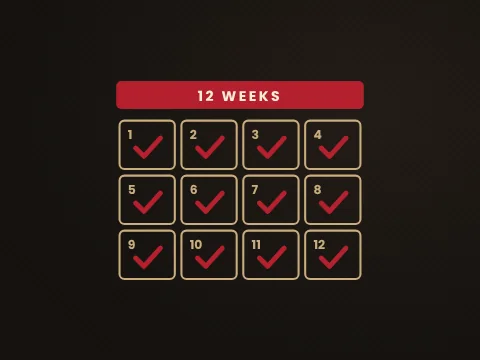
Want a week-by-week calendar? I laid one out in the 12-week offseason hitting plan. College hitters working around fall ball and team lifts should read the college hitter offseason plan. This post is the step before the calendar: deciding what to work on.
THE OFFSEASON PLAN
REST.THEN BUILD.
- Recover body and mind
- Assess before you drill
- 2–3 swing priorities, not 10
- Processor work every day
- Prove it on video
THE DEVELOPMENT WINDOW
3. What should a hitter work on in the offseason?
“Keep your hands back” is not a plan. “Get more connected” is not a plan. Those might be feels that help a hitter, but they need a reason and a way to test whether they work.
At AHD the offseason starts with assessment. Before anybody picks a drill, answer honest questions about last season:
- What happens when he’s on time?If he barrels it when he’s on time, the swing may be fine and the problem lives somewhere else.
- What happens when he’s late?Late can mean a slow start, a long path or a late decision. Each one has a different fix.
- Where does he miss?Under it, rolled over, jammed, out front? The miss pattern points at the cause.
- Can his body repeat the move?If the swing falls apart in the fifth round or the fourth inning, strength and conditioning may be the real issue.
- Does he have a plan in the box?A hitter with no plan chases whatever the pitcher wants him to chase.
Start with the free SwingChecker™. In about three minutes it ranks your hitter’s top priorities across all 4 Pillars, with cues, drills and matching free lessons. Now you’re training the problem instead of guessing at it. For a deeper 12-skill rating, read how to evaluate a hitter and use the free 4 Pillars Hitter Scorecard on the Hitter Development Roadmap.
Once you know the cause, training gets efficient. One hitter needs athletic power. Another needs a better plan for the low pitch. Another needs the confidence to take a strike instead of chasing a pitch he can’t handle. Same offseason, three hitters, three different plans.
4. How do you build a complete hitter, not just a new swing?
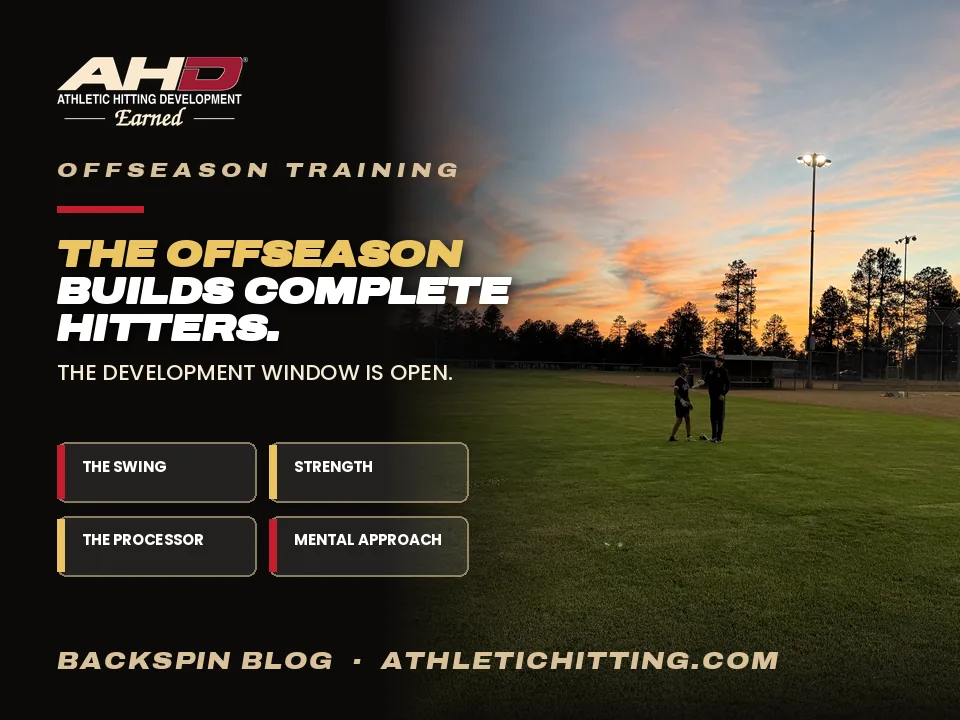
A complete hitter stands on four pillars: The Swing, Strength & Explosiveness, the Hitting Processor and the Mental Approach. The offseason is the one time of year you can touch all four every week without a Saturday tournament demanding the next at-bat.
- The Swing. Build positions that let the body deliver force. AHD hitters work to get into Mechanically Advantaged Angles (MAA), so the swing holds up against velocity, not just off a tee.
- Strength & Explosiveness. Two or three strength sessions and some speed work each week. A stronger body repeats a better move.
- The Hitting Processor. See it, time it, decide, attack it. Trained DAILY, five to ten minutes is plenty.
- Mental Approach. A plan for every count and a routine you’ll actually use in March.
A sample week for a high school hitter: three swing sessions of 20 to 30 minutes (tee and front toss with intent), two or three strength sessions, processor work every day, and one session against live arms or a machine where he has to make real decisions. Adjust it around school, another sport and fall ball.
I tell hitters this every fall: “Two choices: A. Do everything in your control. B. Anything but A.” Almost everything in the offseason is controllable: effort, sleep, preparation, attitude and the reps you choose to take.
5. How do you know if the offseason worked?
Every hitter should finish the offseason able to say four things:
- Here’s what I worked on.One to three priorities, named plainly.
- Here’s why it mattered.Tied to what actually happened in games last season.
- Here’s the evidence I improved.Video at the same angles, a retest, and better results in live at-bats.
- Here’s my plan when the season starts.What I’m hunting, what I’m laying off and how I get ready.
That’s how an offseason becomes a treasure map to better performance instead of a stack of random reps.
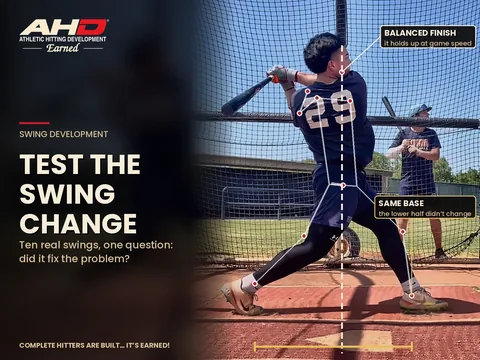
For the evidence, film the same way every time: side and behind, chest high, slow motion, five tee swings and five live or front-toss swings. The free filming checklist is on our online swing analysis page. Want a coach’s eyes on it? AHD Swing Lab is a $79 coach-reviewed video analysis (opening Nov. 15). And before you call a change good or bad, run it through the 4-step swing change test.
“Belief is the most powerful human force.” Belief built on real work, with proof on video, is what lets a hitter swing free when spring arrives.
6. Where should we start this offseason?
Recover. Assess. Train with a purpose. Prove it. Come back a more complete hitter.
If you want the whole map in one place, the Complete Hitter Masterclass covers all 4 Pillars in 24 lessons, most of them 10 to 20 minutes, and Lessons 1–3 are free. Run SwingChecker™ first so you know which lessons to hit hardest.
Don’t collect drills. Build a complete hitter.
THELESSON.
- Games show what you have
- The offseason builds what you lack
- Touch all 4 Pillars every week
- Finish with evidence
Complete Hitters Are Built…Earned.
Want to go deeper? Read Offseason Hitting Plan: 12 Weeks From Fall to Tryouts and How to Know If a Swing Change Is Working.
Quick answers
What should baseball players work on in the offseason?
Start with an honest look at last season, then pick two or three priorities across the swing, strength, pitch recognition and the mental approach. Train them a little every week and retest before spring.
How long should a hitter rest after the season?
Long enough to recover physically and mentally, longer if the body is beat up. Then build back with purpose instead of jumping straight into heavy cage volume.
Should my high school hitter play another sport in the offseason?
Often, yes. Another sport builds athleticism and keeps a hitter fresh. Fit short hitting and strength sessions around it and keep the daily pitch-recognition work going.
Is the offseason a good time to change a swing?
It’s the best time, as long as the change has a baseball reason and a way to test it. Make one change at a time, film it at the same angles, and prove it against live pitching before the season.
Sources: MLB.com: ‘Finding a happy medium’: Pirates prospect Sanford using Fall League to become a more complete hitter (Oct. 2026) · MLB.com: Here are the 2026 Arizona Fall League teams and schedule (Aug. 24, 2026)
Don’t collect drills. Build a complete hitter.
Complete Hitters Aren’t Born. They’re Built… and Earned.