
By BK, Athletic Hitting Development
Complete Hitters Aren’t Born. They’re Built… and Earned.
Key takeaways
- Good timing starts with when the load begins, synced to the pitcher's delivery, not to the ball.
- Train timing in order: rhythm on the tee, then a start cue in front toss, then mixed speeds, then live arms and machines.
- Six drills do it: rhythm tee, the hand-separation start, a two-speed toss, the walking start, short-distance velocity and live at-bats with a plan.
- Being late often looks like slow bat speed. Fix the start before you chase a faster swing.
The best baseball hitting drills for timing teach a hitter when to start the load against the pitcher's delivery, then test that start against changing speeds. Train it in order: rhythm on the tee, a start cue in front toss, mixed speeds, then live arms.
The best baseball timing drills teach a hitter when to start the load against the pitcher's delivery, then test that start against changing speeds. Train it in order: rhythm tee, a start cue in front toss, mixed speeds, then live arms.
Train it: Hitting Processor → Free tool: Bird's-Eye Timing Trainer →Most hitters who are "late" don't have a slow swing. They have a late start. The load begins after the ball is already on the way, and no bat speed in the world catches up to that.
Timing is part of the Hitting Processor: see it, time it, decide, attack it. It's a skill, and like any skill, it gets better with daily reps. Here's how to train it so it shows up in games.
1. What does good timing in hitting actually mean?
Good timing means the hitter is loaded and landed in a strong launch position before deciding to swing, and the barrel meets the ball out in front of the plate where it can do damage.
That depends on the start. The trigger and stride have to begin at the right moment in the pitcher's delivery. I break that down in Trigger and Timing: When the Front Foot Lands.
- Early: out front, rolling over, pulling everything foul.
- On time: hard contact to all fields, especially up the middle.
- Late: jammed, fouling it back, weak contact the other way.
Late can look exactly like slow bat speed. See Bat Speed Isn't Timing before you buy a speed program.
2. When should a baseball hitter start the load?
There's no single answer, because every pitcher's delivery is different. The principle: start early enough that you're landed and loaded before the ball is halfway. In my experience, hitters who are "early to load" can always slow down. Hitters who start late can never catch up.
Pick a start cue on the pitcher, like the knee lift or the hands separating, and train it until it's automatic. Then adjust it against faster or slower arms.
BASEBALL TIMING
EARLY TO LOAD.ON TIME.
- Pick a start cue
- Land before you decide
- Mix speeds in practice
- Test it against live arms
TIMING IS A DAILY SKILL
3. What are the best baseball hitting drills for timing?
Do these in order. Don't move to the next one until the hitter owns the one before it.
- Rhythm tee.A little movement in the stance, then load and swing on a count. It teaches the body to swing from rhythm instead of from a dead stop.
- Hand-separation start (front toss).The tosser shows the ball, then separates the hands as the start cue. The hitter begins the load on that cue and lands before the toss arrives.
- Two-speed toss.Mix firm tosses with slower ones without telling the hitter. Same start, then the hitter adjusts at launch. This is where timing becomes a real skill.
- Walking start.Two small walking steps into the load against front toss or a machine. It builds rhythm and a start that flows instead of jerks.
- Short-distance velocity.Firm toss or a machine from a shorter distance so the hitter feels game-speed reaction time with clean, safe reps. Keep the protective screen up.
- Live at-bats with a plan.Real pitchers, real counts. The hitter picks a start cue and one pitch to hunt, then tracks what happened.
The best hitters are on time for the fastball and adjust to the slower pitch, not the other way around. "Pitchers are basically pizza delivery guys." He's just delivering it. Your job is to be loaded and on time when it shows up.
Be early to load, on time to swing.
4. How do you adjust timing to different pitchers?
Every pitcher has a different rhythm. Some take a big, slow leg kick. Some are quick to the plate. Some slide step with runners on. The start cue stays the same idea: begin the load at a point in the delivery that gets you landed on time.
- Slow, big delivery: start a little later in the delivery, or slow the load down, so you don't land too early and drift.
- Quick to the plate: start earlier, often as soon as the front leg begins to move.
- Slide step: have a shorter, quicker load ready so you're not caught late.
- Hard thrower: same swing, earlier start. Don't rebuild anything.
Watch him warm up and watch the hitters in front of you. By your first at-bat you should already know when you're starting. "The ball ain't changing shape, I promise ya that." A harder thrower doesn't need a new swing, just an earlier start.
This is also why the on-deck circle matters. Time his delivery from there, load with him, and walk up to the plate already in rhythm. See The On-Deck Circle Routine.
5. How can a hitter work on timing at home?
You don't need a cage for most timing work. Five to ten minutes a day is enough to build the habit:
- Video loads. Pull up a pitcher on video and load on his delivery. No swing, just start, land and hold. Ten reps.
- Rhythm tee. Ten swings off the tee with a load on a count.
- Free timing games. The Bird's-Eye Timing Trainer and Contact Point Trainer build the picture of where on-time contact happens.
- Pitch recognition reps. Calling pitches early makes timing easier. See Pitch Recognition Drills.
If you only have five minutes, follow The 5-Minute Daily Hitting Processor Plan.
6. What if the hitter is still late in games?
If the start is on time and the hitter is still late, check two things. First, the load: a big, slow load can eat up the time you saved. Second, decisions: a hitter who isn't sure whether to swing waits too long. That second one is a Hitting Processor problem, and it gets fixed with daily decision training, not more swings.
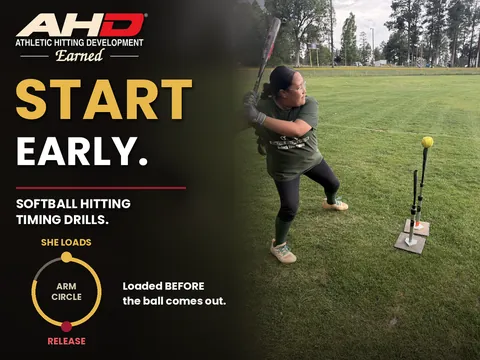
Start free with Lesson 1 of the Hitting Processor course, or run the free SwingChecker to see whether timing, the swing or decisions is the top priority. Softball hitters, see Softball Hitting Timing Drills.
THELESSON.
- Late start, not slow bat
- Rhythm, then speed
- Fastball first, adjust
- Five minutes a day
Complete Hitters Are Built…Earned.
Want to go deeper? Read When Should the Front Foot Land? The Trigger and the Timing Stride and Softball Hitting Timing Drills: 6 Drills That Get Her On Time.
Quick answers
How do I fix being late on fastballs?
Start your load earlier, on a cue in the pitcher's delivery like the hands separating, so you're landed before the ball is halfway. A late start causes most late swings, not slow bat speed.
What is the best drill for hitting timing?
The two-speed toss. Mixing firm and slower tosses without telling the hitter forces the same on-time start and an adjustment at launch, which is what game timing requires.
Can you practice hitting timing at home?
Yes. Load on a pitcher's delivery from video, take rhythm tee swings, and use free timing games. Five to ten minutes a day builds the habit.
Is timing more important than bat speed?
A hitter needs both, but bat speed only helps if the swing starts on time. A late hitter with a fast bat still gets jammed.
Don’t collect drills. Build a complete hitter.
Complete Hitters Aren’t Born. They’re Built… and Earned.