By BK, Athletic Hitting Development
Complete Hitters Aren’t Born. They’re Built… and Earned.
Key takeaways
- Bat speed sets a hitter’s ceiling. Contact and decisions set his floor.
- A fast swing at the wrong pitch, or a fast swing that misses, is still an out. Speed has to be aimed.
- Train three things every week: bat speed, bat-to-ball and the Hitting Processor.
- Parents: watch misses on strikes, chases and hard balls in the air, not just the sensor number.
No, bat speed isn’t everything. Elite bat speed raises a hitter’s ceiling, but contact, swing decisions and launch angle decide whether that speed becomes a complete hitter or just a few loud flashes.
No. Bat speed sets a hitter’s ceiling, but contact rate, swing decisions and launch angle set the floor. Train bat speed, bat-to-ball and the Hitting Processor together so the speed shows up in games.
Train it: Complete Hitter Masterclass → Free tool: Exit Velocity & Bat Speed Calculator →Bat speed is the hottest number in hitting right now, and for good reason. It matters. But I see too many hitters who chase the sensor reading and stop asking the next question: what is that speed actually doing in a game?
Here’s the deal. Speed is a tool. Let’s talk about what turns it into a hitter.
1. Is bat speed everything in hitting?
In late October 2026, FanGraphs ran a piece on young, big-league-ready hitters with high bat speed and high hard-hit rates. About one of them, the writer made a point I agree with all the way. The power numbers tell you how good he could be. The strikeouts tell you how far he could fall.
No names and no numbers here. You don’t need them. The idea is the lesson.
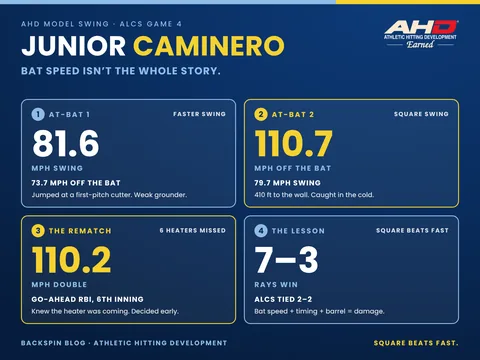
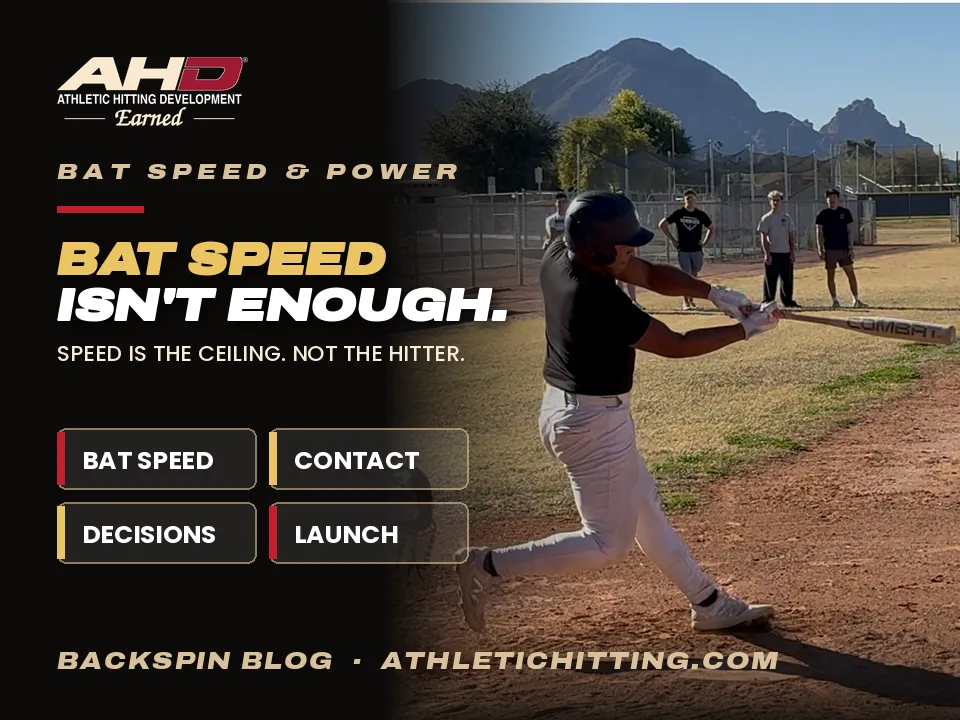
Bat speed sets the ceiling. Contact and decisions set the floor.
That was a fantasy-baseball look at a handful of hitters, not a study, so I hold it as a good frame, not proof. But anybody who has scouted hitters has watched it play out.
BAT SPEED
CEILINGAND FLOOR.
- Bat speed: the ceiling
- Bat-to-ball: finds strikes
- Decisions: right pitches
- Launch: hard and in the air
SPEED HAS TO BE AIMED.
2. Why does bat speed matter so much?
Let’s be clear: I love bat speed. More speed means harder contact when you find the ball, and it lets a hitter see the pitch a little longer before he commits.
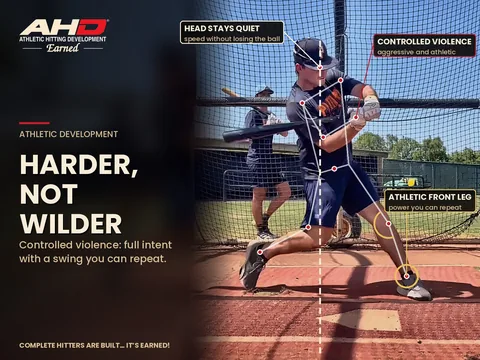
One I use in the cage: “See that wall… knock it down!” Big intent on every swing, under control. That’s controlled violence.
So train it. Swing with intent. Get stronger and more explosive. My bat speed drills that transfer are a good place to start.
But speed with nowhere to go is a loud miss. The barrel still has to find the ball, on the right pitch, at a good angle.
3. What decides whether bat speed becomes a good hitter?
Four skills have to work together. Bat speed is only one of them.
| Skill | The question | If it’s missing |
|---|---|---|
| Bat speed | How fast is the barrel moving? | Low ceiling: soft contact even on good swings |
| Bat-to-ball | Does the barrel find the strikes he swings at? | Loud misses and strikeouts |
| Decisions | Is he swinging at the right pitches? | Fast swings at pitches he can’t hurt |
| Launch | Is the hard contact on a good angle? | Hard ground balls right at infielders |
Notice that only one of those four is about raw speed. The other three are about aiming it. That’s why two hitters with the same sensor reading can look completely different in a game. One squares up strikes and drives them. The other swings just as hard and spends the night fouling pitches back or rolling over.
Fast swing, poor contact: that’s the strikeout floor. Fast swing, poor decisions: he’s swinging hard at the pitcher’s pitch. Fast swing, poor launch: hard outs on the ground. Put all four together and you have a hitter.
Good contact starts with the swing. AHD hitters build Mechanically Advantageous Angles (MAA) so the barrel gets on plane early and stays there, which makes a fast swing much easier to aim.
4. How do you train bat speed and contact together?
Don’t pick one. Train three things every week: bat speed, bat-to-ball and the Hitting Processor.
- Speed with a target.Max-intent swings, but every one still has to hit a ball to a spot. Speed you can’t aim doesn’t count.
- Bat-to-ball every day.Short rounds at different heights and speeds. Score squared-up contact, not distance.
- Decision rounds.Live or machine pitches mixed in and out of the zone. Score the swing decision before the result.
- Check the launch.Count line drives and hard fly balls. If most hard balls are on the ground, fix the path before chasing more speed.
Here’s how a week can look. Two days lead with speed work, 3 sets of 5 max-intent swings with full rest, then bat-to-ball. Two days lead with decision rounds off live arms or a machine. Every day ends with 10 minutes of short bat-to-ball rounds. Speed work goes first in the session, while he’s fresh, so every swing is a real one.
Gotta swing it to hit it. I want hitters aggressive and athletic. Just swing at the right ones. A max-effort swing at a slider in the dirt is still strike three.
Measure where the speed stands with the free Exit Velocity & Bat Speed Calculator. Then read More Bat Speed, Better Decisions for how to add speed without the swing getting wild.
5. What should parents watch besides the bat speed number?
Sensor numbers are easy to love because they go UP. Watch the game too, and keep three tallies.
- Swings-and-misses on strikes. If they climb while bat speed climbs, the speed isn’t under control yet.
- Chases. A faster swing at a ball in the dirt is still a strikeout.
- Hard balls in the air. Line drives and hard fly balls are the payoff of speed plus angle.
If speed is going up and these three are getting better too, you’re building a complete hitter. If speed is up and the game numbers aren’t, the next step is contact and decisions, not more speed.
Want to know which piece is holding your hitter back? Run the free SwingChecker™. In about three minutes it ranks his top priorities across the 4 Pillars, with cues, drills and matching free lessons. Then the Complete Hitter Masterclass trains the swing, strength, the Hitting Processor and the mental approach together in 24 lessons. Lessons 1–3 are free.

THELESSON.
- Love bat speed, but aim it
- Train contact every day
- Score the decision first
- Watch game tallies, not sensors
Complete Hitters Are Built…Earned.
Want to go deeper? Read Harder Without Wilder and Bat Speed Isn’t Timing: Why Late Can Look Like Slow.
Quick answers
Is bat speed the most important thing in hitting?
No. Bat speed raises a hitter’s ceiling, but contact, swing decisions and launch angle decide how much of that speed shows up in games.
Can more bat speed lead to more strikeouts?
It can, if the hitter loses control of the barrel or starts swinging hard at bad pitches. Train contact and decisions alongside speed so the gains carry into games.
Should my hitter train bat speed or contact first?
Both, every week. Speed work with a target, daily bat-to-ball rounds and decision rounds keep the swing fast and accurate.
How do I know if my hitter’s bat speed is good?
Compare it to his age with a bat speed calculator, then watch games. If he hits hard balls in the air and doesn’t miss many strikes, his speed is working.
Sources: FanGraphs (RotoGraphs), “Four Upcoming Fast Swings” (Oct 28, 2026)
Don’t collect drills. Build a complete hitter.
Complete Hitters Aren’t Born. They’re Built… and Earned.