By BK, Athletic Hitting Development
Complete Hitters Aren’t Born. They’re Built… and Earned.
Key takeaways
- College baseball doesn’t make hitting mysterious. It makes it honest: it finds the first part of your game that can’t keep up.
- A complete college hitter trains four pillars together: the swing, strength and explosiveness, the Hitting Processor and the mental approach.
- Most hitters don’t need a new swing at the next level. They need to find the first real gap and train it on purpose.
- Train the Processor every day. Better pitching punishes late decisions faster than it punishes imperfect mechanics.
To hit in college baseball, build all four pillars of a complete hitter at the same time: a swing you can repeat at game speed, a body that moves the bat with intent, a Hitting Processor that decides early, and a mental approach that holds up when the at-bat gets loud. College pitching will find whichever one you skipped.
College baseball rewards hitters who train all four pillars together: the swing, strength and explosiveness, the Hitting Processor and the mental approach. Find the first real gap, train it on purpose and keep pitch-recognition work in every day.
Train it: Complete Hitter Masterclass → Free tool: 4 Pillars Hitter Scorecard →I coached high school and college baseball in Arizona and Texas for 30 years. Most hitters show up at the next level with one thing that has always carried them. Strength. A good swing. Speed. Confidence. A feel for the barrel.
One thing used to be enough. At the college level it isn’t, because the pitcher on the mound has more than one thing too. He throws harder, commands the fastball, lands a breaking ball behind in the count and has a plan for you. You need a plan for him.
1. What changes when a hitter gets to college baseball?
Velocity goes up, but that’s the part everybody expects. The bigger jump is command, sequencing and off-speed in any count. A pitch that was hittable in high school becomes a strikeout pitch when it arrives a tick faster, moves a tick later and is set up by the pitch before it.
None of that means you need to become robotic. It means your preparation has to look more like the game you’re trying to play. I go deeper on the jump itself in how to adjust to college pitching.
The game didn’t get harder. It got honest.
THE NEXT LEVEL
IT FINDSTHE GAP.
- Better command
- Off-speed in any count
- Sequencing with a plan
- Less time to decide
ONE STRENGTH ISN’T ENOUGH
2. What does a college hitter actually need to train?
At AHD we don’t treat hitting as one thing. A complete hitter is built on four pillars, and every one of them gets tested at the next level:
- The Swing. Efficient, athletic movement you can repeat at game speed, with the Mechanically Advantaged Angles (MAA) that let the barrel stay inside and above the ball long enough to adjust.
- Strength & Explosiveness. Enough force, balance and body control to move the bat with intent without falling out of the swing.
- The Hitting Processor. See it, recognize it, time it, decide, attack it. Trained daily, because this is where better pitching wins most at-bats.
- Mental Approach. Belief, a simple plan and a reset that works when results get loud.
Train one pillar and the other three cap you. A strong kid with a late Processor looks slow. A great swing with no plan looks lost. The goal is aggressive and athletic hitters who play with controlled violence, and that takes all four.
3. How do you find the first gap to fix?
Don’t start by changing everything. Start by asking the right question. Is the barrel too early? Is the hitter late because his read is late? Is he trying to fix mechanics in the box because he doesn’t trust his work?
- ObserveFilm game at-bats and live rounds, not just tee work, and watch what actually happens.
- IdentifyName the first meaningful breakdown, the one that causes the others.
- CueGive the hitter one clear cue, not a list.
- TrainBuild the fix with purposeful reps that get more game-like as he owns it.
- ReassessFilm again. If it transferred, move to the next gap. If not, back up a step.
A free SwingChecker™ run ranks a hitter’s top priorities across the four pillars in about three minutes, which is a good place to start the conversation.
4. What does a week of college hitting prep look like?
Every week should touch all four pillars. The emphasis can change. The pillars can’t disappear.
| Pillar | What it looks like in a week |
|---|---|
| Swing | Short, purposeful rounds with one cue and video to check it |
| Strength & Explosiveness | Your program’s lifting plus rotational and speed work, done fresh |
| Hitting Processor | A few minutes every day of reads, timing and yes/no decisions |
| Mental Approach | A pre-pitch routine and a reset you practice, not just talk about |
The drills matter less than the order. If you want the drill side, read college baseball hitting drills that transfer to games. For the fall-to-spring calendar, see the college hitter’s offseason plan.
5. How should a college hitter think in the box?
Better pitching tempts hitters to fill their heads with more. More mechanics, more scouting notes, more fear of getting beat. Do the opposite. Know the zone you want to attack, see it early, be on time and trust the swing you built in practice.
“The ball ain’t changing shape, I promise ya that.” New level, harder thrower, same ball. Your swing and your plan still work if you trust them.
“Belief is the most powerful human force.” Belief built on real work is what lets you swing free when the arm on the mound is the best you’ve seen.
THELESSON.
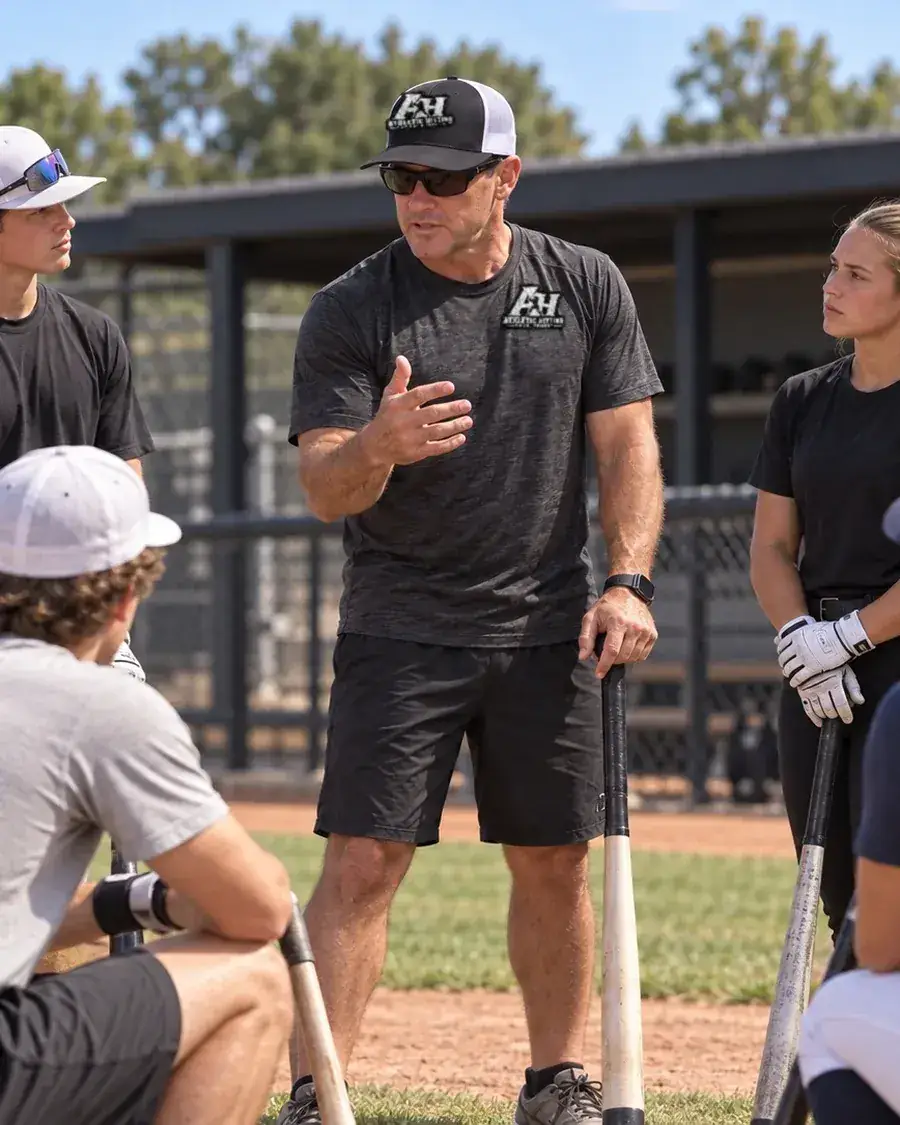
- Train all four pillars
- Find the first real gap
- Processor work every day
- Simple plan in the box
Complete Hitters Are Built…Earned.
6. Where should a hitter start?
If you’re a senior or heading into your first fall, read how to prepare for college baseball pitching and why good high school hitters struggle against college pitching. If you’re still choosing a school, what college coaches look for in a hitter and what JUCO baseball is are worth your time.
Then build the whole hitter. The Complete Hitter Masterclass trains all four pillars in order, and Lessons 1–3 are free. Don’t collect drills. Build a complete hitter.
Want to go deeper? Read How to Adjust to College Pitching (A Hitter’s Plan) and What College Coaches Look For in a Hitter.
Quick answers
How is college baseball hitting different from high school?
College pitchers throw harder, but the bigger change is command, sequencing and off-speed in any count. Hitters have less time to decide and fewer pitches that are accidentally easy.
Do I need a new swing to hit in college?
Usually not. Most hitters need to find the first real gap, often timing or decisions, and train it. Rebuilding a working swing right before or during the season usually makes things worse.
How much should a college hitter train pitch recognition?
A few minutes every day. Pitch recognition and decision-making are skills that improve with frequent short reps, the same way the swing does.
What should a high school senior do to get ready for college baseball?
Get an honest assessment across the swing, body, Hitting Processor and mental approach, then train the first gap while keeping all four pillars in the week. Start the summer before your freshman fall at the latest.
Don’t collect drills. Build a complete hitter.
Complete Hitters Aren’t Born. They’re Built… and Earned.