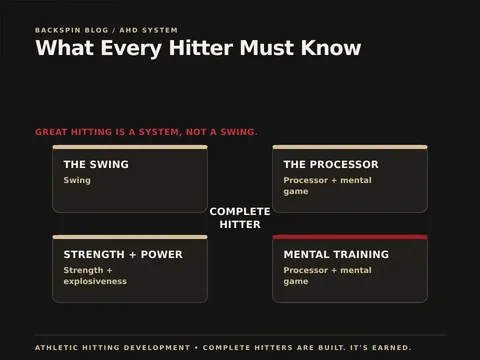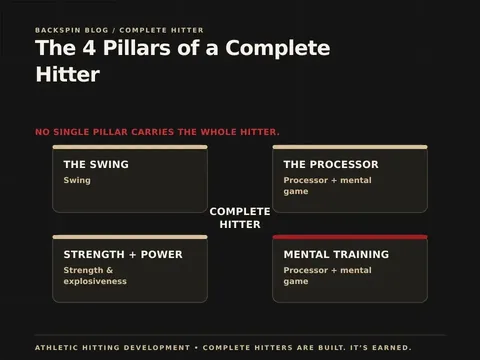
A complete hitter is not a hitter with one pretty swing. The hitter has to be able to create good angles, handle real velocity, see the baseball, adjust to off-speed, compete with an approach, and be aggressive enough to use what the pitcher gives away.
A complete hitter isn’t a hitter with one pretty swing. He builds good angles, handles a real heater, sees the ball at a higher level, adjusts to off-speed, competes with a Heater/Hanger approach, trains pitch tracking on purpose, builds true confidence and stays aggressive enough to punish mistakes.
Train it: Complete Hitter Masterclass →This is the short version of what we want from a high-quality high school hitter—and especially from a college hitter.
1. Talent and want-to set the starting point
Every athlete has a different physical ceiling, learning rate and competitive drive. Coaching does not erase those differences. It does help an athlete identify the real barriers, train what can be trained, and stop wasting time on work that does not transfer. The athlete still has to want the work badly enough to do it.
2. Build good angles
Good hitters organize the body and bat into useful angles: move forward, get above and inside the ball, launch from a strong position, match the plane to the target, and extend through it when appropriate. Those angles are not cosmetic. They create more usable barrel time and a bigger margin for solid contact.
3. Be able to handle a heater
Can the hitter naturally turn on a quality fastball with a clean, athletic, well-angled stroke? A real heater exposes rushed movement, poor positions and a barrel that takes too long to get where it needs to go. The fastball is the baseline test.
THE COMPLETE HITTER STANDARD
MORE THANONE SWING.
- Create good angles.
- Handle real velocity.
- See the baseball.
- Adjust to off-speed.
THE FASTBALL IS THE BASELINE TEST.
4. See the baseball at a higher level
Seeing the ball is more than having good eyesight. It is pickup, visual focus, reading early information, recognizing the pitch and holding the right timing window. The better the hitter sees, the earlier the hitter can prepare an answer instead of reacting after the decision is already late.
5. Hit athletically enough to adjust
Off-speed adjustability is not a trick. It is the product of balance, body control, timing and an athletic movement pattern that gives the hitter options. If a hitter is committed too early or loses posture, the barrel has no room to adjust.
6. Use a Heater / Hanger approach
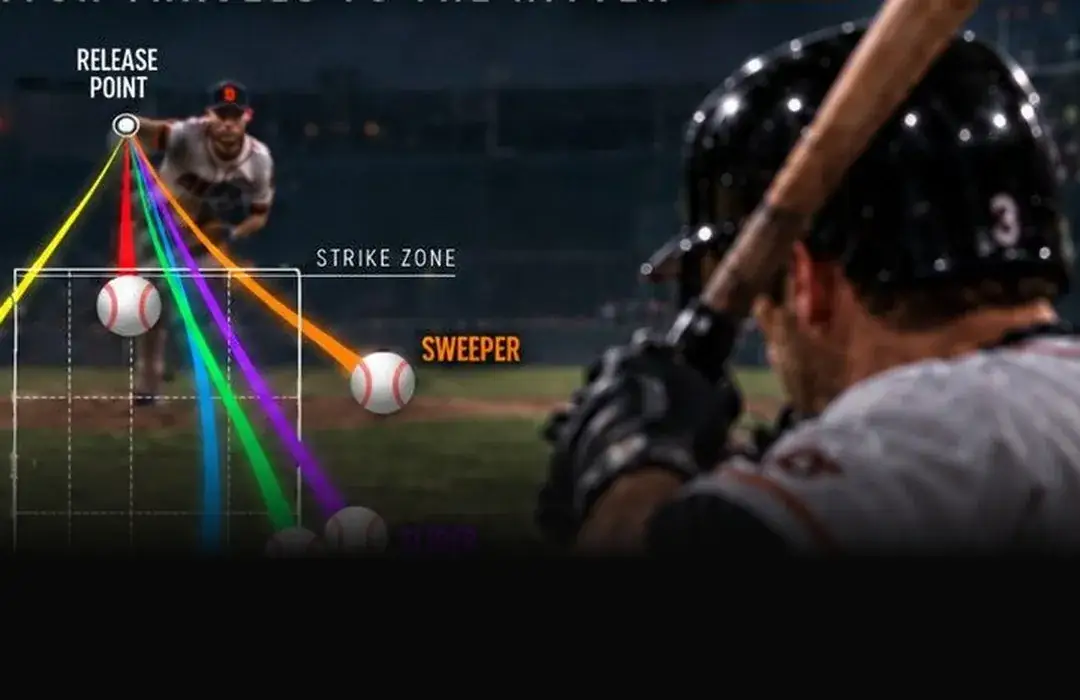
Keep the approach simple. Be ready to destroy the heater in the hitter’s zone. At the same time, stay athletic enough to recognize and adjust to a hanging breaking ball. That is not guessing. It is a clear plan that gives the hitter an aggressive fastball mindset without making the hitter helpless against mistake off-speed.
KEEP THE APPROACH SIMPLE
HEATER,HANGER.
- Destroy the heater in your zone.
- Adjust to the hanger.
- That is not guessing.
AN AGGRESSIVE FASTBALL MINDSET.
7. Master the mundane: train pitch tracking on purpose
Pitch tracking needs individual work. Track real pitches, train the eyes, learn what early cues mean, and repeat it until the process becomes more automatic. The best hitters do not wait for game day to practice seeing the ball. They master the mundane because the mundane sharpens the blade.
8. Build true confidence
True confidence is not pretending every at-bat will be easy. It is honestly believing that every pitcher will eventually make a mistake—and being prepared to eat when that pitch arrives. Confidence comes from preparation, clear choices and knowing the hitter has a plan for both success and failure.
9. Be aggressive
Great hitters swing the bat. Too many athletes watch pitches they can barrel because they are afraid to be wrong, late to recognize the opportunity, or waiting for a perfect pitch that never arrives. Hunt strikes. Hunt barrel-able pitches. Trust the work enough to do damage.

THELESSON.
- Build good angles.
- Handle the heater.
- See it at a higher level.
- Master the mundane.
- Build true confidence.
- Hunt strikes.
Complete Hitters Are Built…Earned.
The standard is not nine separate boxes
These nine standards support each other. Better angles help the hitter handle velocity. Better tracking improves recognition and decisions. Better athleticism creates more adjustability. A Heater / Hanger plan simplifies the at-bat. Confidence and aggression make sure the hitter actually swings at the pitches worth attacking.
Get those things moving in the right direction and you have a confident hitter with a clean swing, a simple effective approach, and a clear development plan for swing, timing, pitch tracking, decision-making and adjustability.
Quick answers
What makes a complete hitter in baseball?
A complete hitter is not a hitter with one pretty swing. He creates good angles, handles real velocity, sees the baseball, adjusts to off-speed, competes with an approach and is aggressive enough to use what the pitcher gives away. Those pieces support each other instead of standing alone.
What is the Heater Hanger hitting approach?
Keep it simple. Be ready to destroy the heater in your zone. At the same time, stay athletic enough to recognize and adjust to a hanging breaking ball. That is not guessing. It is a clear plan that keeps an aggressive fastball mindset without leaving you helpless against mistake off-speed.
How can a hitter get better at pitch tracking?
Pitch tracking needs individual work. Track real pitches, train the eyes, learn what early cues mean and repeat it until the process becomes more automatic. The best hitters do not wait for game day to practice seeing the ball. They master the mundane because the mundane sharpens the blade.
Why is hitting a fastball the first test for a hitter?
A real heater exposes rushed movement, poor positions and a barrel that takes too long to get where it needs to go. If a hitter can naturally turn on a quality fastball with a clean, athletic stroke, the rest of the standard has something to build on.
No subscription. No login. Keep learning, then take one priority into training.