By BK, Athletic Hitting Development
Complete Hitters Are Built… It’s Earned!
Key takeaways
- To hit for power in baseball, a hitter needs three things together: more bat speed, square contact on the barrel and a launch that turns hard contact into line drives and fly balls.
- Bat speed starts in the ground. Ground force, hip and trunk rotation and real strength drive the barrel; the arms deliver it.
- A hard-hit ball on the ground is wasted power. Contact point and bat path decide whether exit velocity becomes distance.
- Drills alone don’t add much power. Strength and explosiveness training does, and it takes months, not days.
To hit for power in baseball, a hitter needs three things working together: more bat speed, square contact on the barrel and a launch that turns hard contact into line drives and fly balls. Bat speed comes from ground force, rotation and real strength, so hitting the ball farther is as much a weight-room job as a cage job.
To hit for power in baseball, increase bat speed, square the ball up on the barrel and launch it as line drives and fly balls. Bat speed comes from ground force, rotation and strength, so real power gains come from strength training plus a swing that uses it.
Train it: Athletic Development →Every parent I talk to wants their kid to hit the ball farther. Every hitter does too. And most of them are looking for a drill that does it.
Here’s the honest version: where power really comes from, why some kids hit it hard but not far, and what to train first so the power shows up in games.
1. How do you hit for power in baseball?
Distance is decided at contact. How hard the ball comes off the bat (exit velocity) and the angle it leaves at (launch angle) do almost all the work. Everything you train is about raising one or both.
MLB’s Statcast makes this clear. Its “barrel” is a batted ball hit at least 98 mph at the right launch angle, about 26 to 30 degrees at 98 mph, and the window gets wider the harder the ball is hit. Hit it harder and more angles work. That’s pros, not 12-year-olds, but the principle holds at every age.
- Bat speed. The faster the barrel is moving at contact, the more energy goes into the ball.
- Square contact. Barrel on the center of the ball. A glancing hit loses most of the speed.
- Launch. Hard line drives and fly balls travel. Hard ground balls don’t.
Notice the order. Bat speed sets the ceiling. Square contact decides how much of it reaches the ball. Launch decides whether that hard contact becomes a double in the gap or a hard ground ball to short. Miss any one of the three and the power doesn’t show up on the scoreboard.
Power is bat speed you can square up.
2. Where does bat speed come from?
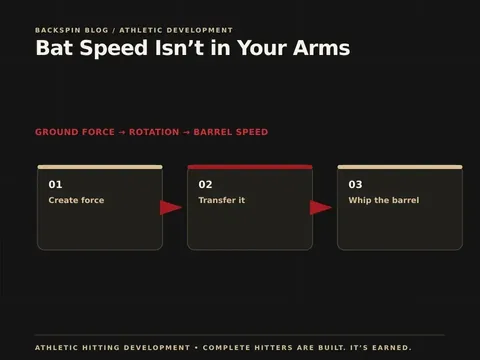
Not the arms. Bat speed is built from the ground up and passed through the body like a whip. The arms and hands deliver what the legs and core create.
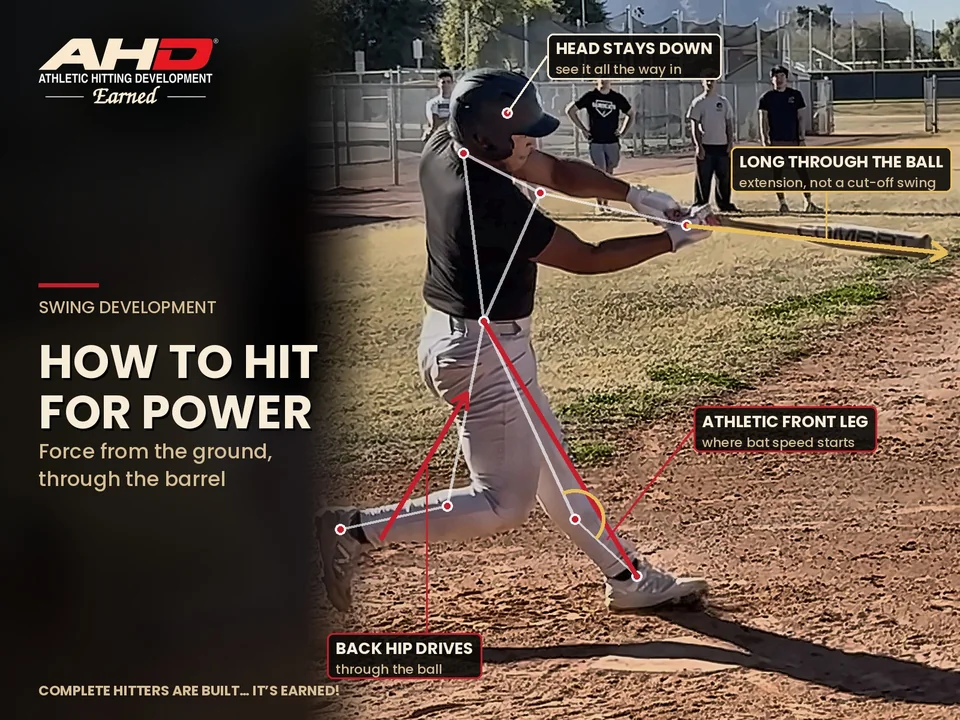
- Push into the ground.The back leg loads and the front leg stays athletic; force from the ground starts the swing.
- Turn the hips.The lower half rotates first and hard, stretching the trunk against the upper half.
- Snap the trunk and shoulders.The torso catches up fast and transfers speed up the chain.
- Deliver the barrel.Arms and hands carry that speed to the ball on a path that matches the pitch.
Each link has to be strong enough to take the speed and pass it on. That’s why stronger, more explosive hitters swing faster. For the rotation piece in depth, see Increase Bat Speed With Rotational Power.
When a link is weak, the hitter compensates. Weak legs and the swing turns into an upper-body swing. A slow hip turn and the arms take over and cast the barrel. That’s why I don’t chase bat speed with the arms. I find the weak link and train it.
WHERE POWER COMES FROM
GROUND UP.BARREL OUT.
- Push into the ground
- Hips turn first
- Trunk snaps through
- Barrel squares the ball
THE ARMS DELIVER, NOT CREATE
3. How do you hit the ball farther without swinging harder?
Plenty of kids hit it hard and still don’t hit it far. Their exit velocity is fine. They’re wasting it. Before you chase more speed, make sure the speed you have is turning into distance.
| What you see | What’s usually happening | What to train |
|---|---|---|
| Hard ground balls | Barrel working down or contact too deep | Bat path that matches the pitch, contact out front |
| Weak fly balls and pop-ups | Getting under the ball or late | On-time start, square contact |
| Hard to the opposite field, no carry | Late; barrel never reaches full speed | Earlier start, contact farther out front |
| Big swing, soft contact | Swinging harder, losing posture | Controlled intent, keep the angles |
Good power hitters hold their Mechanically Advantaged Angles (MAA) through the swing, so their bat speed shows up at the ball instead of leaking out. Line drives are the target, not launch for its own sake; see How to Hit Line Drives. Timing matters too. A hitter who’s late never meets the ball where the barrel is fastest. That’s covered in How to Hit a Fastball.
4. Can hitting drills alone add power?
Not much. I’ll be blunt, because parents spend a lot of money on this. Drills can clean up a swing so the hitter uses the power he already has. They can’t build an engine that isn’t there.
Real power gains come from getting stronger and more explosive: legs, hips, core, and the ability to rotate fast. That’s training, done two or three times a week for months, matched to the hitter’s age. Swinging a heavier bat in the cage is not a strength program.
Age matters. Before puberty, kids gain the most from movement quality, body-weight strength, jumping, throwing and sprinting. Once they’re growing and can lift with good form, real loaded strength work pays off fast. Either way, the plan should be built for the kid in front of you, not copied from a college program.
- Lower-body strength. Squats, hinges and lunges, done right for the age.
- Rotational power. Med ball throws from a hitting stance, fast and with intent.
- Speed and athleticism. Jumps, sprints and movement quality.
- Intent in the cage. Some rounds every week swinging at full speed, measured.
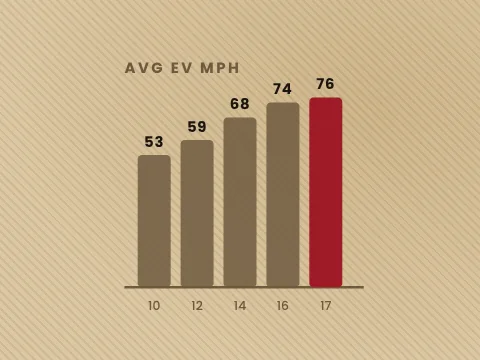
Measure, don’t guess. The free Exit Velocity & Bat Speed Calculator shows where your hitter stands for his age. For a deeper look at the numbers, see How to Increase Exit Velocity. Coaching a fastpitch player? The softball version is How to Hit a Softball Farther.
5. What should a hitter work on first to hit for power?
It depends on what’s missing, and it’s different for every kid. A strong 15-year-old who hits ground balls needs his path fixed. A skinny 12-year-old with a clean swing needs to get stronger and grow. Training the wrong one wastes a season.
- Measure.Record bat speed or exit velocity off a tee at full intent so you have a baseline.
- Film.Side and behind views show contact point, path and whether the angles hold.
- Find the biggest leak.Is it strength, the swing or timing? Fix the biggest one first.
- Retest every 4 to 6 weeks.Same tee height, same bat, same conditions, so the numbers mean something.
Be patient with the numbers. Power comes in steps, not in a straight line, and growth spurts can scramble a swing for a few months. Keep training the body, keep the swing clean and keep measuring. The kids who stick with it for a full year are the ones who show up in spring hitting the ball where the other kids can’t.
The fastest way to find the biggest leak is the free SwingChecker; it ranks your hitter’s top priority across the 4 pillars. If strength is the gap, our Athletic Development course is the bat speed training program that builds it, age-appropriate and progressive. For a 90-day plan with video review of every piece, see our online hitting instruction. Younger players should start with age-right hitting drills and good movement before heavy lifting.

THELESSON.
- Bat speed plus square contact
- Line drives and fly balls
- Strength builds the engine
- Measure, retest, repeat
Complete Hitters Are Built…Earned.
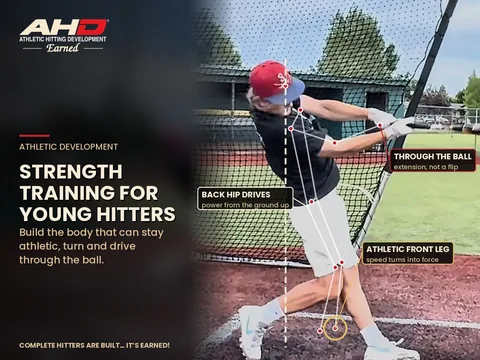
Want to go deeper? Read Bat Speed Isn’t in Your Arms and Strength Training for Young Hitters: What’s Right at Every Age.
Quick answers
How can I hit a baseball farther?
Raise bat speed with strength and rotational power, square the ball up on the barrel, and hit line drives and fly balls instead of ground balls. Contact out front, on time, is where the barrel is fastest.
Does lifting weights help you hit for power?
Yes, when the training is age-appropriate and builds lower-body strength and rotational power. Stronger, more explosive hitters swing faster, but it takes months of consistent work to show up.
Does a heavier bat give you more power?
Only if the hitter can keep his bat speed and control. A bat that’s too heavy slows the swing and makes him late, which usually costs power.
Why do I hit the ball hard but not far?
Usually the launch is wrong: hard ground balls or contact too deep. Fix the bat path and the contact point so your exit velocity turns into line drives and fly balls.
Sources: MLB.com Glossary: Barrel (Statcast)
Don’t collect drills. Build a complete hitter.
Complete Hitters Are Built… It’s Earned!
This article is part of the AHD guide Baseball Swing Mechanics. Start there for the full picture and every related article.