By BK, Athletic Hitting Development
Complete Hitters Are Built… It’s Earned!
Key takeaways
- To hit a fastball, start your load early, with the pitcher, so you are ready to swing when the ball is released instead of starting your move after it.
- Time the heater first. Set your timing for the fastball and adjust down to slower pitches; you cannot speed up from a changeup timing.
- In hitter’s counts, hunt a fastball in one zone and let everything else go.
- Against more velocity, keep the move SHORT and direct; don’t swing harder, start sooner.
How to hit a fastball: start your move early, be on time for the heater, and keep your swing short and direct to the ball. Set your timing for the fastball first, hunt it in hitter’s counts, and adjust down to slower pitches, never up.
To hit a fastball, start your load early with the pitcher so you’re ready at release, and keep a short, direct swing that meets the ball out front. Set your timing for the fastball, hunt it in hitter’s counts, and adjust down to slower pitches.
Train it: Hitting Processor →I’ve watched hitters at every level, from 10U to pro, and the fastball beats more kids than any curveball does. Not because they can’t swing hard enough. Because they’re late before the ball is ever thrown.
Here’s what I teach about hitting the fastball: when to start, what to look for, how to handle more velocity, and how to stay ready for the slower stuff without getting beat by the heater.
1. How do you hit a fastball?
Hitting a fastball comes down to being ready on time. A 90 mph fastball takes about four-tenths of a second to reach home plate, and a hitter needs about a quarter of that second just to see it and react. That leaves very little time to start a swing from a dead stop.
So good fastball hitters don’t start from a dead stop. They’re already loaded and moving when the ball comes out of the hand. Four things have to be in place:
- An early start. The load begins with the pitcher’s motion, not with the ball in flight.
- A plan. He knows which fastball he wants and where he wants it.
- A short, direct move. The barrel gets on plane with the pitch quickly, without a long loop.
- Contact out front. The fastball is met in front of the plate, where the barrel is at full speed.
None of this is a secret. It’s simple. It’s just not easy, and it takes daily reps to own it.
2. When should you start your swing to hit a fastball?
Earlier than you think. The number one fastball problem I see is a hitter who waits to “see it” before he starts his load. By then the ball is halfway home. He rushes, his hands drag, and he fouls it back or swings through it.
Start early. Load with the pitcher.
Starting early doesn’t mean swinging early. It means getting to a loaded, ready position in time, then letting the swing go when the ball says so. I call that being on time, not being quick. Here’s the sequence I teach:
- Start the load as the pitcher separates his hands.Weight shifts back into the back hip with the pitcher’s motion, not after release.
- Get the stride down early.Front foot lands before the ball is halfway, so the hitter is ready instead of still moving.
- See release and pick up the ball early.Eyes go to the release window; the earlier he picks up the ball, the more time he has to decide.
- Decide, then let it go.If it’s his fastball, the swing fires from the ready position; if not, he holds.
If a hitter is fouling fastballs straight back or to the opposite side when he’s trying to pull them, he is usually a hair late. Start the whole thing sooner. For more on the ready position itself, see Launch Position Timing.
FASTBALL TIMING
START EARLY.BE ON TIME.
- Load with the pitcher
- Stride down early
- Pick up release early
- Decide, then let it go
ON TIME BEATS QUICK
3. Should you sit on the fastball?
In hitter’s counts, yes. Hunting the fastball is the simplest plan in baseball. In my experience, most pitchers lean on the fastball, especially when they’re behind in the count. If a hitter is ready for the fastball, he can still react to a slower pitch. The reverse doesn’t work.
Hunting a fastball doesn’t mean swinging at every fastball. It means looking for one fastball in one zone and taking the rest. Here’s how the plan shifts with the count:
| Count | Fastball plan | What to let go |
|---|---|---|
| Ahead (1-0, 2-0, 2-1, 3-1) | Hunt the fastball in your one best zone | Anything soft and anything outside that zone |
| Even (0-0, 1-1) | Fastball timing, a bigger zone | Pitches clearly off the plate |
| Behind (0-1, 1-2) | Stay on time for the fastball, cover more plate | Spin that starts below the knees |
| Two strikes | Fastball timing, shorter move, protect the plate | Only clear balls |
The two-strike row is its own skill. I break it down in Baseball Two Strike Approach.
4. How do you catch up to a faster fastball?
When the velocity jumps, most hitters try to swing harder. That makes it worse. The swing gets longer, the head pulls off, and the timing falls apart. The answer is a shorter move and an earlier start, not more effort.
- Shorter stride or no stride. Less movement means less time to get ready. Many hitters go to a small toe-tap or just a weight shift against real velocity.
- Hands start closer to the launch spot. Fewer inches to travel before the swing starts.
- Direct barrel to the ball. No long loop or casting. The barrel gets on plane early and stays there.
- Start sooner. Same swing, earlier start. Most of the fix is right here.
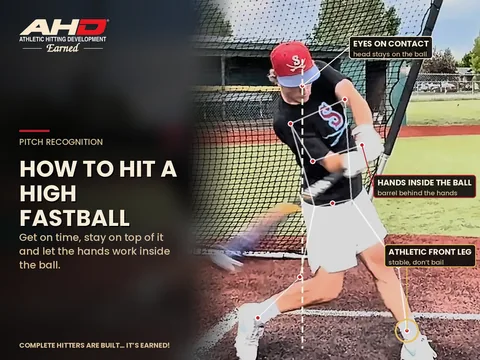
A short move is not a weak arm swing. The body still turns hard. Good fastball hitters keep their Mechanically Advantaged Angles (MAA) so they can stay short AND strong. If the hitter keeps getting beat up in the zone, that’s its own problem: read How to Hit a High Fastball. For what elite timing looks like against 100 mph, see Ready for 100.
Long term, the real way to handle more velocity is more bat speed and better recognition. Strength builds the first; I cover that in How to Hit for Power in Baseball. Softball players face a similar problem with less distance; see How to Hit Fast Pitching in Softball.
5. How do you hit a fastball and still adjust to off-speed?
Time the fastball and adjust down. If a hitter is on time for the heater, a changeup or breaking ball means he has to wait a little longer. He can learn to hold his weight back and let the slower pitch travel. If he sets his timing for the changeup, a fastball blows right by him. You can slow down from fastball timing. You cannot speed up from off-speed timing.
Adjusting is a skill too. Learn the specific pitches in How to Hit a Changeup and How to Hit a Slider.
Don’t collect drills. A few, done daily, will build fastball timing:
- Short-distance front toss.Toss firm from closer than normal, behind a screen, so the hitter must start early to be on time.
- Mixed-speed toss.Mix firm and soft tosses with the same arm action; he stays on firm timing and learns to hold on the soft one.
- Call-the-zone rounds.He names his zone before each round and only swings at firm tosses in it.
- Live at-bats with a count.Start every at-bat at 2-0 or 1-1 and track whether he swung at his fastball.
Not sure if the problem is timing or the swing? Run the free SwingChecker to find his top priority. Timing is trained in our Hitting Processor course: see it, time it, decide, attack it, every day. For a full plan built around your hitter, see our online hitting instruction. Brand new to the swing? Start with How to Hit a Baseball.

THELESSON.
- Time the heater first
- Hunt it in hitter’s counts
- Shorter move, earlier start
- Adjust down, never up
Complete Hitters Are Built…Earned.
Want to go deeper? Read Ready for 100: José Ramírez and Fastball Timing and How to Hit a High Fastball: What Hitters Should Actually Train.
Quick answers
How do you hit a 90 mph fastball?
A 90 mph fastball reaches the plate in about four-tenths of a second, so the hitter has to be loaded and ready at release. Start the load with the pitcher, keep the move short and direct, and look for the fastball in one zone.
Why do I keep fouling off fastballs?
Fouling fastballs straight back usually means you’re a little late or slightly under the ball. Start your load earlier and get your front foot down sooner so the barrel meets the ball out front.
Should a hitter look fastball every pitch?
Most hitters do best keeping fastball timing every pitch and adjusting to slower pitches. In hitter’s counts, narrow that to one fastball in one zone and take everything else.
Does a lighter bat help hit a fastball?
A bat the hitter can control helps him be on time, and one that’s too heavy makes him late. But the bigger fixes are starting earlier and keeping the move short, not just changing bats.
Sources: KQED Science: How Can Anyone Hit a 90-MPH Fastball?
Don’t collect drills. Build a complete hitter.
Complete Hitters Are Built… It’s Earned!
This article is part of the AHD guide Pitch Recognition & Timing. Start there for the full picture and every related article.