By BK, Athletic Hitting Development
Complete Hitters Are Built… It’s Earned!
Key takeaways
- Pulling off the ball means the front shoulder, head and barrel leave the hitting zone before contact.
- It’s a symptom. The usual causes are being late, trying to pull everything, the head chasing the result, and a front side with no job.
- Film from behind and score a 10-swing round so you know the cause before you pick a fix.
- Stay closed long enough to hit the ball, not forever. The hips still have to rotate.
To stop pulling off the ball, find out WHY the front shoulder and head open early, then fix that cause. Most hitters pull off because they’re late, they’re trying to pull everything, or their head is chasing the result, and each one needs a different fix.
To stop pulling off the ball, find out why the front shoulder and head open early, then fix that cause. Most hitters pull off because they’re late, trying to pull everything, or chasing the result with their head, so film the swing, score 10 outer-half swings and train the one fix that matches.
Train it: Swing Structure & Mechanics →You’ve seen it. Rollover ground ball to the pull side. Swing and miss on the pitch away. The head finishes looking at the dugout and the front shoulder is open before the ball gets there.
Yelling “stay closed” from the stands won’t fix it. Here’s what pulling off really is, what causes it, how to check it on video and the work I use to fix it.
1. What does pulling off the ball mean?
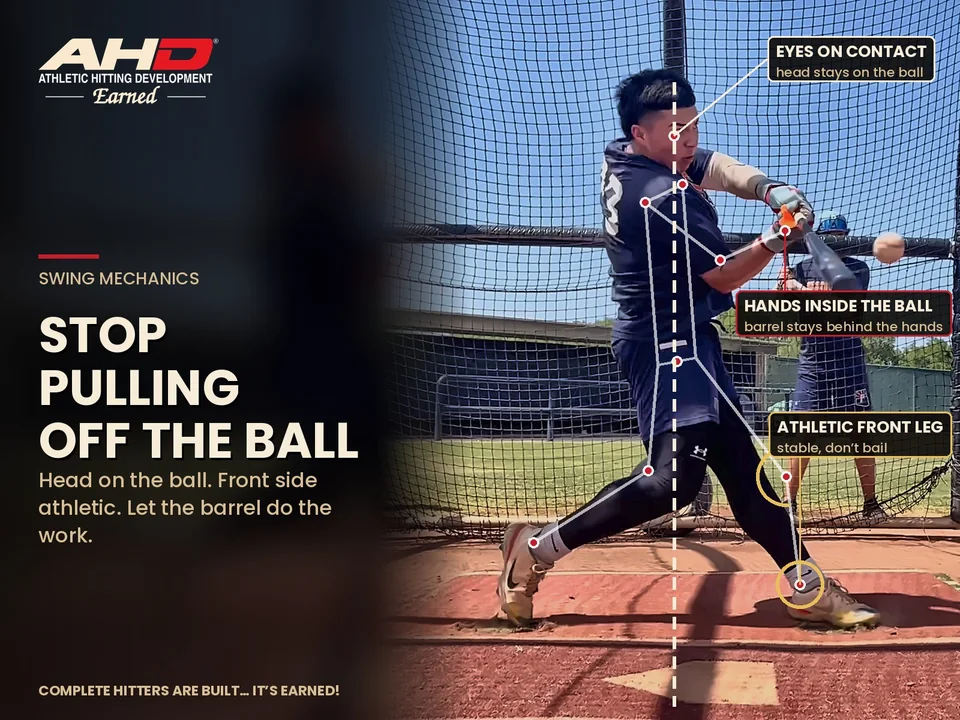
Pulling off the ball means the front side (the front shoulder, the head and often the front hip) opens up before contact. The body spins away from the plate, and the barrel gets dragged out of the hitting zone with it.
Here’s what it usually looks like in games:
- Rollover ground balls to the pull side, especially on pitches away.
- Swings and misses on the outer half, or weak contact off the end of the bat.
- The head moves toward the pull side before the ball is hit.
- The front shoulder opens before the front foot is down.
One honest note: the hips are SUPPOSED to rotate. A good swing turns hard. The problem isn’t opening. The problem is opening in the wrong order, or too early, so the shoulders and head leave before the barrel gets to the ball.
PULLING OFF THE BALL
FIND THECAUSE.
- Late, so the body rushes
- Trying to pull everything
- Head chasing the result
- Front side with no job
THE SHOULDER IS THE SYMPTOM
2. Why does my hitter keep pulling off the ball?
In my experience, it comes down to four causes. Most hitters have one main one.
- Being late.A hitter who starts late has to rush, and the fastest way to catch up is to spin the front side open.
- Trying to pull everything.A hitter who wants to yank every pitch opens early to get the barrel out front, and the outside pitch is gone.
- The head chasing the result.The hitter wants to see where the ball went before it’s hit, so the head and front shoulder leave together.
- A front side with no job.If the front shoulder and the front leg don’t know their job, the body spins instead of rotating around an athletic front side.
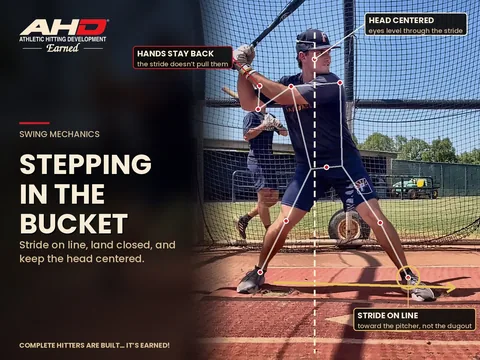
There’s a fifth one I see with young hitters: a bat that’s too heavy or a fear of the ball. Both pull the body away from the plate. I covered those in Stepping in the Bucket: Why It Happens and the Fix, because they usually show up in the stride first.
3. How do I know if my hitter is pulling off?
Don’t guess from the bleachers. Film it. From behind and from the side, chest high, in slow motion (120 or 240 fps) if your phone has it. The full checklist is in How to Film Your Swing for Analysis.
- Pause at foot strike.If the front shoulder is already open when the front foot lands, the front side is leaving early.
- Pause at contact.Look at the head. If it has moved toward the pull side, the eyes left the ball.
- Compare tee and live swings.Fine on the tee but open on live pitching usually means timing (late) or the head chasing the ball.
- Score a 10-swing round.Front toss to the outer half and count line drives up the middle or the other way; write the number down.
That last number is your baseline. You’ll retest it every week. Or run the free SwingChecker to rank your hitter’s top priority in about 3 minutes.
4. What drills stop pulling off the ball?
Match the drill to the cause. Don’t collect drills. One fix, worked every day for a couple of weeks, beats ten drills you saw online.
- Late? Start earlier. In front toss, have the hitter begin the load as the tosser’s arm starts back. On time takes away the need to rush and spin.
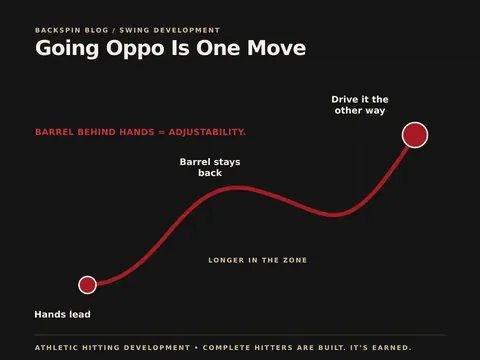
- Pulling everything? Outer-half rounds. Tee and front toss on the outer half where the only goal is a line drive up the middle or the other way. More on that in How to Hit Opposite Field.
- Head chasing? See it hit. On the tee, the hitter keeps the eyes on the contact spot for a full beat after the ball is gone.
- Front side with no job? Athletic front side. Slow tee swings where the front leg firms up and the front shoulder stays closed until the hands start forward.
Stay closed long enough. Not forever.
Do 3 rounds of 8 swings of the one drill that matches the cause, then the same 10-swing outer-half round you scored on video. That’s about 15 minutes. If the number climbs over two or three weeks, it’s working. If it doesn’t, go back to the video. You may have the cause wrong.
5. Why pulling off is never just a swing problem
Pulling off shows up in the swing, but the cause is often somewhere else. A hitter who can’t pick up the ball early is late, and late turns into pulling off. A hitter who swings at everything away is fighting pitches he can’t hit square. That’s The Hitting Processor: see it, time it, decide, attack it. It should be trained DAILY. Start with Why Your Kid Swings at Bad Pitches.
The hitters I develop at AHD stay on the ball because their bodies work from Mechanically Advantaged Angles (MAA), and they’re on time. Structure plus timing. That’s why we build all 4 Pillars of a Complete Hitter: The Swing, Strength & Explosiveness, The Hitting Processor and the Mental Approach.
If you want the swing side taught as principles, the Swing Structure & Mechanics course is 16 lessons, $139, one-time price, and Lessons 1–3 are free. Want my eyes on your hitter’s video? Contact BK or look at online swing analysis.

THELESSON.
- Film it before you fix it
- Match the drill to the cause
- Be on time first
- Retest the same 10 swings
Complete Hitters Are Built…Earned.
Want to go deeper? Read Stepping in the Bucket: Why It Happens and the Fix and Going Oppo Is One Move.
Quick answers
Is pulling off the ball the same as stepping in the bucket?
Not exactly. Stepping in the bucket is the front foot striding away from the plate. Pulling off is the front shoulder and head opening early, and it can happen even with a good stride.
Why does my kid hit so many ground balls to the pull side?
Rollover ground balls to the pull side are a common sign of pulling off. The front side opens early, the barrel gets pulled across the ball and the hands roll over. Check whether the hitter is late or trying to pull everything.
Should my hitter try to hit everything to the opposite field?
No. Outer-half and opposite-field rounds are a training tool to keep the front side in. In games, hitters should hit the inside pitch to the pull side and the outside pitch where it’s pitched.
What is the best cue for pulling off the ball?
There isn’t one cue that fixes it, because the cause differs. For head pull, “see it hit” works for many hitters. For timing, the fix is starting earlier, not a cue about the shoulder.
Don’t collect drills. Build a complete hitter.
Complete Hitters Are Built… It’s Earned!