By BK, Athletic Hitting Development
Complete Hitters Aren’t Born. They’re Built… and Earned.
Key takeaways
- Pitch recognition training online works when it trains decisions: see the pitch, read it early, then commit to swing or take.
- Free online games can build the read; real at-bats, live arms and machines with variety prove it.
- Ten focused minutes a day beats an hour once a week. The Hitting Processor is trained DAILY.
- Measure it: track how early you call the pitch and how often your swing-or-take decision is right.
Yes, you can train pitch recognition online, free, at home. The best online training makes you read the pitch early and commit to a swing-or-take decision, 10 minutes a day, and then you prove it in the cage and in games.
Yes, you can train pitch recognition online, free, at home. Use tools that make you read the pitch early and commit to swing or take, 10 minutes a day, then prove it in the cage by calling every pitch out loud.
Train it: Hitting Processor → Free tool: Pitch Recognition Trainer →Most hitters think pitch recognition is something you have or you don’t. It isn’t. It’s a skill, and like every skill it gets better with the right reps.
At AHD we call it the Hitting Processor: see it, time it, decide, attack it. It’s one of the 4 Pillars of a Complete Hitter, and it’s the one most hitters never train on purpose.
1. What is pitch recognition training?
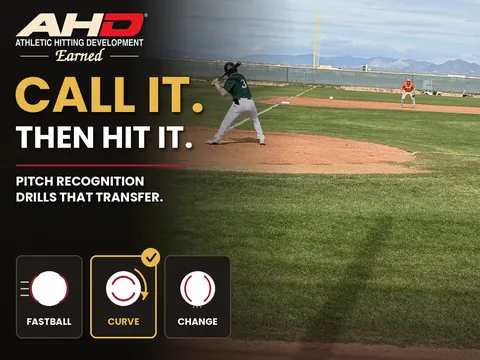
Pitch recognition training teaches a hitter to identify the pitch type, speed and location early enough to make a good decision. Not just “that was a curveball” after it’s in the catcher’s mitt. Early. While there’s still time to swing or take.
That last part matters most. Recognizing a pitch is only useful if it changes what you do. So good training always ends in a decision: swing or take, attack or let it go.
- See it.Find the release point and pick up the ball early, with both eyes.
- Time it.Start your load on time so you have a choice to make.
- Decide.Is it a pitch you can drive, in your zone, in this count?
- Attack it.If yes, swing with intent. If no, take it with conviction.
For the full breakdown, read Time It, Decide, Adjust.
2. Can you really train pitch recognition online?
You can train a big part of it. A screen can show you release points, spin, speed changes and locations over and over, with instant feedback on whether you got it right. That’s more decisions in 10 minutes than most hitters get in a week of batting practice.
What a screen can’t do is put a real arm in front of you. So think of online training as the classroom and the cage as the test. You need both.
- Online is great for: fast reads, lots of decisions, instant feedback, learning spin and speed changes.
- Online can’t replace: real velocity, depth perception, live timing and the pressure of an at-bat.
- The bridge: call every pitch out loud in the cage, on the machine and in live BP, just like you do in the game.
PITCH RECOGNITION
SEE IT.DECIDE.
- Read the release early
- Call it before feedback
- 10 minutes, every day
- Prove it in the cage
TRAIN DECISIONS, NOT JUST EYES
3. What are the best free pitch recognition tools?
We built free tools on the AHD site for exactly this. Each one trains a different piece of the Hitting Processor.
| Free tool | What it trains |
|---|---|
| Pitch Recognition Trainer | Reading the pitch early and making the swing-or-take call |
| Spin Read Test | Seeing spin to tell fastball from off-speed |
| Guess the Pitch | Fast identification of pitch type |
| Softball Pitch Recognition Trainer | Rise, drop and change reads for fastpitch hitters |
They’re free, they work on a phone, and they take a few minutes. Pick one or two, not all four every day.
4. What does a daily pitch recognition plan look like?
Ten minutes. Every day. The Hitting Processor is trained DAILY, the same way you’d train a swing or a lift.
- Minutes 1–3: warm the eyes.Track a ball, find a release point, then a few quick reads in the Spin Read Test.
- Minutes 4–7: decisions.One round in the Pitch Recognition Trainer. Call it before the feedback shows.
- Minutes 8–9: your zone.Say out loud which pitches you’d attack in a 0-0 count and which you’d take.
- Minute 10: log it.Write down your score and one thing you missed, so tomorrow has a target.
Then take it outside. In the cage, call every pitch out loud before you swing: “heater,” “spin,” “take.” Our 5-minute daily Hitting Processor plan has a version you can run before practice.
And when the read says it’s yours, go get it. "Swing at a bad pitch? No biggie. Take a good pitch to hit? Not happening." Training your eyes is about being MORE aggressive on the right pitches, not more passive.
5. What are the most common pitch recognition training mistakes?
Most hitters who say pitch recognition training didn’t work made one of these mistakes. Every one of them is easy to fix.
- Watching instead of deciding. If a rep doesn’t end in swing or take, it isn’t training the Hitting Processor.
- Calling it late. Make the call before the feedback shows, or you’re just reading the answer.
- Only training the fastball. The pitch that beats you is usually the one that looks like a fastball and isn’t.
- Doing it once a week. A skill trained once a week stays a once-a-week skill.
- Never taking it outside. If you don’t call pitches in the cage and in games, the screen work stays on the screen.
Fastpitch hitters have their own reads. The ball comes from a low release, so the rise ball and the drop ball move through the zone differently than a baseball pitch does. Use the softball trainer for those reps, and read why hitters get fooled by off-speed for the decision side of it.
6. How do you know pitch recognition training is working?
You measure it. If you can’t measure it, you’re guessing.
- Your scores go up in the free tools, and you call pitches earlier.
- Fewer chases on pitches out of the zone, especially with two strikes.
- Fewer called third strikes on hittable pitches.
- Harder contact on pitches in your zone, because you swung at the right ones.
See it. Time it. Decide. Attack it.
Good hitters do this without thinking because they trained it thousands of times. AHD hitters pair it with Mechanically Advantageous Angles (MAA) in the swing, so when the read says “yes,” the barrel is ready to do damage.
Start free with the Pitch Recognition Trainer and the free SwingChecker, which ranks your top priority across the 4 pillars. If the Hitting Processor comes up as your priority, the Hitting Processor course gives you 16 lessons that build the read, the timing and the decision in order. Lessons 1–3 are free, starting with Test Day: your decision baseline.
For more drills to run in the cage, see 7 pitch recognition drills that transfer.
THELESSON.
- It’s a skill, not a gift
- Free tools build the read
- Live reps prove it
- Measure it weekly
Complete Hitters Are Built…Earned.
Want to go deeper? Read Pitch Recognition Drills: 7 Drills That Actually Show Up in Games and Train the Eyes Without Swinging.
Quick answers
Can you improve pitch recognition at home?
Yes. Free online tools let you practice reading pitches and making swing-or-take decisions with instant feedback. Then carry it to the cage by calling every pitch out loud.
How long does it take to improve pitch recognition?
It depends on the hitter and how often they train it. Ten focused minutes a day, measured every week, moves it faster than occasional long sessions.
Are pitch recognition apps worth it?
They’re worth it when they make you decide, not just watch, and when you also train against live pitching. Start with free tools before paying for anything.
Does pitch recognition training work for softball?
Yes. Fastpitch hitters read rise, drop and change from a low release, and AHD has a free softball pitch recognition trainer built for those reads.
Don’t collect drills. Build a complete hitter.
Complete Hitters Aren’t Born. They’re Built… and Earned.