By BK, Athletic Hitting Development
Complete Hitters Aren’t Born. They’re Built… and Earned.
Key takeaways
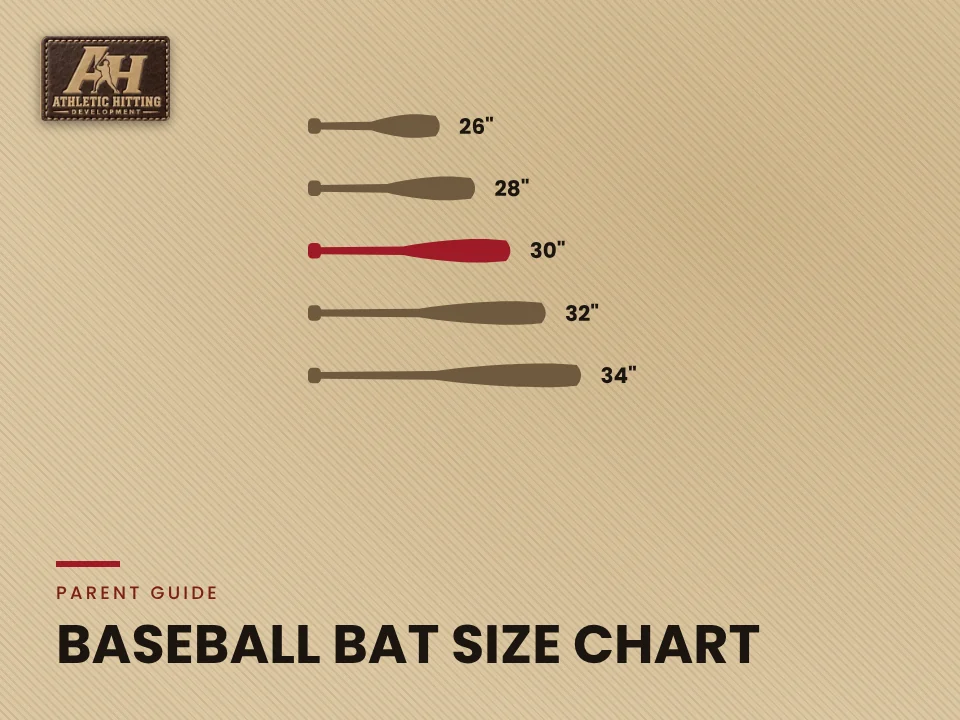
- A baseball bat size chart matches age, height and weight to a length: about 24–26 inches for tee ball, 28–31 inches for most 9–12-year-olds and 31–34 inches in high school.
- Drop is length minus weight; a -10 bat is lighter than a -5 bat, and BBCOR bats are -3.
- The stamp matters as much as the size: USA Baseball for most youth leagues, USSSA for many travel tournaments and BBCOR for high school and Little League Senior League.
- When in doubt, go lighter and shorter. A bat he controls beats a bat he “grows into.”
A baseball bat size chart matches a hitter’s age, height and weight to a bat length and weight: about 24–26 inches for tee ball, 28–31 inches for most 9–12-year-olds and 31–34 inches in high school. Use the chart to get close, check the stamp his league requires, then confirm the fit with a quick swing test.
Use a baseball bat size chart by height and weight: about 24–26 inches for tee ball, 28–31 inches for most 9–12-year-olds and 31–34 inches in high school. Then match the stamp your league requires (USA Baseball, USSSA or BBCOR) and choose the lighter bat if in doubt.
Train it: Complete Hitter Masterclass →The fastest way to get this right: use our free Bat Size Calculator. Enter age, height and weight and it does the math for you: length, weight, drop and the stamp his league needs.
If you want to understand the numbers behind it, here’s the chart, what drop means, which stamp your league requires and how I check a bat in a player’s hands.
1. What size baseball bat does my son need by age?
These ranges come from a widely used retailer sizing guide and the Little League bat rules. Smaller kids sit at the low end, bigger kids at the high end.
| Age | Typical length | Typical weight | Stamp to check |
|---|---|---|---|
| 4–6 (tee ball) | 24–26 in | 12–16 oz | USA Baseball tee ball mark (Little League max 26 in) |
| 7–8 (coach pitch) | 26–29 in | 13–18 oz | USA Baseball or USSSA, per league |
| 9–10 | 27–32 in | 15–22 oz | USA Baseball or USSSA, per league |
| 11–12 | 29–32 in | 19–22 oz | USA Baseball (Little League Major max 33 in) or USSSA |
| 13–15 | 31–33 in | 19–28 oz | USA Baseball, USSSA with drop limits, or BBCOR |
| High school and college | 31–34 in | 28–31 oz | BBCOR (-3) |
Age is only a starting point. A big 10-year-old and a small 10-year-old can need very different bats. That’s why height and weight matter more.
One more note on age. Bat weight climbs faster than length as kids move up. A 12-year-old and a 14-year-old may swing the same 31-inch length, but the 14-year-old’s bat can be several ounces heavier because of a smaller drop. That jump is where a lot of hitters get slow. Make sure he can handle it before game day.
2. What size bat should I get by height and weight?
The common height-and-weight chart crosses the two and gives one length. A few examples from it:
Notice the pattern. Height pushes length up more than weight does. A tall, light kid usually needs more length; a short, heavy kid usually doesn’t need a longer bat just because he’s strong. When he falls between two sizes, start with the shorter one.
- 4’1”–4’4”, 61–70 lbs: 29 inches.
- 4’5”–4’8”, 71–80 lbs: 30 inches.
- 5’5”–5’8”, 131–140 lbs: 32 inches.
- 5’9”–6’0”, 141–150 lbs: 33 inches.
Skip the grid. Let the calculator do the math.
Our free Bat Size Calculator runs the full height and weight chart for you, then adds the drop and stamp for his league. Then confirm the fit in his hands:
- Arm-extension test.Knob at the center of his chest, bat along his outstretched arm; the end should reach about his fingertips.
- Shoulder test for youth.Standing upright, a youth bat should be no longer than about shoulder height.
- Hold-it-out test.He holds the bat by the handle, arm straight out to the side; if it drops in under about 20 seconds, it’s probably too heavy.
- Swing test.Ten full swings. If the barrel drags or he’s late on firm toss, go lighter.
BAT FIT CHECK
SIZE IT.THEN SWING IT.
- Knob at chest, reach fingertips
- No longer than shoulder (youth)
- Hold it out 20 seconds
- On time on firm toss
CONTROL BEATS SIZE
3. What does drop mean on a baseball bat?
Drop is the bat’s length in inches minus its weight in ounces. A 30-inch, 20-ounce bat is a -10. A 33-inch, 30-ounce bat is a -3. The bigger the number, the lighter the bat for its length, so a -10 is lighter than a -5.
Generally, the older and stronger the player, the smaller the drop. Some leagues set limits:
- Little League Senior League: a bat may weigh no more than three ounces less than its length, which is a -3.
- USSSA 13U: maximum drop of -8, per the published USSSA guide.
- USSSA 14U: maximum drop of -5.
- High school and college: BBCOR bats, which are -3.
Moving to a heavier drop is a step, not a birthday present. Make the change when he can swing the heavier bat on time, not just because he aged up.
For young players who are still learning to swing, a lighter drop is the smart default. Common youth guidance puts younger kids in the -10 to -12 range and 9 to 12-year-olds around -8 to -10, then moves them toward -5 and -3 as they get stronger and move up to bigger fields.
4. Which bat stamp does my league require: USA Baseball, USSSA or BBCOR?
This is where parents lose money. A great bat with the wrong stamp is illegal. Check the knob or taper for the certification mark, and check your league before you buy.
- USA Baseball. Little League requires the USA Baseball mark on non-wood and laminated bats in tee ball and Minor/Major divisions. Major division bats max out at 33 inches and a 2-5/8 inch barrel.
- USSSA. Many travel tournaments use bats with the USSSA 1.15 BPF stamp, with barrels up to 2-3/4 inches. These are not legal in Little League play.
- BBCOR. Little League Senior League requires BBCOR on non-wood bats (max 36 inches). Intermediate 50/70 and Junior League allow USA Baseball or BBCOR bats up to 34 inches. High school and college use BBCOR.
A simple buying rule: find out every league and tournament he’ll play this year before you buy. If he plays Little League in the spring and USSSA travel in the summer, he may need two bats, or one that is legal in both places. Wood bats are legal almost everywhere, and swinging wood in practice is a great teacher of square contact.
Rules change. Little League updates its bat page every season, so check it and your travel organization’s rules each year.
5. Is a longer or heavier bat better for a young hitter?
No. This is the coaching part of the answer. A bat that’s too long or too heavy makes a kid late, drags the barrel and teaches him bad habits to survive. I’d rather see a hitter a little under-sized and FAST than over-sized and slow.
Watch for the signs of an oversized bat: the barrel dips below his hands before he swings, his head pulls off the ball, or he’s late on every firm pitch and early on nothing. Any of those, and the bat is winning. Swap it for a lighter one and watch how fast he gets on time.
Good hitters swing a bat that lets them hold their Mechanically Advantaged Angles (MAA) and stay on time. If you want more power, build it in the body, not the bat; see How to Hit for Power in Baseball. And a pricier bat won’t fix a swing; I explain why in $500 Bats Don’t Build Hitters.
Once the bat fits, put it to work. Run the free SwingChecker to find his top priority, try age-right work like Hitting Drills for 10-Year-Olds, and build all 4 pillars with the Complete Hitter Masterclass. Want a coach watching his swing every week? See our online hitting instruction. Have a fastpitch player too? Use the Softball Bat Size Chart.

THELESSON.
- Chart gets you close
- Check the league stamp
- Smaller drop as he grows
- Lighter beats too heavy
Complete Hitters Are Built…Earned.
Want to go deeper? Read Bat Speed by Age: Baseball and Softball Benchmarks (2026 Chart) and What Age Should a Kid Start Hitting Lessons?.
Quick answers
What size bat should a 10 year old use?
Most 10-year-olds swing a 28 to 31 inch bat, depending on height and weight. Check the stamp his league requires and make sure he can swing it on time.
How do I know if a baseball bat is too heavy?
If he can’t hold it straight out to the side for about 20 seconds, or the barrel drags and he’s late on firm pitches, it’s too heavy. Go lighter or shorter.
Can you use a USSSA bat in Little League?
No. Little League requires the USA Baseball mark on non-wood bats in its younger divisions and BBCOR or USA Baseball bats in older ones. USSSA bats are for leagues and tournaments that allow them.
What does -10 mean on a bat?
It’s the drop: the length in inches minus the weight in ounces. A 30-inch bat that weighs 20 ounces is a -10, which is lighter than a -5 of the same length.
Sources: Baseball Monkey: Baseball Bat Size Chart (height/weight chart and age tables) · Little League: Bat Rules (baseball divisions, stamps and max lengths) · Baseball Monkey: USSSA Bat Rules by Age
Don’t collect drills. Build a complete hitter.
Complete Hitters Aren’t Born. They’re Built… and Earned.
This article is part of the AHD guide Baseball Hitting Drills by Age. Start there for the full picture and every related article.