By BK, Athletic Hitting Development
Complete Hitters Are Built… It’s Earned!
Key takeaways
- To hit a changeup, time the fastball, keep your hands and barrel back long enough to adjust, and drive the ball to the middle or opposite field.
- The tell is the mismatch: fastball arm speed with a ball that comes out slower and floats a little, often with a slight hump.
- Stay back means the lower half can go while the hands wait; a hitter who commits his hands early has no swing left for the changeup.
- Changeup recognition is a Hitting Processor skill, trained daily with mixed-speed reps, not by guessing at the plate.
To hit a changeup, a hitter sits on the fastball, reads the slower ball coming out of fastball arm speed, and keeps his hands back long enough to let it travel before driving it to the middle or opposite field. Hitters who commit their hands early end up out front and roll it over or swing through it.
To hit a changeup, sit on the fastball and read the slower ball coming out of fastball arm speed. Stride on time but keep your hands back until you see it, let it travel, and drive it to the middle or opposite field.
Train it: Off-Speed / Spin →I’ve watched thousands of hitters get beat by the same pitch: a changeup down in the zone that looked like a fastball until it was too late. The fix isn’t to look for the changeup. It’s to build a swing and an eye that can wait on it.
If you want the deeper ‘why’ behind getting fooled, read Why Hitters Get Fooled by Changeups & Curveballs. This post is the how: what to see, how to stay back, and how to train it.
1. What does a changeup do in baseball?
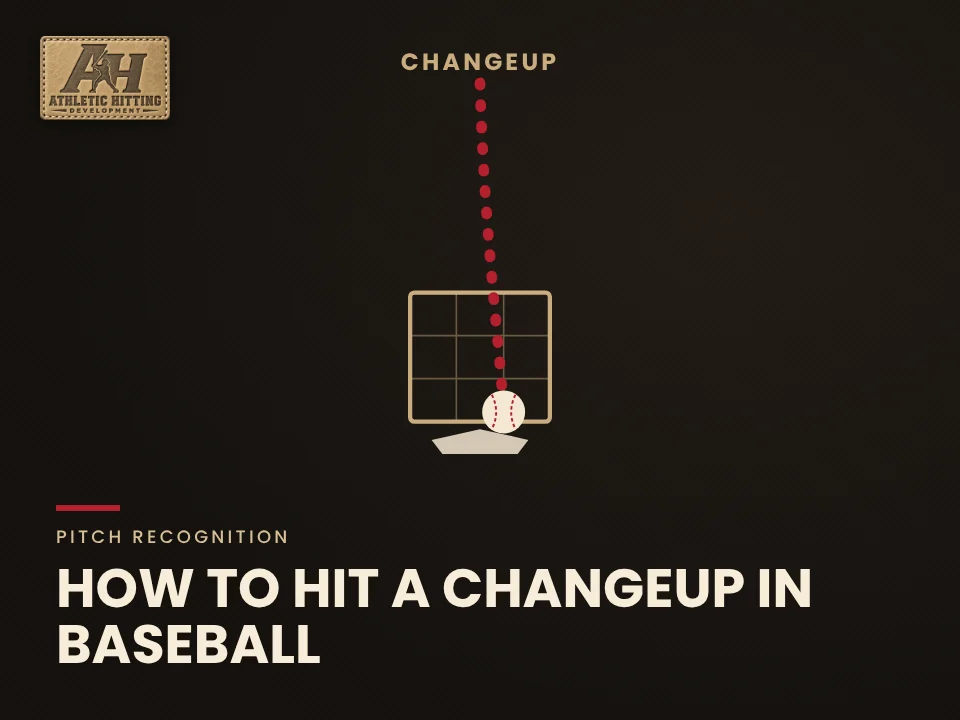
A changeup is built to look like a fastball and arrive late. It is thrown with a nearly identical motion to the fastball, released on a fastball-looking path, but at a significantly slower velocity. The goal is simple: get the hitter to start his swing for a fastball.
Good changeups usually finish down and often fade toward the pitcher’s arm side. Bad ones stay up, and once a hitter sees it, a slow pitch that doesn’t move much is one of the easiest pitches to hit.
The changeup doesn’t beat your swing. It beats your timing.
That’s the key idea. A hitter who is fooled by a changeup usually doesn’t have a bad swing. He has a swing that started on the fastball schedule and couldn’t wait.
2. How do you recognize a changeup out of the pitcher’s hand?
Read arm speed against ball speed. The pitcher’s arm says ‘fastball.’ The ball says something different. Hitters learn to trust the ball, not the arm.
- Ball speed doesn’t match arm speed. The arm whips; the ball comes out softer. That mismatch is the tell.
- A slight hump out of the hand. Many changeups pop up a touch out of release before they fade and drop.
- The ball looks bigger and slower. It hangs in his vision a beat longer than the fastball did.
- The count and the pitcher. Know when this pitcher likes it: behind in the count, to opposite-side hitters, or as his out pitch.
The reading part only works if his eyes are quiet and locked on the release window early. A head that moves during the load makes every pitch look the same. That’s why recognition gets trained in the Hitting Processor: see it, time it, decide, attack it.
You can train this without swinging at all. Watch video of a pitcher, stop it a few frames after release, and have him call fastball or changeup. Then check. Ten minutes a few times a week sharpens the read faster than most kids expect. The method is in Occlusion Training for Hitters. And when he does read it, he still has to make a decision: is this changeup a strike he can drive, or one diving below the knees?
3. How do you stay back on a changeup without being late on the fastball?
‘Stay back’ is the most repeated and least understood cue in hitting. It does NOT mean sit on the back leg and wait. That makes him late on every fastball.
Here’s what it really means: the stride and the lower half can start on fastball time, while the hands and barrel stay loaded until he decides. The body moves. The hands wait. When he reads changeup, the hands still have a full swing in them.
- Load and stride on fastball time.Get the front foot down early so he’s never rushed by the heater.
- Land with the hands still back.At foot strike the hands stay near the back shoulder; no early push toward the pitcher.
- Read the ball, not the arm.If the ball is slower, the hands keep waiting while the lower half holds strong.
- Let it travel.Contact deeper in the zone than a fastball he’s pulling, usually middle of the plate.
- Drive it middle or opposite field.Changeups hit to center and the other way stay off the ground; pulled ones roll over.
Hitters who can hold their hands this way usually have strong angles in the swing. AHD hitters build Mechanically Advantaged Angles (MAA), and those angles are what let the barrel stay loaded and still get there fast.
CHANGEUP KEYS
BODY GOES.HANDS WAIT.
- Read arm speed vs ball speed
- Stride on fastball time
- Hands back at foot strike
- Drive it middle or the other way
TRUST THE BALL, NOT THE ARM
4. Should a hitter sit fastball and adjust to the changeup?
For most hitters, yes. Sit on the fastball and adjust to off-speed. You can always slow down from fastball time. You can’t speed up from changeup time.
There are exceptions. If a pitcher throws his changeup a lot in certain counts, a hitter with a plan can hunt it, especially ahead in the count. And with two strikes, he should be ready for it down in the zone; see our two strike approach for that plan.
| Situation | Approach | What he’s looking for |
|---|---|---|
| Most counts | Sit fastball, adjust | Fastball timing, hands ready to wait |
| Pitcher lives on the change | Hunt it when ahead | Changeup up in the zone to drive |
| Two strikes | Middle, adjust | Changeup down: lay off below the knees |
| Changeup down and away | Take it early in the count | Pitcher’s best spot; let him miss |
Fastball timing comes first, though. If he’s late on the fastball, he’ll never have room to wait on anything. Start with How to Hit a Fastball, then come back here.
5. What drills help a hitter hit a changeup?
Don’t collect drills. Pick a few that train reading speed and holding the hands, and do them often.
- Two-speed front toss. The feeder mixes firm and soft tosses from the same arm action, about 1 in 3 soft. He hits the firm one hard and still drives the soft one to center. 15–20 reps.
- Hands-back tee. Set the tee a few inches deeper than normal. He strides on a ‘go’ call, holds the hands, then swings on a second call. 10 reps to feel the separation.
- Call it out. In machine or live BP, mixed speeds, he calls ‘hard’ or ‘soft’ out loud before contact. Recognition first, then the swing.
- Middle-away scoring. Points only for changeups driven to center or the opposite field.
Film from the side so you can see where the hands are at foot strike. Not sure off-speed is his real problem? Run the free SwingChecker; it ranks his top priority across the 4 pillars. For the complete off-speed plan, the Off-Speed course builds recognition and the hold step by step, and the slider has its own read in How to Hit a Slider. Want Coach to review your hitter’s at-bats against off-speed? That’s what our online hitting instruction is for. Fastpitch families, the softball version is different enough to read on its own: How to Hit a Changeup in Softball.

THELESSON.
- Sit fastball, adjust
- Read the speed mismatch
- Keep the hands loaded
- Train mixed speeds daily
Complete Hitters Are Built…Earned.
Want to go deeper? Read Why Your Hitter Gets Fooled by Changeups and Curveballs and The Off-Speed Test.
Quick answers
Why do I always swing early on changeups?
Your hands are committing on fastball timing before you read the slower ball. Keep the stride on time but hold the hands back until you see the ball speed, and train it with mixed-speed front toss.
How do you tell a changeup from a fastball?
Watch the ball, not the arm. A changeup comes out of fastball arm speed but looks slower and often pops up slightly out of the hand before it fades and drops.
Where should you hit a changeup?
Most hitters do best driving the changeup to the middle or opposite field. Trying to pull it usually means being out front and rolling it over.
Is a changeup easier to hit than a curveball?
Once recognized, a changeup that stays up is one of the easiest pitches to hit. Its danger is timing deception, while a curveball adds big break, so each needs its own read.
Sources: MLB.com Glossary: Changeup
Don’t collect drills. Build a complete hitter.
Complete Hitters Are Built… It’s Earned!
This article is part of the AHD guide Pitch Recognition & Timing. Start there for the full picture and every related article.