By BK, Athletic Hitting Development
Complete Hitters Aren’t Born. They’re Built… and Earned.
Key takeaways
- You can measure bat speed three ways: a sensor on the knob, a radar set up for swings, or slow-motion video. Consistency beats the tool.
- Where on the bat you measure changes the number. MLB measures bat speed at the sweet spot, about six inches from the end of the barrel.
- Test on the same day of the week, same warm-up, same bat, same setup, and use the average of the hard swings, not the one best rep.
- Bat speed only matters if it shows up on time against a real pitch. Measure it, then train the whole hitter.
To measure bat speed, use a sensor on the knob of the bat, a radar set up for swings, or slow-motion video, and measure the same way every time. The best measurement is the one you can repeat: same bat, same warm-up, same setup, and the average of the hard swings, not the single best one.
Measure bat speed with a bat sensor, a radar set up for swings, or slow-motion video, and use the same bat, warm-up and setup every time. Track the average of 10 hard swings off a tee and retest every 4–6 weeks.
Train it: Athletic Development → Free tool: Exit Velocity & Bat Speed Calculator →Parents ask me this every week. They bought a sensor, the number jumped around, and now they don’t know what to believe.
Here’s how each method works, what MLB actually measures, and how to read the number so it helps your hitter instead of messing with his head.
1. What is bat speed, exactly?
Bat speed is how fast the bat is moving at contact. The catch: different parts of the bat move at different speeds. The end of the barrel moves faster than the label, and the label moves faster than the hands.
That’s why the spot matters. MLB’s Statcast bat tracking measures bat speed at the point about six inches from the head of the bat, what most people call the sweet spot. It reports a hitter’s average bat speed as the average of his top 90% of swings, and calls any swing of 75 mph or more a fast swing.
One lab study comparing bat sensors to motion capture found the speed at the tip and the speed about 15 cm (6 inches) down the barrel differed by roughly 5 m/s, about 11 mph. Same swing, two very different numbers. So before you compare your kid to anybody, know where each number was measured.
Same swing. Different spot on the bat. Different number.
2. What are the ways to measure bat speed?
| Method | How it works | Watch out for |
|---|---|---|
| Bat sensor | A small motion sensor on the knob estimates speed at a point on the barrel | Loose mounts, very fast swings, comparing different brands |
| Radar | Reads the speed of the moving bat in its beam | Aim and distance change the reading; keep the setup identical |
| Slow-motion video | Measure how far the barrel travels between frames, divide by the time | It’s an estimate; frame rate and camera angle limit accuracy |
Bat sensors are the most common. Researchers who tested four knob-mounted sensors against lab motion capture found all of them tracked swing speed well across a wide range of players. They also found the readings varied enough that small changes for one hitter could be noise, accuracy dropped on very fast swings (above about 30 m/s, roughly 67 mph), and a mount that slips on the knob throws the number off. Tape it down and check it.
Radar can work if it’s set up for swings, not pitches. Put it in the same spot, at the same distance, every session.
Video is free and you already own the phone. Film in slow motion from the side, measure how far the barrel moves across a few frames near contact, and divide by the time between frames. Use it to compare your hitter to himself, not to a sensor number.
MEASURE BAT SPEED
SAME TEST.EVERY TIME.
- Same bat, same warm-up
- Same sensor or camera setup
- 10 hard swings off a tee
- Track the average
CONSISTENCY BEATS THE TOOL
3. How do you run a bat speed test you can trust?
A bat speed test is only as good as its routine. Run it like this:
- Warm up the same way every time.Same dynamic warm-up and the same number of easy swings before you record.
- Use the same bat and the same setup.Same sensor mount, same radar spot, same camera position. Change one thing and you can’t compare.
- Swing off a tee at a real target.Full intent, hit the ball, middle of the field. Dry swings at air run fast and lie.
- Take 10 hard swings.Rest between them so fatigue doesn’t change the test.
- Record the average, then the best.The average tells you who he is. The best tells you what’s in there.
- Retest every 4–6 weeks.Bat speed moves slowly. Weekly testing mostly measures noise.
Softball hitters can use the same routine. Our softball bat speed profile shows how to track it over a season.
4. What does the bat speed number actually mean?
It tells you what the swing CAN produce. It doesn’t tell you if he’s on time, if he swung at a good pitch, or if he squared it up. A hitter can have a big number on the tee and still get beat by a fastball because he started late.
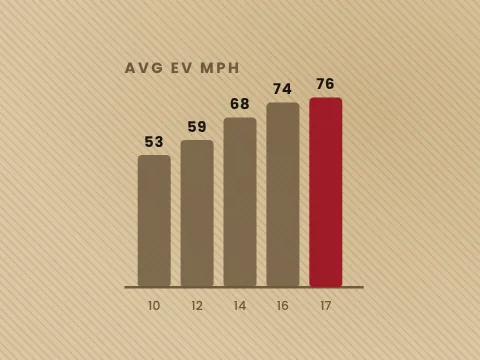
Compare him to himself first. If you want a rough idea of where he stands for his age, see our bat speed by age chart, and plug his numbers into the free exit velocity and bat speed calculator to see how well that speed is turning into exit velocity. For the difference between the two numbers, read bat speed vs exit velocity.
Good hitters don’t just swing fast. They get to strong positions, what we call Mechanically Advantageous Angles (MAA), so the speed they have shows up at contact, on time.
"Ball — powdered." That’s the sound we’re chasing. A fast swing that doesn’t make that sound against a real pitch is a number, not a weapon.
5. What should you do after you measure bat speed?
Use the number to pick the next piece of work, not to judge the kid.
- Low speed, good timing. Build the body. Strength, rotational power and speed work, then swings with intent. See bat speed drills that transfer.
- Good speed, poor contact. The speed is there; the barrel isn’t finding the ball. That’s path, timing or decisions.
- Big tee number, late in games. That’s the Hitting Processor: seeing it and starting on time. Read bat speed isn’t timing.
- Number jumping all over. Check the test before you change the swing. Mount, setup, warm-up, fatigue.
Not sure which one it is? The free SwingChecker ranks his top priority across the 4 pillars in about 3 minutes. The Athletic Development course builds the body that makes speed, and the Complete Hitter Masterclass puts it together with the swing, the Hitting Processor and the mental side.

THELESSON.
- Know where it’s measured
- Average beats best
- Retest every 4–6 weeks
- Speed has to be on time
Complete Hitters Are Built…Earned.
Want to go deeper? Read Bat Speed by Age: Baseball and Softball Benchmarks (2026 Chart) and Bat Speed Drills That Actually Transfer to Games.
Quick answers
Where on the bat is bat speed measured?
MLB’s Statcast measures bat speed at the sweet spot, about six inches from the head of the bat. Sensors and radar may measure a different point, so only compare numbers taken the same way.
Are bat speed sensors accurate?
In lab testing, knob-mounted sensors tracked swing speed well across many players, but readings varied swing to swing and accuracy dropped on very fast swings. Mount the sensor firmly and use averages, not single swings.
Can you measure bat speed with a phone?
Yes, roughly. Film in slow motion from the side, measure how far the barrel travels between frames near contact and divide by the time. It works best for comparing a hitter to himself.
How often should my kid test bat speed?
Every 4 to 6 weeks is plenty. Bat speed changes slowly, so testing every week mostly measures noise and can make a hitter chase a number.
Sources: Baseball Savant: Statcast Bat Tracking leaderboard (bat speed measured six inches from the head of the bat) · Baseball Savant: Statcast Metrics Context (average bat speed = top 90% of swings; fast swing = 75+ mph) · Morishita et al. (2022), Accuracy and Error Trends of Commercially Available Bat Swing Sensors in Baseball, Sports
Don’t collect drills. Build a complete hitter.
Complete Hitters Aren’t Born. They’re Built… and Earned.