By BK, Athletic Hitting Development
Complete Hitters Aren’t Born. They’re Built… and Earned.
Key takeaways
- The average MLB bat speed in 2026 was 72.1 mph on competitive swings, per Baseball Savant.
- Statcast calls any swing of 75 mph or more a “fast swing.” About 26.6% of big league competitive swings got there in 2026.
- The 2026 leaders swung around 77–79 mph, led by Junior Caminero at 79.4 and Jordan Walker at 79.3.
- Bat speed is a tool, not the whole hitter. Speed only pays when it’s on time, on plane and on a pitch you can drive.
The average MLB bat speed in 2026 was 72.1 mph, according to Statcast bat tracking on Baseball Savant. The fastest qualified hitters averaged about 77 to 79 mph, and MLB calls any swing of 75 mph or more a “fast swing.”
The average MLB bat speed in 2026 was 72.1 mph on competitive swings, per Statcast. MLB calls a swing of 75+ mph a fast swing, and the fastest qualified hitters, led by Junior Caminero at 79.4 mph, averaged about 77 to 79 mph.
Train it: Complete Hitter Masterclass → Free tool: Exit Velocity & Bat Speed Calculator →Parents and players ask me this all the time, usually right after a sensor reading at a showcase. It’s a great question. The number matters. But it matters a lot more when you know what it measures and what it doesn’t.
Here are the real 2026 numbers, straight from Statcast, and how a high school or college hitter should actually use them.
1. What is the average bat speed in MLB?
In 2026, the league-wide average was 72.1 mph. That number comes from Baseball Savant’s bat tracking leaderboard, which measured more than 73,000 competitive swings across the league.
Two details matter here. First, Statcast measures bat speed at the sweet spot: a point six inches from the head of the bat. Second, it only averages competitive swings, meaning a player’s fastest 90% of swings plus any 60+ mph swing that produced a 90+ mph exit velocity. Check swings and defensive pokes don’t drag the number down.
So 72 mph is what a big leaguer’s real, game-intent swing looks like on an average night. That’s the honest benchmark.
MLB BAT SPEED 2026
72.1 MPHAVERAGE.
- Measured 6 in. from the bat head
- Competitive swings only
- Fast swing = 75+ mph
- Leaders: about 77–79 mph
STATCAST BAT TRACKING
2. What counts as a fast swing in MLB?
MLB defines a “fast swing” as any swing that reaches 75 mph. Its fast-swing rate is simply the share of a hitter’s swings that get there. In 2026, 26.6% of competitive swings league-wide did.
Why 75? MLB says that’s the speed where per-swing production reaches league average, and the gap is big. In MLB’s own early 2024 data, fast swings hit .307 and slugged .603. Swings under 75 mph hit .246 and slugged .369.
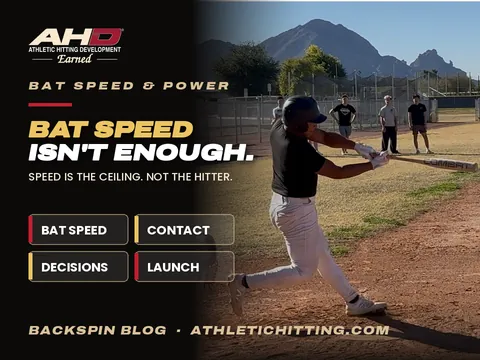
Swinging hard matters. Swinging hard on time matters more.
That’s the identity of an AHD hitter: aggressive and athletic. Controlled violence. Not a max-effort swing that’s late, but a fast swing that shows up on time, every time.
3. Who had the fastest bat speed in MLB in 2026?
Here are the top of Baseball Savant’s 2026 bat speed leaderboard among qualified hitters, average bat speed on competitive swings:
| Rank | Hitter | Avg bat speed | Fast-swing rate |
|---|---|---|---|
| 1 | Junior Caminero | 79.4 mph | 84.9% |
| 2 | Jordan Walker | 79.3 mph | 85.5% |
| 3 | Nick Kurtz | 78.2 mph | 80.4% |
| 4 | Cam Smith | 77.9 mph | 78.0% |
| 5 | Oneil Cruz | 77.7 mph | 72.7% |
| 6 | Garrett Mitchell | 77.6 mph | 80.7% |
Kyle Schwarber (77.1), Jo Adell (77.4), Jac Caglianone (77.0) and Willson Contreras (77.0) rounded out the top 10. Notice the spread: the fastest bats in the world sit only about 5 to 7 mph above league average.
Notice something else. Being at the top of this list doesn’t make you the best hitter in the league. We broke that down in Junior Caminero: why bat speed isn’t the whole story. Speed gives you a bigger margin for error. Timing, path and decisions decide what you do with it.
4. How does my hitter’s bat speed compare to MLB?
Don’t compare a 15-year-old to Junior Caminero. Compare him to where he was last month, and to hitters his age. Our bat speed by age chart lays out realistic ranges from 8 through 18, for baseball and softball.
Also know that sensors read differently. A bat-mounted sensor, a radar gun and Statcast’s camera system don’t all measure the same point the same way. Use one device, test the same way every time, and track the trend.
- Test the same way. Same bat, same device, tee or front toss, 10 full-intent swings.
- Track the average, not the max. Statcast uses averages for a reason.
- Pair it with exit velocity. Speed without contact quality is just wind. Run the numbers in our free exit velocity and bat speed calculator.
- Retest every 4–6 weeks. Bat speed moves slowly. Don’t panic over one session.
5. Does bat speed matter for high school and college hitters?
Yes. Scouts and college coaches look at it because it’s hard to fake and hard to teach late. A hitter with more speed has more time: he can start a little later, see the ball a little longer and still get the barrel there.
But I’ve watched plenty of hitters with big sensor numbers who couldn’t hit live pitching. The speed showed up on the tee and disappeared against a good arm, because the swing started late or the decision was wrong. Bat speed you can’t use in a game doesn’t help you.
So build it, test it and be proud of it. Then make sure it shows up when the pitcher is trying to beat you. That’s the difference between a number on a showcase sheet and a complete hitter.
6. How do hitters actually build MLB-type bat speed?
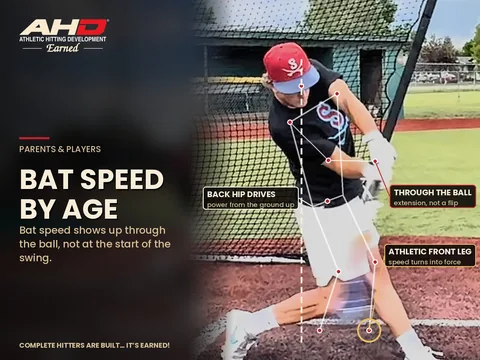
Not by swinging harder in the cage. Big league bat speed is built by the body. It comes from an athletic load, a strong bump into an athletic front leg and a body that can produce force and then let it go. That’s why AHD hitters build Mechanically Advantageous Angles (MAA): positions that let the body’s speed reach the barrel.
It’s two pillars working together: the Swing and Athletic Development. A hitter with a sound move and a stronger, faster body gets faster. A hitter who only swings harder usually just gets longer. See bat speed drills that transfer to games and how to increase exit velocity for the work itself.
And when it all comes together, you’ll hear it. "Ball — powdered." That sound of a barreled ball is the real target. Chase that sound, not a number on an app.
Not sure what’s holding your speed back? Run the free SwingChecker. It ranks your top priority across all 4 pillars in about 3 minutes. Then build the whole hitter in the Complete Hitter Masterclass.

THELESSON.
- Know the real benchmark
- Compare to your age
- Track averages, not maxes
- Speed must be on time
Complete Hitters Are Built…Earned.
Want to go deeper? Read Bat Speed by Age: Baseball and Softball Benchmarks (2026 Chart) and Junior Caminero Bat Speed: How Fast Is His Swing, and Why Does It Work?.
Quick answers
What is the average MLB bat speed?
In 2026 the MLB average bat speed was 72.1 mph on competitive swings, per Statcast bat tracking on Baseball Savant.
Who has the fastest bat speed in MLB?
Among qualified hitters in 2026, Junior Caminero led at 79.4 mph, just ahead of Jordan Walker at 79.3 mph, per Baseball Savant.
What is a good bat speed for a high school hitter?
It depends on age, size and strength. Use an age-based chart and compare your hitter to their own past tests rather than to big leaguers.
Where is bat speed measured?
Statcast measures bat speed at the sweet spot, six inches from the head of the bat. Other sensors may measure differently, so stick with one device.
Sources: Baseball Savant: 2026 Statcast bat tracking, league average and measurement method · Baseball Savant: 2026 bat speed leaderboard, qualified batters · MLB Glossary: Fast-swing rate (75+ mph) and fast vs. non-fast swing results
Don’t collect drills. Build a complete hitter.
Complete Hitters Aren’t Born. They’re Built… and Earned.