
By BK, Athletic Hitting Development
Complete Hitters Aren’t Born. They’re Built… and Earned.
Key takeaways
- Hitting drills for 13 year olds should keep him on time while everything around him changes: field size, pitch speed, bat and his own body.
- Six drills cover it: high-low tee, short-distance firm toss, fastball-changeup mix, opposite-field line drives, med-ball throws and count at-bats.
- Plan on about 30–45 minutes, three or four days a week, with 60–80 quality swings. Stop when the bat slows down.
- Growth spurts mess with timing. That’s normal. Keep the plan simple and keep him swinging hard on purpose.
The best hitting drills for 13 year olds keep a hitter on time as the field gets bigger and the pitching gets firmer: tee work for a clean bat path, short-distance toss for timing, a fastball-changeup mix and a few hard, rested swings for bat speed. Plan on 30–45 minutes, three or four days a week.
Hitting drills for 13 year olds should build timing and a clean bat path for a bigger field: high-low tee work, short-distance firm toss, a fastball-changeup mix, opposite-field line drives and med-ball throws. Plan on 30–45 minutes, three or four days a week.
Train it: Complete Hitter Academy → Free tool: Spin Read Test →Thirteen is the bridge year. Depending on the league, a 13 year old might play on a 50/70 field, a full 60/90 field, or both in the same summer. The arms get stronger, the breaking balls get real, and a lot of kids grow three inches between April and August.
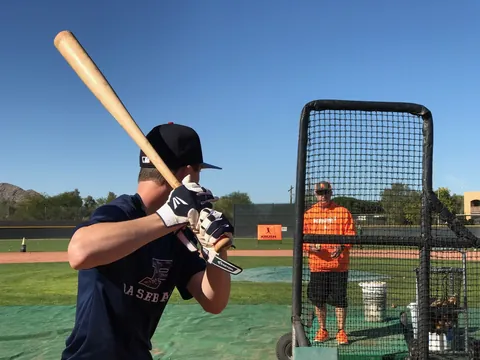
I’ve seen it a thousand times: a kid who raked at 12 shows up at 13 late on everything. He didn’t forget how to hit. Everything around him changed at once. Here’s how to keep him on time.
1. What changes for a 13 year old hitter?
- The field. Little League’s Intermediate (50/70) division, for ages 11–13, uses a 50-foot mound and 70-foot bases. Senior League (ages 13–16) plays on a full 60/90 field.
- The pitching. More kids throw hard, and more of them throw a changeup or a curveball for a strike.
- The body. Growth spurts change his levers, his strength and his timing, sometimes in a few months.
- The bat. Many 13 year olds move to a heavier bat. If it’s too heavy to control, the swing gets long.
None of that means he needs a new swing. It means he needs the same swing, on time, against better stuff. If he’s still missing the basics from the small field, go back to the 12U hitter development plan first.
One of my favorite lines for this age: "The ball ain't changing shape, I promise ya that." Bigger field, harder thrower, same ball. Same swing, same plan.
New field. Same ball. Be on time.
2. What are the best hitting drills for 13 year olds?
Six drills. Pick four or five per session. Every swing has a job.
- High-low tee.Set one tee at the top of the zone and one at the bottom; alternate swings so he learns to match the plane of each pitch instead of grooving one swing. 2 rounds of 10.
- Short-distance firm toss.Behind an L-screen, firm front toss from a shorter distance to shrink his reaction time and force an earlier start. 3 rounds of 8.
- Fastball-changeup mix.Mix firm and slow tosses without telling him which is coming; he hunts the fastball and stays back on the changeup. See it, time it, decide, attack it.
- Opposite-field line drives.One round where the only goal is a hard line drive the other way. It rewards a barrel that stays behind the ball and through it.
- Med-ball rotational throws.Light med ball, explosive throws into a wall, 3 sets of 5 per side, to build the rotational power behind bat speed.
- Count at-bats.Live or machine at-bats that start at 2-0, 1-1 and 0-2. He changes his plan for each count and scores the quality of the at-bat, not just hits.
Two rules. First, full intent: a 13 year old builds bat speed by swinging hard on purpose and resting between rounds, not by taking 200 lazy swings. Second, the game bat shows up every session. If he’s tired or the swing is getting longer, that’s the end of the day.
On the opposite-field round, I want to hear this one from him: "Hard, down the other way means we are on our way!" A hard ball the other way means he was on time and stayed through it.
13U HITTING
BRIDGEYEAR.
- Bigger field, firmer arms
- Growth spurts change timing
- Same ball, same swing
- Be on time first
THE BALL AIN'T CHANGING SHAPE
Want more timing work? See Baseball Hitting Drills for Timing and Bat Path Drills.
3. How long should a 13 year old practice hitting?
About 30–45 minutes, three or four days a week, is what I see work for most 13 year olds. That’s roughly 60–80 good swings. Quality beats volume every time.
| Block | Time | Reps |
|---|---|---|
| Warm-up and med-ball throws | 6–8 minutes | 30 throws |
| High-low tee | 8 minutes | 20 |
| Short-distance firm toss | 8 minutes | 24 |
| Fastball-changeup mix or opposite-field round | 8–10 minutes | 15–20 |
| Count at-bats | 5–10 minutes | 3–5 at-bats |
In season, cut it down. Two or three short sessions a week that keep his timing sharp are plenty when he’s playing games. Save the bigger bat speed and strength work for the offseason.
4. What if a growth spurt messes up his swing?
It will, at some point. Longer arms and legs change his timing and where the barrel shows up. Parents panic and start changing everything. Please don’t.
Keep the plan simple: same setup, same timing drills, more short-distance toss to get the clock back. Add basic strength work so his body can control the new levers. Our strength training by age guide shows what’s right at 13.
Check his bat too. If he’s grown, he may need a longer one. If the bat is too heavy, he’ll cast and get long. The baseball bat size chart and free bat size calculator will tell you.
5. What approach should a 13 year old hitter have?
Simple. Hunt a fastball in his zone early in the count. With two strikes, shorten up, widen the zone a little and put the ball in play.
The worst thing a 13 year old can do is take a good pitch to hit because he’s scared to miss. "Swing at a bad pitch? No biggie. Take a good pitch to hit? Not happening." Be aggressive on pitches he can drive.
This is where all 4 pillars come together. AHD hitters build Mechanically Advantageous Angles (MAA) in the swing, the athletic base to create bat speed, a Hitting Processor trained daily and a Mental Approach that holds up at 0-2.
Not sure where to start? The free SwingChecker ranks his top priorities in about three minutes. When he’s ready for the big field, read Hitting Drills for 14 Year Olds.
Softball note: 13U fastpitch hitters face a different speed jump: Little League’s Junior and Senior League softball pitch from 43 feet. See How to Hit Fast Pitching in Softball.
THELESSON.
- Keep the plan simple
- Swing hard on purpose
- Hunt the fastball early
- Train all 4 pillars
Complete Hitters Are Built…Earned.
Want to go deeper? Read Hitting Drills for 14 Year Olds: Getting Ready for 60/90 and Bat Speed by Age: Baseball and Softball Benchmarks (2026 Chart).
Quick answers
What field size does a 13 year old play on?
It depends on the league. Little League’s Intermediate (50/70) division for ages 11–13 uses a 50-foot mound and 70-foot bases, while Senior League for ages 13–16 plays on a full 60/90 field. Check your league.
How many swings a day should a 13 year old take?
About 60–80 quality swings on a training day, three or four days a week, is plenty for most 13 year olds. Stop when the bat speed drops.
Should a 13 year old use a weighted bat?
Short, rested rounds can help, but the game bat should get most of the swings. If a heavier bat makes the swing long, put it away.
Why is my 13 year old suddenly late on every pitch?
Usually faster pitching, a bigger field, a heavier bat or a growth spurt, often all at once. Short-distance firm toss and a simple plan get his timing back.
Sources: Little League: Baseball Divisions (Intermediate 50/70 and Senior League) · Little League: Teenage Divisions (Junior and Senior League softball dimensions)
Don’t collect drills. Build a complete hitter.
Complete Hitters Aren’t Born. They’re Built… and Earned.