
By BK, Athletic Hitting Development
Complete Hitters Aren’t Born. They’re Built… and Earned.
Key takeaways
- High school pitching changes the job: more speed from 43 feet, plus rise balls, drop balls and changeups that make a travel-ball swing look slow.
- Pick drills by her need, not by what looks cool on video. Don’t collect drills. Build a complete hitter.
- Timing and pitch decisions come first. A great swing that starts late is still late.
- Film the same angles every week and track one number per drill. If nothing is measured, nothing is managed.
The best softball hitting drills for high school players train timing, pitch decisions on the rise and drop ball, staying back on the changeup, a direct bat path and two-strike battle. Pick the 2–3 drills that match her weakness, do them most days for 15–20 minutes, and film her every week.
The best softball hitting drills for high school players train timing, rise and drop ball discipline, staying back on changeups, a direct bat path, power and two-strike hitting. Pick the 2–3 that match her weakness and do them 15–20 minutes most days.
Train it: Swing Structure & Mechanics → Free tool: SwingChecker™ →I’ve coached high school and college softball, and I see the same thing every spring. A hitter dominates travel ball, then runs into varsity pitching and suddenly looks a step slow. Her swing didn’t get worse overnight. The pitching got better.
So the drills have to change too. Here’s what I’d have a high school hitter do, and why.
1. What changes when she hits high school pitching?
In most high school and college softball the pitching distance is 43 feet. At that distance, a 70 mph pitch gives a hitter roughly the reaction time of a mid-90s baseball fastball. That’s not a lot of time.
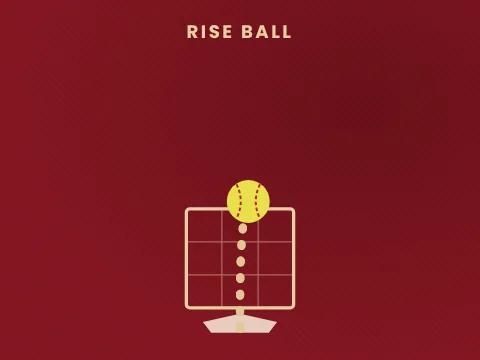
On top of the speed, she’ll see real movement. A rise ball is released low and can truly travel up through the zone. A drop ball is thrown down through the zone, and hitters who chase it beat it into the ground. Then comes the changeup, built to make her start too early.
Speed, spin and speed changes. She needs drills for all three.
HIGH SCHOOL PITCHING
FASTER.SMARTER.
- 43 feet, less time
- Rise balls up through the zone
- Drop balls down and away
- Changeups to start her early
TRAIN THE PITCHING SHE’LL SEE
2. 7 softball hitting drills for high school players
Each drill fixes one thing. Use the ones that match what you see in her at-bats.
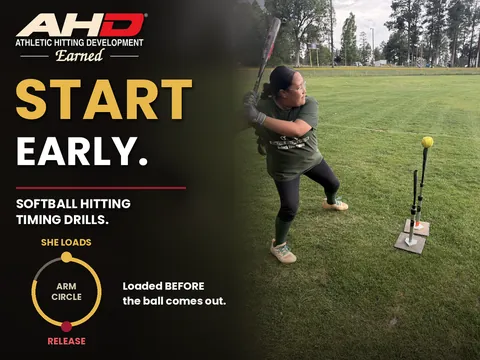
- Start-early front toss (timing)Partner tosses from a short distance and changes the rhythm. She starts her load as the tosser’s arm starts. 3 rounds of 8. Cue: “Load with the arm, land before the ball.”
- Rise ball ‘lay-off’ rounds (discipline)Toss or machine aimed at the top of the zone and above. She only swings at the strikes and calls ‘up’ out loud on anything above her hands. Count her good takes.
- Drop ball ‘stay on plane’ roundsLow tosses at the knees and below. She hits strikes on a line through the middle and lets the low ones go. Ground balls on low strikes mean she’s chopping, not matching the plane.
- Two-speed changeup roundsMix fast and slow tosses without telling her which. Her body loads and lands on time; her hands WAIT. Win = staying balanced on the slow one and still driving it.
- Inside-path tee (bat path)Tee on the inner half with a soft object just outside her hands’ path. Short, direct path; barrel above and inside the ball. 3 rounds of 6.
- Med ball or heavy-ball rotations (power)Explosive side throws into a wall, 3 sets of 5 each way, before hitting. Power comes from the ground up, not from the arms.
- Two-strike battle roundsLive or mixed toss, two strikes on every pitch. Her job: spoil tough pitches, put strikes in play, win the at-bat. See the two-strike approach.
More timing work lives in my post on softball timing drills.
3. Which drills does SHE need?
| What you see in games | Start with |
|---|---|
| Late on fastballs, fouling everything back | Start-early front toss + two-speed rounds |
| Chasing the rise ball | Rise ball lay-off rounds |
| Rolling over on low pitches | Drop ball rounds + inside-path tee |
| Out in front on changeups | Two-speed changeup rounds |
| Weak contact even when on time | Inside-path tee + med ball rotations |
| Striking out with two strikes | Two-strike battle rounds |
Not sure which line is hers? Run the free SwingChecker™. It ranks her top priorities across all 4 pillars in about 3 minutes.
4. Mistakes I see in high school hitting practice
Most high school hitters work hard. The problem is WHAT they work on. Here’s what I see most:
- Only hitting off a tee. The tee is great for path. It can’t teach timing, spin or speed changes.
- Batting practice that’s too slow. If every pitch is easy, she’s practicing being early.
- Swinging at everything in BP. Practice the takes too. Good decisions are a skill.
- Changing her swing every week. Pick one priority, train it, film it, then move on.
- No plan for two strikes. Games are won and lost there, so practice it there.
Fix those five and her same swing will play a lot better against varsity pitching.
5. An in-season week of hitting
High school season is busy. Practices, games, school. So keep it short and keep it daily.
- Game days: 5–10 minutes. Start-early toss and a few two-speed swings. Feel on time, then go compete.
- Practice days: 15–20 minutes of her 2–3 drills, plus 5 minutes of pitch-calling.
- Off days: power work and tee path work, then rest.
- Every day: see pitches and make decisions, even if it’s only a few minutes.
Her best hitting comes when she’s aggressive and athletic, not tentative. The drills build that trust.
6. How to film and measure her progress
Film side and behind, chest high, landscape, slow motion if you have it. Whole body and bat through the finish. Same angles every time, so you can compare week to week.
Track one simple number per drill: good takes in the lay-off rounds, line drives in the drop ball rounds, balanced swings on the slow pitch. If the numbers move, the drill is working. If not, change the drill, not the hitter.
If you want my eyes on her video and a plan built for her, that’s what online softball hitting lessons are for. If you want the system to run yourself, start with Swing Structure & Mechanics; Lessons 1–3 are free.
THELESSON.
- Pick 2–3 drills by need
- 15–20 minutes most days
- Film the same angles
- Track one number per drill
Complete Hitters Are Built…Earned.
Either way, start today. It’s a great day to hit!!
Want to go deeper? Read Softball Hitting Timing Drills: 6 Drills That Get Her On Time and How to Hit a Rise Ball in Fastpitch Softball.
Quick answers
What are the best softball hitting drills for high school players?
Drills that train timing, rise ball and drop ball discipline, staying back on changeups, a direct bat path, power and two-strike hitting. Choose the two or three that match her biggest weakness.
How often should a high school softball player hit?
A little most days. In season, 5 to 10 minutes on game days and 15 to 20 minutes of focused drills on practice days works well, with some pitch-recognition work every day.
How do I stop chasing the rise ball?
Train lay-off rounds with pitches at the top of the zone and above, and call 'up' out loud on pitches above the hands. Good takes are the win.
Can online softball hitting lessons help a high school player?
Yes, when the coach reviews her video, builds a plan around her top priorities and retests her progress. Without a plan and measuring, it is just more swings.
Sources: OHSAA: 2010 NFHS softball rule changes (pitching distance to 43 feet)
Don’t collect drills. Build a complete hitter.
Complete Hitters Aren’t Born. They’re Built… and Earned.